

Yes, tyres can be professionally fitted at home when your vehicle is parked in a safe, accessible place with enough room for the technician to work. Mobile tyre fitting at home brings the essential equipment, replacement tyre and trained fitter directly to your driveway, workplace or another suitable parking area. That means you do not have to force a damaged tyre through traffic, arrange recovery or spend part of your day sitting in a waiting room. Picture finding a completely flat tyre before work, hearing the soft hiss of escaping air and realising the car should not be driven. In that situation, having the work completed where the vehicle already stands can be both practical and safer.
The service is not a makeshift wheel change carried out with a basic roadside jack. A properly equipped technician can remove the wheel, take the old tyre off the rim, install the replacement, set the correct pressure and balance the wheel before refitting it. The ground and surrounding space still matter because the vehicle must be lifted securely and the fitter needs safe access around the affected wheel. A level driveway is usually ideal, although some private parking areas, quiet residential spaces and workplace car parks may also be suitable. Before booking, describing the surface, traffic level and available space helps the provider decide whether the location is workable. Mobile Tyre Giant provides professional mobile tyre fitting at homes, workplaces and roadside locations where the work can be completed safely.
Yes, Tyres Can Be Professionally Fitted at Home
Many drivers assume that tyre replacement requires a workshop because traditional garages use large machines, compressors and balancing equipment. Modern mobile fitting vans are designed to carry compact professional versions of that equipment, allowing the core tyre fitting process to happen outside a fixed garage. This is why mobile tyre fitting at home can be used for planned tyre replacement as well as an unexpected flat tyre. A technician can arrive with the correct tyre, lift the vehicle, remove the wheel and complete the fitting without asking you to travel. For a parent managing a busy morning or a remote worker moving between meetings, that convenience can feel like getting an hour of the day back. It also avoids the uneasy decision of driving slowly on a tyre that may already be too damaged for the journey.
However, being at home does not automatically make every location suitable. A car parked tightly against a wall, on soft grass or beside fast-moving traffic may not give the technician enough space to work safely. Even a legally parked vehicle can be in a poor fitting position when the road is narrow or visibility is limited. A responsible fitter may ask you to move the vehicle a short distance or may delay the job if the conditions are unsafe. That is not poor service; it is the correct decision when lifting a vehicle and working beside traffic could create unnecessary risk.
What Is Mobile Tyre Fitting?
Mobile tyre fitting is a service in which a technician travels to your vehicle with the tyre, tools and machinery needed to complete a professional replacement. Instead of driving to a workshop, you provide the vehicle registration or tyre size, postcode, tyre problem and preferred appointment time. The provider then checks availability and sends a suitable tyre with the mobile technician. Once on site, the technician assesses the vehicle, confirms the tyre specification and checks that the working area is safe. This process makes mobile tyre fitting at home useful for both routine replacements and tyres that are no longer safe to drive.
The van normally contains lifting equipment, a tyre-changing machine, a wheel balancer, an air compressor, torque tools and pressure-testing equipment. These tools allow the fitter to separate the old tyre from the wheel, mount the replacement and correct any weight imbalance before the wheel returns to the vehicle. Readers who want a closer look at the setup can explore how the equipment inside a mobile tyre van supports the fitting process. One concern repeatedly raised by first-time customers is whether a van can really balance a wheel properly, and that question is reasonable because poor balancing can cause vibration. You may feel that imbalance as a faint tremor through the steering wheel that becomes more noticeable as road speed rises. The important point is that a professional mobile service should complete the essential fitting checks rather than treating the job as a temporary roadside solution.
How Does Mobile Tyre Fitting at Home Work?
The process begins before the technician starts driving towards you. You usually share your vehicle registration, tyre size if known, postcode, number of affected tyres and a brief description of the damage. A clear sidewall photograph can help when the vehicle has different front and rear tyre sizes or uses a specialist run-flat specification. You should also explain whether the car is on a driveway, street, car park or roadside so the provider can judge access before dispatch. Accurate information matters because the fastest technician is still useless if the wrong tyre arrives. Mentioning a missing locking wheel nut key early can also prevent an avoidable surprise after the van reaches your location.
After reaching the location, the technician confirms the tyre and inspects the working area before lifting the vehicle. The wheel is removed, the old tyre is taken off the rim and the rim, valve and visible tyre damage are checked for anything that could affect the new fitting. The replacement tyre is then mounted, inflated to the appropriate pressure and balanced to reduce the risk of steering shake or uneven wear. Mobile Tyre Giant also offers dedicated mobile wheel balancing when vibration or imbalance needs separate attention. Finally, the wheel is refitted, the wheel nuts are tightened correctly and the technician completes basic checks before the vehicle is returned to you.
Is Your Home Suitable for Mobile Tyre Fitting?
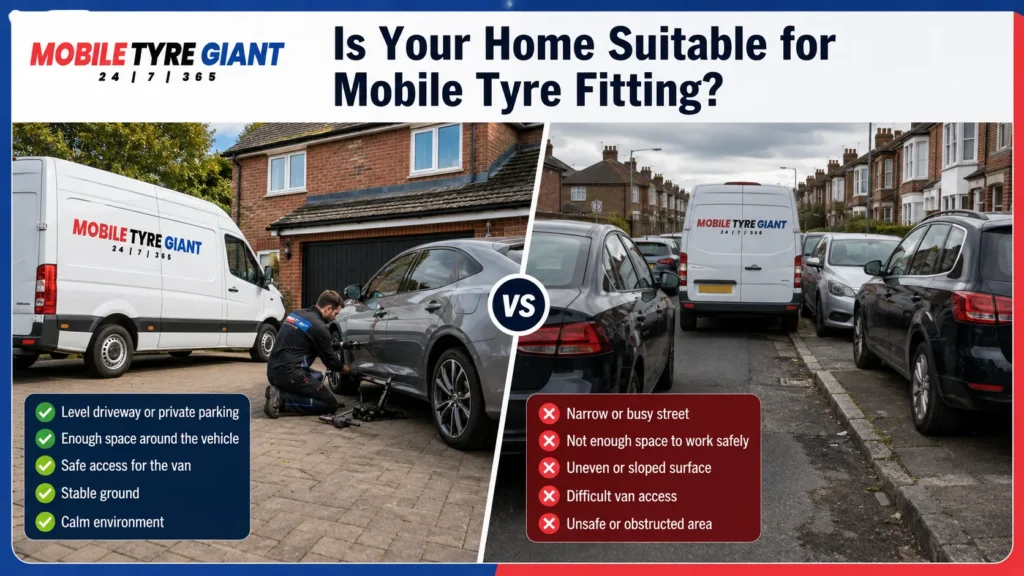
Your home can be suitable for mobile tyre fitting even when you do not have a large private driveway. The technician mainly needs firm ground, safe access and enough space to work around the affected wheel. A flat, paved driveway is usually the easiest setting because the vehicle can be lifted securely and the technician remains away from moving traffic. A private parking bay or workplace car park may also work when the mobile van can park nearby. Think of the fitting area like the space needed to open a wide door rather than squeeze through a narrow gap. The fitter needs room to position lifting equipment, remove the wheel and carry it safely to the van. Bins, bicycles, garden furniture and nearby vehicles can quickly turn an apparently open driveway into a cramped working area. Clearing these obstacles before the appointment can make the fitting smoother and reduce unnecessary delays.
The condition of the ground matters just as much as the amount of space available. Soft grass, deep mud or loose surfaces may not safely support a jack carrying the vehicle’s weight. Heavy rain can also change a previously firm surface into something unstable and slippery. The technician must be able to reach the vehicle without blocking emergency access or placing equipment in the path of passing traffic. Good lighting is especially important for evening and overnight callouts because tyre damage, wheel nuts and lifting points must remain clearly visible. You should describe the parking location honestly when requesting a quote rather than simply saying the car is at home. Mention any narrow gates, steep slopes, underground parking restrictions or limited access for a large van. This allows the provider to assess the situation before travelling and helps avoid an unsuccessful visit.
Do You Need a Driveway for Mobile Tyre Fitting?
No, a private driveway is not always required for mobile tyre fitting at home. A technician may be able to complete the work in a quiet residential parking bay, a private car park or another safe space near your property. The important point is whether the vehicle can be lifted without putting the technician, customer or passing traffic at risk. A driveway simply removes many of the complications associated with roadside work. It normally provides better access, more privacy and a more stable working surface. However, a narrow driveway can still be unsuitable if the affected wheel sits too close to a wall, hedge or another vehicle. In some cases, moving the car only a few feet can create enough clearance for the fitting to continue. That is why the exact parking position matters more than whether the location is officially called a driveway.
Drivers who live in flats or terraced homes should explain the parking arrangement before booking. Shared residential car parks may have management rules, restricted spaces or barriers that prevent the van from entering. Workplace car parks can be convenient, but security staff or site managers may need advance notice. Multi-storey and underground car parks can create additional problems because of low ceilings, tight turns and poor ventilation. A technician may also need enough space to open the van and move a wheel between the vehicle and the fitting machine. Sending a photograph of the location can be useful when access is difficult to describe over the phone. It gives the provider a clearer view of the surface, traffic exposure and surrounding space. A simple photograph can prevent the frustration of a fitter arriving and discovering that the vehicle cannot be serviced safely.
Can Tyres Be Fitted on the Street Outside Your House?
Tyres can sometimes be fitted on the street outside your home, but the decision depends on safety rather than convenience alone. A quiet residential road with good visibility and enough space around the vehicle may be workable. A busy main road, blind corner or narrow street with constant traffic is a very different situation. The technician may need to stand beside the vehicle while removing the wheel, which can place them close to passing cars. A legally parked vehicle is not automatically in a safe position for tyre fitting. The kerb, camber of the road and distance from moving traffic all affect whether the vehicle can be lifted securely. Poor lighting or heavy rain may make an otherwise acceptable location unsafe. A responsible fitter should never feel pressured to continue when the working area exposes people to unnecessary danger.
Parking restrictions can also affect a street-side appointment. The mobile van may need to remain close to the vehicle while carrying tools and moving the removed wheel. Double yellow lines, loading restrictions, bus lanes and controlled parking zones can limit where the technician can stop. The customer may need to arrange a visitor permit or move the vehicle to a nearby side road. When the tyre is completely flat, even a short movement should only be attempted after receiving professional advice. Driving or rolling on a flat tyre can damage the sidewall and wheel, turning a possible repair into a full replacement. Clearly describe the road, parking conditions and tyre damage when contacting the provider. This helps the dispatcher decide whether the job can be completed outside your home or whether a safer nearby location is needed.
Can Mobile Tyre Fitting Be Done on Gravel or a Sloping Driveway?
Mobile tyre fitting may be possible on a gravel or gently sloping driveway, but neither surface should be assumed safe without assessment. Firm, compacted gravel is different from loose stones that shift under pressure. When a vehicle is lifted, the equipment must remain stable instead of sinking or sliding. A technician may use suitable support boards or wheel chocks when the surface and slope remain manageable. However, these tools do not make every driveway safe. Deep gravel can hide uneven ground and make it difficult to position lifting equipment correctly. A steep slope can also cause the vehicle’s weight to move in an unsafe direction. The final decision must remain with the technician who can inspect the real conditions.
Customers should avoid describing a steep driveway as “slightly sloped” simply to secure the booking. That can waste time and create an awkward situation when the fitter arrives. A clear side-view photograph often communicates the incline better than words. You should also mention whether the surface becomes muddy, soft or slippery during wet weather. Vehicles parked partly on grass and partly on paving can be particularly difficult to lift evenly. In some cases, moving the car to a flatter section of the property solves the problem. In others, a nearby road or car park may provide a safer alternative. Safety must take priority because no amount of convenience justifies lifting a vehicle on unstable ground.
What Should You Prepare Before the Mobile Tyre Fitter Arrives?
Good preparation helps the technician bring the correct tyre and complete the work without avoidable delays. Start by having the vehicle registration, tyre size, postcode and a clear description of the problem ready. The tyre size is printed on the sidewall in a format such as 205/55 R16, followed by the load index and speed rating. A clear photograph of this marking can reduce the chance of a mistake. You should also explain whether the vehicle uses run-flat tyres, different front and rear sizes or specialist manufacturer-approved tyres. Tell the provider how many tyres are affected and whether the vehicle is completely immobilised. Remove bins, bicycles and other obstacles from around the vehicle before the technician arrives. Leave enough room for the van to park nearby and for the fitter to move safely between the van and the car.
The vehicle keys and locking wheel nut key should be easy to access. Locking wheel nut keys are often stored in the glovebox, boot, spare wheel compartment or original tool kit. Searching for the key after the technician arrives wastes valuable appointment time and may prevent the wheel from being removed. When the key is missing or damaged, Mobile Tyre Giant can provide locking wheel nut removal at your location, although this may require additional work. You should remain contactable even when you plan to continue working inside your home. The technician may need permission to move the vehicle, discuss unexpected damage or confirm a different tyre option. Check that gates, security barriers and parking areas will be accessible at the expected arrival time. A few minutes of preparation can turn a complicated callout into a straightforward fitting.
What Tyre Services Can Be Completed at Home?
Mobile tyre fitting at home can cover much more than replacing one obviously flat tyre. A properly equipped technician may be able to inspect punctures, replace damaged tyres, balance wheels, fit standard valves and deal with selected TPMS problems at the vehicle’s location. The exact service depends on the tyre damage, wheel condition, available equipment and safety of the parking area. For example, a nail sitting in the centre of the tread may lead to a repair, while a split sidewall usually requires a replacement. The technician must inspect the tyre before confirming which option is safe because the visible damage may not reveal what has happened inside. Think of it like a cracked phone screen: the mark you can see does not always tell you whether the structure underneath is still sound. This is why a responsible fitter will avoid promising a repair based only on a photograph or telephone description. The goal is not simply to make the tyre hold air again but to return the vehicle in a condition that is safe to drive.
The service can also include checks that drivers sometimes overlook when concentrating on the damaged rubber. The fitter may inspect the valve, rim edge, visible wheel condition and tyre pressure before completing the job. If the wheel has struck a pothole, the tyre may not be the only damaged component. A bent rim, cracked alloy or serious impact mark can prevent the new tyre from sealing correctly. The technician should explain any additional concern rather than fitting a tyre and ignoring a problem that could cause another pressure loss. Mobile tyre fitting at home works best when the provider is clear about what has been inspected, what has been completed and what may still need workshop attention. That transparency is especially important during an emergency, when a stressed driver may be tempted to approve the first available solution. A good mobile service should solve the immediate tyre problem without pretending that every wheel-related fault can be repaired beside the road.
Mobile Tyre Replacement at Home
Tyre replacement is normally required when the existing tyre cannot be repaired safely. Common reasons include sidewall cuts, bulges, exposed cords, serious tread damage, blowouts and tread that has worn beyond a safe or legal level. A tyre that has been driven while completely flat may also suffer internal damage even when the original puncture looks small. The sidewall can become crushed between the road and wheel, leaving dark rubber dust or internal creasing that is invisible until the tyre is removed. In these situations, pumping the tyre up again does not restore its strength. A professional fitter should remove and inspect it instead of relying on how it looks from the outside. Mobile Tyre Giant provides mobile tyre replacement at your location when damage makes continued use or repair unsuitable. This allows the vehicle to receive the correct replacement without being driven on a tyre that may fail.
Before the replacement is fitted, the technician should confirm the tyre size, load index, speed rating and construction. This matters because two tyres can look almost identical while having different load capabilities or performance characteristics. Vehicles with staggered wheel setups may use a wider tyre at the rear than at the front, while some cars require run-flat or manufacturer-marked tyres. The new tyre is mounted on the rim, inflated and balanced before the wheel is returned to the vehicle. The technician should also check for obvious rim damage and confirm that the tyre is seated evenly around the wheel. When replacing only one tyre, the condition of the tyre on the opposite side of the axle may also need consideration. A large difference in tread depth or tyre type can affect handling, particularly in wet conditions. Mobile tyre fitting at home should therefore involve correct selection and fitting rather than simply installing whichever tyre happens to be available.
Can a Puncture Be Repaired at Home?
A puncture can often be repaired at home when it is located within a repairable section of the main tread and the tyre remains structurally sound. The technician must remove the tyre from the wheel to inspect the inside because an external nail does not reveal the full extent of the damage. A small object may have entered at an angle, damaged the internal cords or allowed the tyre to run underinflated for a long period. Sidewall and shoulder damage are generally unsuitable for a standard puncture repair because those areas flex heavily while the vehicle is moving. A tyre with exposed cords, a bulge, severe cracking or evidence of being driven flat will usually need replacement. Previous repairs also matter because multiple injuries close together can affect whether another repair is appropriate. Mobile Tyre Giant’s mobile puncture repair service assesses the damage before deciding whether repair or replacement is the safer option. This inspection-first approach protects drivers from a cheap repair that fails to address a weakened tyre.
Drivers sometimes assume that any object visible in the tread means the tyre should immediately be pulled out or covered with sealant. Removing a nail before the technician arrives can cause the tyre to lose air more quickly, making the vehicle harder to move into a safe position. Tyre sealant can also complicate the inspection and does not turn serious damage into a permanent repair. When the vehicle is safely parked, leaving the object in place and asking for professional advice is often the better choice. Tell the provider whether the tyre is still holding pressure, whether it was driven while flat and whether any temporary sealant has been used. These details help the technician understand what equipment or replacement options may be needed. A proper repair should restore an eligible puncture according to an accepted repair method rather than plugging the visible hole from outside and sending the driver away. The quiet relief of seeing the pressure remain steady is valuable, but it should come from a sound repair, not a temporary shortcut.
Valves, TPMS and Pressure Problems
Not every pressure problem is caused by a puncture through the tread. Air can escape through a damaged valve, a leaking valve core, corrosion around the rim or a poor seal between the tyre and wheel. A cracked rubber valve may release air slowly, leaving the tyre looking normal in the evening but noticeably softer the following morning. Vehicles with tyre pressure monitoring systems may use sensor-equipped valves that require different parts and handling from standard rubber valves. The dashboard warning light may remain illuminated when pressure is incorrect, a sensor has failed or the system needs to relearn after work is completed. Mobile tyre fitting at home can include valve assessment and selected TPMS work when the correct parts and diagnostic equipment are available. Mobile Tyre Giant offers mobile TPMS valve replacement for damaged or faulty valve components that can be serviced at the vehicle’s location. Providing the vehicle registration in advance helps the technician identify the likely sensor and valve requirements.
A TPMS warning should not be dismissed simply because the tyre still looks round. Modern tyres can lose a significant amount of pressure before the change becomes obvious from a few steps away. Driving underinflated creates extra heat, increases tyre flex and can damage the sidewall over time. The technician should check the actual pressures, inspect for leaks and identify whether the problem comes from the tyre, valve or sensor. If the light returns after fitting, the driver should contact the provider rather than repeatedly adding air without finding the cause. Some systems update after a short drive, while others need a reset or relearn procedure. The correct response depends on the vehicle, so broad promises should be avoided. Clear communication about what was tested and whether the warning has been resolved gives the customer something more useful than simply watching the light disappear for a few minutes.
What Cannot Always Be Fixed During a Home Visit?
Mobile fitting is highly practical, but it is not a complete replacement for every workshop service. Full wheel alignment normally requires specialist measuring equipment and a controlled setup that may not be available inside a mobile van. Cracked or badly bent alloy wheels may need professional straightening, welding or replacement before a tyre can seal safely. Suspension damage, worn bearings, damaged hubs and steering faults also require wider mechanical diagnosis. A driver may first notice these problems as vibration, pulling, noise or unusual tyre wear, but fitting a new tyre will not remove the underlying cause. Severe corrosion around the rim can create another limitation because the tyre may continue leaking even after replacement. Problems following a collision or deep pothole impact should therefore be described fully when booking. An honest technician will explain when the vehicle needs a workshop rather than presenting mobile tyre fitting at home as a cure for every symptom.
The working environment can also prevent a job that would otherwise be straightforward. A vehicle on a steep slope, soft verge, crowded road or restricted underground level may not be safe to lift. The van may be unable to enter a car park with a low height barrier, or there may be no room to remove the wheel and carry it to the fitting machine. In another example, a wheel nut may be so damaged or seized that forcing it on the driveway could harm the stud or wheel. Stopping the job in that situation is better than creating a more expensive repair. Mobile services are most effective when the tyre problem is clear, the correct product is available and the location supports safe working. Knowing the limitations does not weaken the value of the service. It helps drivers choose the right solution the first time and prevents a convenient home appointment from becoming an unsafe compromise.
Mobile Tyre Fitting at Home Versus Visiting a Garage
Mobile tyre fitting at home is often the better option when the vehicle should not be driven, the customer cannot leave home, or travelling to a workshop would create unnecessary disruption. The technician comes to the parked vehicle, so there is no need to arrange recovery or risk damaging the tyre and wheel during the journey. You can continue working, caring for children or handling everyday tasks while the fitting takes place nearby. A garage can still be more suitable when the vehicle needs wheel alignment, alloy repair, suspension diagnosis or broader mechanical inspection. The right choice therefore depends on the problem rather than convenience alone. A straightforward tyre replacement and wheel balancing can usually be handled by a well-equipped mobile van. A bent wheel or steering fault may require workshop equipment.
Price should not be compared in isolation because travelling to a garage can include fuel, recovery, waiting time and missed work. Mobile attendance may carry a callout cost, particularly for urgent, late-night or distant appointments. However, a scheduled home appointment can still offer strong value when the customer avoids losing several hours of the day. The existing guide explaining whether mobile tyre fitting is worth it can help drivers compare convenience, cost and service suitability in more detail. Customers should ask what the total price includes before confirming the booking. The quote should clearly cover the tyre, fitting, balancing, valve work, disposal and any callout charge. Transparent pricing is more useful than a low starting figure that increases after the technician arrives.
How Long Does Mobile Tyre Fitting at Home Take?
A straightforward single-tyre replacement commonly takes around 20 to 40 minutes after the technician reaches the vehicle. Replacing two or four tyres takes longer because every wheel must be removed, fitted, balanced and checked separately. Larger wheels, low-profile tyres and run-flat constructions may also require additional care. The actual fitting time can increase when wheel nuts are corroded, the locking wheel nut is damaged or the tyre has been driven while flat. Limited working space may slow the process because the technician needs to reposition tools and equipment carefully. A hidden valve leak or damaged rim can also turn a routine appointment into a more detailed inspection. For that reason, no responsible fitter should promise the same completion time for every vehicle.
Arrival time and fitting time must be treated as two different stages. Traffic, previous appointments, technician availability and tyre stock can affect when the van reaches your address. An estimated arrival window is more realistic than an exact minute because an earlier job may reveal seized nuts or unexpected wheel damage. Mobile Tyre Giant’s guide to realistic mobile tyre fitting times explains these factors in greater detail. When booking, tell the provider if you have an appointment or journey later that day. Allow some extra time rather than planning to leave immediately at the end of the estimated slot. Clear access, correct tyre details and a ready locking wheel nut key can help prevent unnecessary delay.
How Much Does Mobile Tyre Fitting at Home Cost?
The cost of mobile tyre fitting at home depends on the tyre, location and type of appointment. A common small tyre from a budget range will usually cost less than a large premium, run-flat or performance tyre. The number of tyres also affects the total because replacing a complete set requires more products and fitting time. Scheduled appointments may be priced differently from emergency or out-of-hours callouts. Distance, local technician availability and the time of day can also influence the service charge. Additional work such as TPMS valve replacement or locking wheel nut removal may increase the final amount. This is why a universal price advertised without vehicle or tyre details is rarely useful.
Before approving the job, ask for the exact tyre brand, model, size and condition. Confirm whether the tyre is new and whether fitting, balancing, standard valve work and old-tyre disposal are included. You should also ask whether the quote contains VAT, callout costs and any evening or emergency surcharge. A written quote provides clearer protection than a vague estimate given during a hurried call. The cheapest option is not automatically the best if it excludes balancing or supplies an unsuitable tyre. In the same way, an expensive quote is not automatically justified simply because the service is urgent. The best value comes from receiving the correct tyre, professional installation and transparent aftercare at an agreed total price.
Can Run-Flat and Electric Vehicle Tyres Be Fitted at Home?
Many run-flat tyres can be fitted at home when the mobile technician has suitable machinery and the correct replacement tyre. Run-flat sidewalls are usually stiffer than those of standard tyres, so fitting them can require additional care and appropriate equipment. The provider must know that the vehicle uses run-flats before dispatch because a standard tyre should not be supplied as an automatic substitute. The tyre size, load index, speed rating and manufacturer requirements should all be confirmed. Large performance wheels and low-profile tyres may also need protective fitting procedures to reduce the risk of marking the alloy. Stock availability can be more limited for specialist sizes, especially during an emergency callout. Providing a clear sidewall photograph can help the supplier identify the correct product.
Electric vehicle tyres can also often be fitted through a mobile service. The technician must consider the vehicle’s weight, approved lifting points and required tyre load rating. Some EV tyres use noise-reducing foam, reinforced construction or manufacturer-specific markings that should be matched correctly. An unsuitable tyre may affect handling, road noise, range and load capability. The provider should therefore receive the vehicle registration and exact tyre details before recommending an option. TPMS requirements should also be discussed because many modern electric vehicles rely heavily on accurate pressure monitoring. Mobile fitting remains convenient for specialist vehicles, but convenience should never replace correct specification and safe handling.
Is Mobile Tyre Fitting at Home Safe?
Mobile tyre fitting at home is safe when the technician uses professional equipment, follows correct fitting procedures and works in a suitable location. The vehicle must be lifted on stable ground using equipment appropriate for its weight and lifting points. The replacement tyre must match the required size, construction, load index and speed rating. After mounting, the wheel should be balanced to reduce vibration and uneven wear. The tyre should be inflated correctly, and the wheel nuts must be tightened using an appropriate torque procedure. Valves, TPMS components and the visible wheel condition should also be checked. These steps matter more than whether the work happens inside a garage or beside a home.
The location remains a major part of the safety assessment. A quiet, level driveway may provide an excellent working environment, while a narrow road beside fast traffic may not. Weather can also change conditions quickly, especially when heavy rain creates poor visibility or unstable ground. The dedicated guide to mobile tyre fitting in the rain explains when wet-weather work may continue and when safety requires a delay. Customers should never pressure a technician to continue in dangerous conditions simply because the vehicle is urgently needed. A short delay is frustrating, but an unstable vehicle or exposed working position creates a far greater problem. Professional judgement should always take priority over speed.
How to Book Mobile Tyre Fitting at Home
Start the booking by sharing your vehicle registration or the full tyre size printed on the sidewall. Provide the postcode, exact parking location and number of tyres that may need attention. Describe whether the tyre is flat, punctured, worn, bulging, split or damaged after an impact. Mention whether the vehicle uses run-flat tyres, TPMS or different front and rear tyre sizes. Tell the provider if the car is electric, hybrid or fitted with unusually large wheels. Explain whether it is parked on a driveway, street, car park or roadside. Accurate details help the technician bring the right tyre and equipment on the first visit.
Before confirming, ask for the exact tyre option and total price. Check whether fitting, balancing, valves, disposal, callout and VAT are included. Find the locking wheel nut key and clear enough room around the vehicle. Remain available by phone in case the technician needs access or approval for additional work. You can also check Mobile Tyre Giant service coverage before requesting attendance. After the job, inspect the fitted tyre and monitor the vehicle during the first drive. The guide covering checks after mobile tyre fitting explains what to watch for if a warning light, vibration or pressure problem appears.
Final Words: Can Tyres Be Fitted at Home?
Yes, tyres can be fitted professionally at home without taking the vehicle to a traditional garage. A mobile technician can bring the replacement tyre, lifting tools, tyre-changing machinery and wheel-balancing equipment directly to the parked vehicle. This service is particularly useful when the tyre is unsafe to drive, the customer has a busy schedule or reaching a workshop would require vehicle recovery. However, the location must provide stable ground, safe access and enough space for the technician to work. A private driveway is helpful but not always essential, as some quiet parking areas and workplace car parks may also be suitable. Busy roads, steep driveways and unstable surfaces can make mobile fitting unsafe.
The best experience starts with accurate information and realistic expectations. Confirm the tyre size, vehicle details, parking conditions, locking wheel nut key and any specialist requirements before the technician travels. Request a complete quote and check whether fitting, balancing, valves, disposal and callout charges are included. Mobile tyre fitting at home can solve many common tyre problems, but services such as wheel alignment, alloy repair and wider suspension diagnosis may still require a workshop. A professional provider should explain these limitations clearly. When the correct tyre, suitable equipment and safe working location come together, home tyre fitting offers a practical and reliable way to get your vehicle back on the road.
Get Your Tyres Fitted at Home
Share your vehicle details, tyre size and location to arrange professional mobile tyre fitting at a safe and accessible place.
Frequently Asked Questions
Find quick answers to the most common questions our customers ask.
Yes. Tyres may be fitted in a suitable parking bay, workplace car park or quiet residential area when the ground is stable and sufficient safe working space is available.
Yes. A properly equipped mobile fitter can balance the wheel inside the van before refitting it, helping reduce steering vibration, uneven wear and uncomfortable driving at higher speeds.
A straightforward single-tyre replacement usually takes around 20 to 40 minutes after arrival, although corroded nuts, specialist tyres, damaged valves or restricted access can extend the appointment.
Yes, when the puncture sits within a repairable tread area and the tyre remains structurally safe. Sidewall, shoulder or internal damage normally means replacement is the safer option.
Light rain may not stop fitting, but flooding, lightning, strong wind, poor visibility or unstable ground can make lifting and working around the vehicle unsafe for the technician.
The wheel may not be removable normally. A technician with specialist tools may attempt removal, but the process can add time, increase cost and cannot always be guaranteed beforehand.
It can cost more during emergencies or out-of-hours visits, but scheduled fitting may remain competitive when recovery, travel, garage waiting time and missed work are considered together.