
Driving through London can feel straightforward until a ULEZ sign appears beside the road. You might be heading to work, visiting family or catching a flight. Suddenly, an ordinary journey raises an important question about additional charges. The answer depends on your vehicle, your route and whether an exemption applies. This ULEZ driving guide for London motorists explains the rules without unnecessary technical language.
Think of ULEZ as another important check before starting your journey. There are no toll booths waiting at the boundary. Instead, cameras help enforce the rules while traffic continues moving. Understanding the charging area beforehand can prevent an expensive misunderstanding later. Whether you drive every day or occasionally visit London, knowing the basics makes travelling easier.
What Is ULEZ and How Does It Work in London?
ULEZ stands for Ultra Low Emission Zone, a scheme designed to reduce harmful vehicle exhaust emissions. It sets minimum emissions standards for vehicles travelling within its boundaries. Vehicles meeting those standards can drive without paying the ULEZ charge. Most non-compliant cars, motorcycles and eligible light vehicles face a £12.50 daily charge unless exempt. The scheme encourages cleaner vehicles rather than banning every older car from London.
ULEZ compliance depends on emissions standards, not simply how modern your vehicle looks. Two cars manufactured around the same time can have different compliance ratings. A well-maintained older vehicle may qualify, while another vehicle might not. That is why guessing from a number plate or registration year is unreliable. Checking your exact vehicle details before travelling is the safest approach.
ULEZ rule | Current requirement |
Daily charge | £12.50 for affected non-compliant light vehicles |
Operating hours | 24 hours a day |
Operating days | Every day except Christmas Day |
Coverage | All London boroughs and the City of London |
M25 motorway | Excluded from ULEZ |
Charging period | Midnight to midnight |
Where Does the London ULEZ Apply?
London’s ULEZ covers much more than busy central streets and famous landmarks. Since August 2023, it has extended across all London boroughs. This means suburban journeys can be affected just as easily as central London trips. Even a short drive towards a local shopping centre may fall within the zone. Checking your destination is therefore more useful than assuming only central London has restrictions.
ULEZ boundaries are marked with road signs, including warnings near entry points. Drivers will not encounter barriers or a traditional toll plaza. Cameras identify number plates as vehicles travel through the area. Navigation apps may provide directions without clearly explaining every applicable road charge. Before travelling, check the official boundary information for your intended route.
Does ULEZ Cover All London Boroughs?
Yes, ULEZ operates across London’s boroughs and the City of London. This includes outer areas that motorists may not associate with central London charging rules. Visiting a relative in the suburbs can still involve entering the zone. Living within the zone does not automatically provide an exemption. Whether you pay depends on your vehicle’s compliance and any applicable exemption.
Imagine driving only a few streets to collect a parcel. The distance might be short, but the journey still counts as driving inside ULEZ. A compliant vehicle can make that journey without paying the ULEZ charge. A non-compliant vehicle may incur the daily charge for the same trip. The key factor is eligibility, not how far you travel.
Is the M25 Inside the ULEZ Zone?
The M25 motorway itself is not included in London’s ULEZ. Drivers can use it to travel around London without triggering ULEZ simply by remaining on the motorway. However, leaving at a junction may take you onto roads inside the zone. This distinction matters when following unfamiliar routes. A small change in your journey can change whether the charging rules apply.
Picture approaching a motorway exit while your navigation system suggests a quicker route. The motorway might be outside ULEZ, but nearby local roads could be inside. Do not assume the entire journey is exempt because it includes the M25. Check your planned exit and final destination before setting off. This is particularly useful when traffic delays or roadworks encourage unexpected diversions.
Does ULEZ Apply at Heathrow Airport?
Yes, Heathrow Airport falls within London’s ULEZ, including Terminals 2, 3, 4 and 5. This surprises some drivers who assume airports sit outside London’s charging boundaries. Even a quick passenger collection involves driving within the zone. A non-compliant vehicle may therefore incur the £12.50 daily charge. This is separate from any airport parking or drop-off fees.
Imagine leaving home before sunrise for an early flight. Quiet roads and an empty terminal approach do not remove ULEZ requirements. Drivers of compliant vehicles do not need to pay the ULEZ charge. Those using non-compliant vehicles should check their charging obligations before departure. For longer airport journeys, checking vehicle condition is also sensible, and this tyre safety guide explains useful preparation checks.
When Does ULEZ Operate in London?
Unlike some other London road charges, ULEZ does not stop after rush hour. It operates 24 hours a day, seven days a week, except Christmas Day. Late-night journeys are therefore subject to the same emissions requirements as daytime driving. Its charging period runs from midnight to midnight. This distinction matters when a journey continues into another calendar day.
For example, imagine entering the zone at 11:45 pm and leaving at 12:15 am. Your journey has crossed into a second charging day. A non-compliant vehicle without an exemption could incur two £12.50 charges. Completing the same journey entirely before midnight would fall within one charging day. Understanding this rule helps prevent confusion when arranging overnight travel.
Does ULEZ Apply on Weekends and Bank Holidays?
Yes, ULEZ remains active on Saturdays, Sundays and bank holidays. Quieter roads do not automatically mean a charge-free journey. A Sunday family visit can still trigger the daily charge. Christmas Day is the only annual exception to ULEZ operation. Other public holidays remain subject to the normal rules.
This can be confusing because different London road charging schemes have different schedules. ULEZ follows its own operating timetable regardless of other charges. A compliant vehicle can travel without paying ULEZ, including on weekends. A non-compliant vehicle may still require payment on a quiet holiday morning. Checking the date before travelling is a simple way to avoid mistakes.
Do You Pay ULEZ if Your Vehicle Is Parked?
No, simply keeping your vehicle parked inside ULEZ does not trigger the daily charge. The charge applies when an affected non-compliant vehicle is driven within the zone. If your car remains parked throughout Saturday, no ULEZ charge arises just from parking. However, driving it for a short errand could make that day chargeable. This difference is particularly important for overnight visitors.
Consider arriving at a London hotel on Friday and leaving on Sunday. If your non-compliant vehicle remains parked throughout Saturday, that day does not attract a ULEZ charge. Friday and Sunday may still be chargeable because you drove on those days. Separate hotel parking fees could apply throughout your stay. Keeping track of actual driving dates helps you avoid unnecessary payments and missed charges.
Which Vehicles Are ULEZ Compliant in 2026?
Not every vehicle driving through London has to pay the ULEZ charge. Whether your car qualifies depends mainly on its exhaust emissions rather than its appearance, mileage or market value. Many petrol and diesel vehicles already meet the required standards. However, older models may need closer inspection before you assume they are compliant. Understanding these differences can help you avoid unnecessary payments or unexpected penalties.
Think about two neighbours driving similar-looking cars into London. One might meet the emissions requirements while the other falls below the minimum standard. Even if both vehicles have valid MOT certificates, their ULEZ status could differ. A successful MOT does not automatically prove that a vehicle meets London’s emissions requirements. Checking compliance separately is therefore an important part of planning your journey.
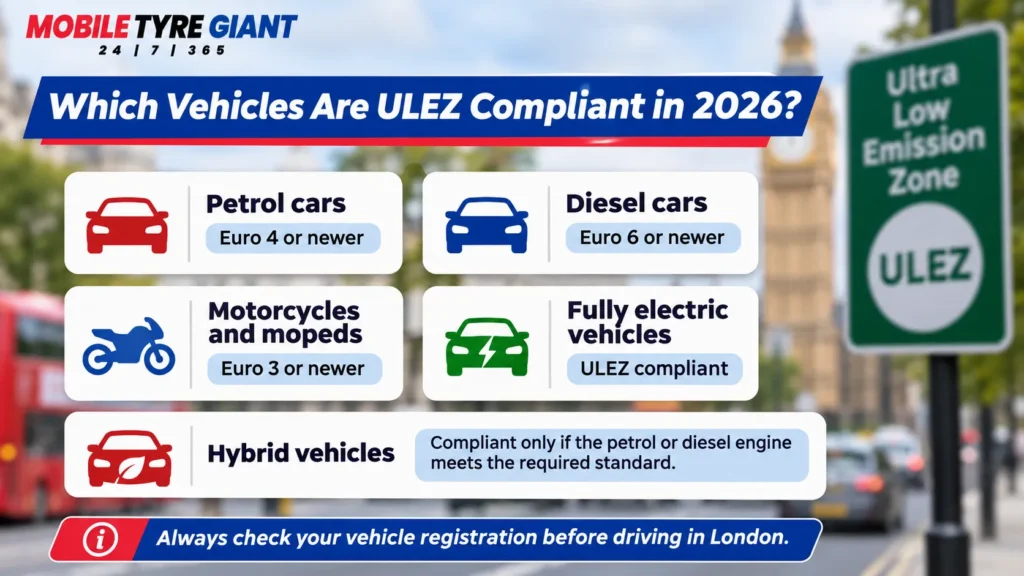
ULEZ Standards for Petrol, Diesel and Motorcycles
London’s ULEZ uses European emissions standards to determine which vehicles qualify. Petrol cars generally need to meet at least Euro 4, while diesel cars require Euro 6. Motorcycles and mopeds must meet Euro 3 requirements. These standards limit harmful exhaust pollutants, including nitrogen oxides and particulate matter. Vehicles falling below the relevant standard may face the daily charge unless an exemption applies.
Registration dates can offer a rough indication, but they are not definitive proof. Many petrol cars registered from 2006 and diesel cars registered from September 2015 onwards meet the requirements. However, manufacturers introduced compliant engines at different times, and vehicle specifications can vary. A car registered before these dates is not necessarily non-compliant. Always verify the individual vehicle rather than relying entirely on its age.
Vehicle type | Minimum ULEZ emissions standard |
Petrol cars | Euro 4 |
Diesel cars | Euro 6 |
Motorcycles and mopeds | Euro 3 |
Petrol vans up to 3.5 tonnes | Euro 4 |
Diesel vans up to 3.5 tonnes | Euro 6 |
Fully electric vehicles | Meet ULEZ exhaust-emissions requirements |
Are Electric and Hybrid Cars ULEZ Compliant?
Fully electric vehicles meet ULEZ emissions requirements because they produce no exhaust emissions while driving. This means electric car owners do not have to pay the ULEZ daily charge. However, being exempt from ULEZ does not mean every London road charge disappears. Separate charges, including the central London Congestion Charge, may still apply. Understanding this distinction is especially important for drivers unfamiliar with London’s charging schemes.
Hybrid vehicles work differently because they combine an electric motor with a petrol or diesel engine. Their ULEZ status depends on whether the combustion engine meets the relevant emissions standard. A petrol hybrid generally needs Euro 4 compliance, while a diesel hybrid needs Euro 6. The word “hybrid” on a vehicle badge does not guarantee exemption. Checking its registered emissions details is the reliable way to confirm eligibility.
How Can You Check Your Vehicle’s ULEZ Status?
The easiest way to check compliance is through Transport for London’s official vehicle checker. Enter your registration number and select the correct country of registration when requested. The system uses vehicle records to determine whether the relevant emissions requirements are met. This is particularly useful when buying a second-hand car or planning an unfamiliar journey. Check the results before travelling rather than making assumptions at the last minute.
You can also review your V5C log book and vehicle manufacturer’s specifications if the recorded information appears incorrect. Some older vehicles meet the required emissions limits despite their age. If the checker shows an unexpected result, investigate it before entering the zone. A seller’s description or an online advertisement should never replace proper verification. Spending a few minutes checking can prevent a far more frustrating situation later.
Who Is Exempt From London’s ULEZ Charge?
Although ULEZ applies across Greater London, certain vehicles and drivers qualify for exemptions or temporary discounts. These arrangements recognise circumstances involving disability, historic vehicles and specific transport services. However, eligibility depends on particular conditions rather than broad assumptions. Some exemptions apply automatically, while others require registration or supporting documents. Understanding the difference helps motorists avoid relying on benefits they may not actually qualify for.
A vehicle can also be ULEZ compliant without having a special exemption. For example, a petrol car meeting Euro 4 standards does not need an exemption to avoid the charge. Meanwhile, a non-compliant vehicle might temporarily qualify through an approved grace period. These are separate reasons why a driver may not need to pay. Checking the correct category is essential before making travel arrangements.
Are Blue Badge Holders Exempt From ULEZ?
Holding a Blue Badge does not automatically exempt a vehicle from ULEZ charges. The badge supports eligible disabled people with parking arrangements, but ULEZ follows separate emissions rules. A Blue Badge holder driving a non-compliant vehicle may therefore still have to pay. However, certain disabled drivers and qualifying vehicles benefit from specific grace periods. These arrangements should be checked carefully before assuming the daily charge applies.
Vehicles registered in the disabled or disabled passenger vehicle tax class can qualify for a grace period until 24 October 2027. Eligible wheelchair-accessible vehicles and people receiving certain disability benefits may also qualify under separate arrangements. Some of these schemes require an application and supporting documents. Having a disability benefit does not automatically mean every vehicle is covered. Confirming eligibility beforehand provides greater confidence when travelling.
Are Historic Vehicles Exempt From ULEZ?
Some historic vehicles qualify for an exemption even when they do not meet modern emissions standards. Vehicles built before 1 January 1973 fall within one exemption category. Vehicles over 40 years old may also qualify when successfully registered in the historic vehicle tax class. However, age alone does not necessarily establish eligibility for every older vehicle. The official registration and tax classification are important.
Imagine owning a carefully restored classic car that you occasionally drive through London. Its age might make it eligible, but its recorded classification still needs checking. A vehicle that looks historic is not automatically recognised as exempt. Non-UK registered historic vehicles may also need to register their exemption before travelling. Confirming the vehicle’s status is safer than assuming its appearance tells the whole story.
What Other ULEZ Exemptions and Grace Periods Apply?
Additional arrangements cover certain London-licensed taxis, eligible community transport minibuses and specialised vehicles. Some qualifying community transport organisations can receive temporary discounts until October 2027. Certain wheelchair-accessible private hire vehicles also benefit from specific conditions during authorised bookings. These rules are narrower than a general exemption for every taxi, minibus or adapted vehicle. Drivers should check their exact vehicle category and operating circumstances.
Some NHS patients may also qualify for reimbursement of ULEZ charges. This generally depends on a clinical assessment showing that public transport is unsuitable for their journey. The treating hospital determines whether the patient meets the reimbursement conditions. It is important not to confuse reimbursement with an automatic exemption at the point of travel. Eligibility, documentation and application requirements should always be confirmed before relying on these arrangements.
ULEZ vs Congestion Charge: What Is the Difference?
ULEZ and the Congestion Charge are two separate schemes that motorists often confuse. ULEZ focuses on vehicle exhaust emissions and covers Greater London. The Congestion Charge aims to manage traffic within a smaller central London charging area. Their boundaries, operating hours and payment rules are different. Understanding both is important because following one set of rules does not automatically satisfy the other.
ULEZ operates around the clock except on Christmas Day, while the Congestion Charge applies during specified daytime hours. In 2026, the standard Congestion Charge is £18 when paid in advance or on the travel day. It rises to £21 when paid within the following three-day payment window. ULEZ remains £12.50 per charging day for affected non-compliant light vehicles. Motorists should check both schemes whenever travelling into central London.
Feature | ULEZ | Congestion Charge |
Main purpose | Reduce harmful exhaust emissions | Manage central London traffic |
Coverage | Greater London | Smaller central London zone |
Standard daily charge | £12.50 if applicable | £18 in advance or on the day |
Weekday hours | 24 hours | 7 am to 6 pm |
Weekend and bank holiday hours | 24 hours | Noon to 6 pm |
Vehicle eligibility | Depends on emissions standards and exemptions | Separate discounts and exemptions apply |

Can You Be Charged for Both on the Same Journey?
Yes, some drivers may need to pay both ULEZ and the Congestion Charge. Imagine driving a non-compliant diesel car into central London during weekday charging hours. If no exemption or discount applies, you could face the £12.50 ULEZ charge alongside the £18 Congestion Charge. That brings the combined daily cost to £30.50 when both standard charges are paid on time. Other road charges or parking costs may apply separately.
Even drivers of ULEZ-compliant cars should not assume central London is free to enter. Electric cars meet ULEZ requirements but can still be liable for the Congestion Charge. In 2026, eligible electric cars registered with Auto Pay receive a 25% Cleaner Vehicle Discount, reducing that charge to £13.50. Without the qualifying discount, the standard Congestion Charge can apply. Checking every relevant scheme before travelling is the simplest way to avoid unexpected costs.
How Much Is the ULEZ Charge in London in 2026?
The standard ULEZ charge is £12.50 per day for an affected non-compliant vehicle driven within the zone. This applies to most cars, motorcycles, vans and eligible light vehicles that fail to meet the required emissions standards. The charge is not calculated according to the distance you travel. Driving just a short distance can trigger the same daily payment as a longer journey. Understanding this beforehand helps you budget for your trip.
For drivers who regularly enter London, these daily payments can quickly become a noticeable expense. Someone driving a non-compliant car on ten separate charging days would pay £125. The total increases with the number of days the vehicle is driven inside the zone. However, you only pay once per charging day, regardless of how many journeys you make. Checking your vehicle’s compliance before travelling can help you avoid paying unnecessarily.
How Does the £12.50 Daily Charge Work?
The daily charge covers driving within ULEZ during a single calendar day. You do not need to make another ULEZ payment every time you enter or leave the zone on that date. For example, you could drive to a morning appointment and return later without paying twice. The amount remains £12.50 if your vehicle is liable for the charge. However, other London road charges may still apply separately.
Think of the payment as a daily permit rather than a ticket for one journey. Once you have paid for the correct vehicle and date, additional trips that day do not create another ULEZ charge. The important detail is ensuring the payment matches your actual travel date. Paying for the wrong date may leave your journey unpaid. A quick check of the payment confirmation can prevent an avoidable problem.
Do You Pay ULEZ Twice When Driving Across Midnight?
Yes, driving a non-compliant vehicle across midnight can result in two daily ULEZ charges. Each charging day starts at midnight and ends immediately before the following midnight. Imagine entering the zone at 11:40 pm and leaving at 12:20 am. Although the journey lasts only 40 minutes, it involves driving on two calendar days. This could result in a total charge of £25.
This situation commonly affects airport journeys, late-night workers and motorists visiting friends. It is easy to assume that paying once covers the following 24 hours, but ULEZ does not work that way. If you are planning an overnight trip, check both arrival and departure dates. Parking overnight without driving during the second day does not itself trigger another charge. Knowing the difference can save money and prevent missed payments.
How to Pay the ULEZ Charge and Avoid Payment Mistakes
You can pay the ULEZ charge through Transport for London’s official payment service. Payment is available online, through the official Pay to Drive in London app or by telephone. You will need your vehicle registration details and the correct travel date. The process is straightforward, but entering inaccurate information can cause problems. Always review the details before completing your transaction.
Using the official payment service is particularly important because unofficial websites may charge additional fees. Some third-party services can also create confusion about whether a payment has been completed. Before entering your card details, confirm that you are using an authorised TfL payment method. Keep your confirmation reference once the transaction is successful. This provides useful evidence if you need to check a payment later.
When Is the ULEZ Payment Deadline?
Drivers can pay the ULEZ charge before travelling, on the journey date or shortly afterwards. The final deadline is midnight on the third calendar day following the journey. For example, if you drive within the zone on Monday, payment must be completed by midnight on Thursday. Leaving payment until the final evening increases the risk of forgetting. Paying in advance is often easier when your travel plans are confirmed.
TfL allows ULEZ charges to be paid up to 90 days before the journey. This can be useful when arranging appointments, airport transfers or planned family visits. However, make sure your chosen date is correct before completing payment. Changing a purchased charge may involve an administration fee, and refund options are restricted. Checking your plans carefully can prevent unnecessary expense.
Payment situation | Deadline or requirement |
Paying before travel | Up to 90 days in advance |
Paying on the journey date | Before midnight that day |
Paying after travelling | By midnight on the third day after travel |
Travelling on two calendar days | A separate charge may apply for each day |
Missing the payment deadline | A Penalty Charge Notice may be issued |
How Does TfL Auto Pay Work?
TfL Auto Pay offers a convenient option for motorists who regularly travel within London’s charging zones. Once activated, the service automatically records applicable journeys for registered vehicles. Payments are then collected through the linked payment method according to the billing cycle. There is currently no registration or annual renewal fee for adding vehicles. This reduces the need to remember individual payments.
However, Auto Pay must be active for your journeys to be covered. A trip made the previous day will not be included simply because you register afterwards. Check that your vehicle details and payment method have been saved correctly. It is also sensible to review your statements for unexpected charges. Automatic billing simplifies payment, but checking the account remains your responsibility.
What Common ULEZ Payment Mistakes Should Drivers Avoid?
One of the most common risks is entering an incorrect vehicle registration number. Confusing similar-looking letters and numbers can cause a payment to be assigned to the wrong vehicle. Selecting the wrong journey date creates a similar problem. Drivers sometimes also assume that paying the Congestion Charge automatically covers ULEZ. These are separate schemes with different requirements.
Another mistake is assuming that a payment attempt means the transaction succeeded. A slow internet connection or interrupted checkout can leave you uncertain about the result. Always check for confirmation rather than relying on the payment screen alone. Save the receipt and verify the vehicle registration and travel date shown. These small checks are particularly valuable when paying close to the deadline.
What Happens if You Forget to Pay ULEZ?
Forgetting to pay the ULEZ charge can lead to a Penalty Charge Notice, commonly called a PCN. TfL uses number plate recognition cameras to help identify vehicles travelling within the zone. If a non-compliant vehicle is recorded without the correct charge or applicable exemption, enforcement action may follow. The penalty is significantly higher than the ordinary daily charge. This makes payment deadlines worth taking seriously.
If you realise you have forgotten to pay, check whether the three-day payment window is still open. You may still be able to settle the original charge without receiving a penalty. Once that deadline passes, a late payment does not automatically cancel enforcement. Do not assume that waiting for a reminder will protect you. Acting promptly is the simplest way to limit potential problems.
How Much Is a ULEZ Penalty Charge Notice?
The standard ULEZ penalty for an affected car or other eligible light vehicle is £180. This amount is reduced to £90 if paid within 14 days of the notice being served. Drivers normally have 28 days from the date of service to pay or formally challenge the notice. Missing this period without taking appropriate action can result in additional enforcement steps. The amount can increase to £270 if a Charge Certificate is issued.
Receiving a PCN can be frustrating, especially when you believed your vehicle was compliant or had already paid. Before responding, examine the registration number, alleged contravention date and other information on the notice. Compare these details with your records and any available payment confirmation. If the notice is correct, paying within the discounted period may reduce the cost. If something appears wrong, consider the formal challenge process instead.
Can You Challenge an Incorrect ULEZ Penalty?
Yes, you can challenge a ULEZ penalty if you believe it was issued incorrectly. TfL allows motorists to submit formal representations online or in writing. You generally have 28 days from the date the notice was served to make your representation. Supporting evidence might include payment receipts, vehicle registration records or documentation showing an applicable exemption. Providing clear information helps explain why you believe the penalty should be cancelled.
However, making an honest mistake does not guarantee that an appeal will succeed. Paying for the wrong date or forgetting the charge may not provide sufficient grounds for cancellation. TfL will review your representation and explain whether it has been accepted or rejected. If your formal challenge is rejected, the notice should explain your right to appeal to an independent adjudicator. Always follow the stated deadlines and retain copies of your correspondence.
What Should You Check Before Driving in London?
Preparing for a London journey involves more than checking your destination and starting the engine. ULEZ regulations, traffic restrictions and vehicle condition can all affect your plans. A journey that looks simple on a navigation app may involve additional charges or unexpected delays. Taking a few minutes to prepare can make the experience considerably easier. The key is knowing which checks matter before you leave.
Start by confirming whether your vehicle meets London’s emissions requirements. Next, review your route and identify any charging zones you might enter. If payment is required, make sure you understand the applicable dates and deadlines. It is also worth checking your vehicle’s condition, particularly before a longer journey. These practical steps help reduce uncertainty without making driving unnecessarily complicated.
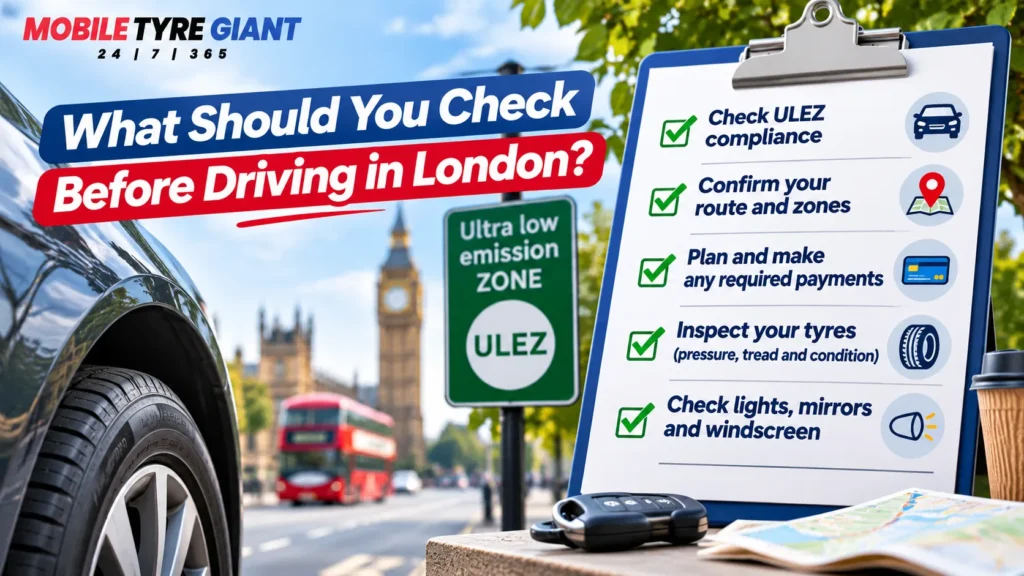
Check Your Route, Vehicle and Travel Dates
Before leaving, check whether your destination falls within the ULEZ boundary. Remember that the M25 itself is excluded, although nearby roads may be inside the zone. Use the official vehicle checker to confirm your car’s emissions compliance. If you are driving a non-compliant vehicle, establish which dates require payment. This is especially important when your journey involves overnight travel.
Imagine arranging an evening visit and deciding to return home shortly after midnight. That small change in timing could mean driving on two charging days. Reviewing your departure and return times helps you understand the possible cost. Also consider whether the Congestion Charge or another London road charge applies. Checking these details before departure is much easier than correcting a payment mistake afterwards.
Check Your Tyres and General Vehicle Condition
London’s busy roads can expose problems that drivers overlook during short everyday journeys. Before travelling, inspect your tyres for visible damage, unusual wear and signs of underinflation. Correct tyre pressure supports safe handling and helps prevent unnecessary tyre wear. If you are unsure about the recommended settings, this tyre pressure guide explains how to find the correct figures for your vehicle. Always use the manufacturer’s specifications rather than choosing a universal pressure.
Your windscreen, mirrors and lights also deserve attention before a longer drive. Make sure the glass is clean, the washer system works and dashboard warnings have been investigated. For cars and light vans, the legal minimum tyre tread depth is 1.6mm across the central three-quarters of the tread and around its circumference. A current MOT certificate does not remove your responsibility to keep the vehicle roadworthy. Remember that roadworthiness and ULEZ emissions compliance are separate requirements.
What Should You Do if You Discover a Tyre Problem Before Travelling?
Finding a damaged tyre before departure is frustrating, especially when you have an appointment to reach. However, ignoring visible damage or a rapidly deflating tyre can create a more serious problem. Check whether the tyre has a puncture, sidewall bulge or another obvious defect. Avoid driving on a completely flat tyre because doing so can damage its internal structure and the wheel. If you cannot establish that the vehicle is safe, arrange appropriate assistance.
A tyre problem discovered during your journey requires slightly different decisions. Your immediate priority should be reaching a place of relative safety without creating further danger. London’s parking restrictions can make choosing somewhere to stop particularly difficult. This guide to dealing with a flat tyre in London explains practical stopping and parking considerations. Professional mobile tyre fitting may also be appropriate when a damaged tyre needs replacement at a safe, accessible location.
A Practical Checklist Before Driving in London
A useful London driving checklist should combine regulatory preparation with basic vehicle safety. You do not need specialist knowledge to complete most of these checks. Start with vehicle compliance, then confirm the route, travel dates and payment requirements. Follow this with a quick inspection of your tyres, lights and visibility. This approach helps you deal with potential problems before they interrupt your journey.
The checklist below is particularly useful for occasional visitors and drivers unfamiliar with London’s charging arrangements. It can also help regular motorists avoid mistakes when changing vehicles or travelling at unusual times. Remember that paying ULEZ does not make an unsafe vehicle roadworthy. Equally, having perfectly maintained tyres does not make a non-compliant car exempt from the charge. Both responsibilities should be considered separately.
Before-you-drive check | What you should do |
Vehicle compliance | Check your registration against ULEZ emissions requirements |
Journey route | Confirm whether your destination and route enter the zone |
Other road charges | Check whether additional London charges apply |
Payment dates | Review travel dates, especially around midnight |
Tyre condition | Check pressure, tread and visible damage |
Vehicle safety | Inspect lights, visibility and relevant dashboard warnings |
Payment confirmation | Keep receipts and check your registered details |
Final Words: Plan Your London Journey With Confidence
Understanding ULEZ rules makes driving through London easier to manage. The most important steps are checking your vehicle’s compliance, understanding the charging boundaries and confirming whether payment is required. If your vehicle is non-compliant, pay attention to the correct travel dates and deadlines. Remember that ULEZ and the Congestion Charge are separate schemes. Taking these precautions can help prevent avoidable charges and unnecessary stress.
Vehicle preparation matters just as much as planning the route. Before setting off, check your tyres, visibility and general roadworthiness, particularly when travelling long distances. If you discover a problem, address it rather than hoping the vehicle will complete the journey safely. Keep your payment confirmation and check any unfamiliar charging requirements before departure. A well-planned journey leaves you free to focus on the road rather than worrying about mistakes.
Driving in London? Make Sure Your Tyres Are Ready!
Driving into London? Check your tyres before setting off. Arrange professional mobile tyre fitting for worn or damaged tyres at a safe, accessible location nearby.
Frequently Asked Questions
Find quick answers to the most common questions our customers ask.
Yes, London residents must pay the daily charge when driving a non-compliant vehicle within the zone unless an applicable exemption or discount applies. Living inside ULEZ does not automatically remove the charge.
Yes, Heathrow Airport is inside London's ULEZ, including Terminals 2, 3, 4 and 5. Drivers of non-compliant vehicles may need to pay even when making a short passenger collection.
Yes, the M25 motorway itself is excluded from ULEZ. However, leaving the motorway onto roads within Greater London may trigger the charge if your vehicle is non-compliant.
No, simply keeping your vehicle parked does not trigger the ULEZ charge. However, driving a non-compliant vehicle on separate calendar days may create a charge for each day.
No, hybrid vehicles must meet the relevant emissions requirements for their petrol or diesel engines. Check the vehicle's registration details to establish whether the daily charge applies.
No, a Blue Badge alone does not provide a ULEZ exemption. Certain qualifying disabled drivers and vehicles may benefit from specific exemptions or grace periods.
Yes, non-UK registered vehicles must meet the relevant emissions standards or pay the charge unless exempt. They also need to complete TfL's applicable vehicle registration process, even when compliant.
Yes, London's ULEZ operates 24 hours a day, including Sundays and bank holidays. The only annual exception is Christmas Day, 25 December.
Yes, you can pay by midnight on the third day after travelling. Make sure the payment matches your registration number and journey date to avoid potential penalties.
Potentially, yes, because each ULEZ charging day runs from midnight to midnight. Driving a non-compliant vehicle before and after midnight can result in two separate £12.50 charges.