

Your tyres are the only parts of the car that stay in direct contact with the road, but they cannot do that job properly without the suspension controlling each wheel. Springs, shock absorbers, struts, bushes, joints and control arms all help keep the tyre positioned correctly as the car accelerates, brakes, turns and travels over bumps. When those components begin to wear, the wheel can move more than it should or sit at the wrong angle. The tyre then stops sharing the load evenly across its tread and starts wearing harder in particular areas. You may first notice a rough ride, a knocking sound or a car that feels less settled, but sometimes the tyre wear is the first visible warning. A tyre that was expected to last for thousands more miles can lose useful tread surprisingly quickly when the suspension is no longer controlling it correctly.
This is why suspension problems can damage tyres even when the tyre itself is not defective. Worn dampers can allow the wheel to bounce, damaged bushes can let alignment angles change while driving, and weakened joints can affect the way the tyre meets the road. Drivers often respond by replacing the worn tyre, only to find the same pattern appearing on the new one because the underlying mechanical problem was never corrected. The smarter approach is to read tyre wear as information about what is happening elsewhere on the vehicle. A regular tyre safety check can help identify uneven wear before it becomes severe. Understanding the connection between suspension condition and tyre wear can save money, improve handling and stop the replacement tyre from being damaged in exactly the same way.
How Does the Suspension Protect Your Tyres?
A car suspension does much more than make rough roads feel comfortable. Its job is to control wheel movement and help keep each tyre in consistent contact with the road as the vehicle moves. When you drive over a bump, the spring allows the wheel to move upward while the shock absorber or damper controls how quickly that movement happens. Bushes and joints then guide the wheel through a controlled path so its angle does not change unpredictably. When everything is working correctly, the tyre can place its tread against the road relatively evenly. That controlled contact helps the tread wear progressively rather than developing random high and low areas.
Once a suspension component weakens, the tyre may no longer remain planted in the same way. A worn shock absorber can allow the wheel to continue bouncing after a bump, while a deteriorated bush may let the wheel shift slightly forwards, backwards or sideways under braking and cornering. Those movements may sound tiny, but tyres rotate thousands of times during an ordinary journey. A small geometry change repeated on every rotation can gradually remove rubber from one shoulder, one edge or scattered patches around the tread. This is why suspension-related tyre wear usually develops over time rather than appearing after one short drive. By the time the pattern becomes obvious, the suspension fault may already have been affecting the tyre for hundreds or thousands of miles.
Why Do Worn Shock Absorbers Cause Uneven Tyre Wear?
Shock absorbers control the repeated movement of the suspension after the wheel passes over a bump or uneven surface. When a damper becomes weak, the wheel can continue moving up and down instead of settling quickly. Imagine bouncing a basketball against the ground compared with pressing it firmly against the floor. A tyre controlled by a healthy damper stays in more consistent contact, while a poorly controlled wheel can repeatedly load and unload different sections of tread. Over time, this can contribute to irregular or scalloped wear commonly described as cupping. The pattern may feel like a series of shallow dips as you run your hand around the tread.
The driver may notice other symptoms at the same time, such as excessive bouncing after bumps, a less stable feeling through bends or increased nose-diving under braking. Tyre noise can also change because the uneven tread no longer meets the road with a smooth, consistent surface. None of these symptoms proves that a shock absorber is definitely faulty, because wheel imbalance and other suspension problems can create similar effects. The important clue is the combination of irregular tyre wear and a change in how the vehicle controls vertical movement. If the tread looks patchy rather than evenly worn, a proper suspension inspection should happen before another tyre is fitted. Replacing the rubber without checking the damper can leave the new tyre exposed to the same repeated bouncing.
How Do Worn Bushes and Joints Damage Tyres?
Suspension bushes are designed to allow controlled movement while holding components in the correct relationship to one another. As the rubber deteriorates, cracks or separates, the component can move further than intended when the vehicle brakes, accelerates or turns. Ball joints and other suspension joints can create a similar problem when excessive play develops. The wheel may then change its toe or camber angle dynamically while the vehicle is moving, even if it appears reasonably straight when parked. That changing geometry pushes more load onto certain parts of the tread. One edge may begin disappearing faster while the rest of the tyre still looks healthy.
This type of wear can be frustrating because simply adjusting wheel alignment may not provide a lasting solution if worn components are still allowing movement. The alignment could be set correctly in the workshop and then shift again as soon as braking or cornering loads are applied. That is why repeated one-sided or feathered tyre wear deserves more than another quick adjustment. The mechanic needs to check whether the suspension and steering components are actually capable of holding the specified geometry. If you already see unusual tread patterns, the guide on how to check tyre tread can help you compare the inner, centre and outer parts of each tyre. The wear pattern is not a complete diagnosis, but it is an important clue about where the investigation should begin.
What Tyre Wear Patterns Can Suspension Problems Cause?
Suspension faults do not produce one universal tyre wear pattern. The appearance depends on which component is worn, how the wheel geometry has changed and whether another issue such as incorrect pressure or imbalance is present at the same time. Worn dampers can contribute to patchy or cupped wear, while worn bushes or joints may allow the wheel to develop one-sided wear or feathered tread. Incorrect camber can concentrate wear on the inner or outer shoulder, and changing toe angles can produce a directional sharp-to-smooth pattern across the tread blocks. Sometimes several problems overlap, making the tyre look more complicated than a textbook diagram.
This is why tyres should be inspected across their full width and around more than one point of the circumference. Looking only at the outside shoulder can miss heavy inner-edge wear, while checking one tread groove may hide patchy wear somewhere else around the tyre. Compare tyres on the same axle as well because a difference between left and right can reveal that one corner of the suspension is behaving differently. Do not assume that every uneven tyre needs wheel balancing or that every worn inner edge proves one specific suspension part has failed. Tread patterns tell you where the tyre is being stressed, but a professional inspection is needed to confirm why. Reading the pattern correctly helps avoid replacing tyres repeatedly while the original suspension problem continues underneath the car.
Which Suspension Problems Are Most Likely to Damage Tyres?
Not every suspension fault affects tyres in exactly the same way. Some problems allow the wheel to bounce, while others change the angle at which the tyre sits against the road. Worn shock absorbers or struts can reduce control over vertical wheel movement, while damaged bushes, ball joints or control arms can allow unwanted sideways or fore-and-aft movement. Broken or weakened springs can also change ride height and alter how weight is distributed across the vehicle. Even a small change in wheel position can become important when it is repeated through thousands of tyre rotations. The tread may gradually develop cupping, one-sided wear, feathering or other irregular patterns.
The difficulty is that several faults can create similar symptoms. A tyre worn heavily on one edge may be linked with alignment, but alignment itself may have changed because a suspension component is worn. Likewise, vibration can come from wheel imbalance, a damaged tyre, worn suspension or more than one problem at the same time. This is why replacing a tyre based only on appearance can be expensive guesswork. The tyre gives you evidence of abnormal contact with the road, but the suspension inspection explains why that contact changed. The most useful approach is to combine tread condition, steering behaviour, suspension movement and alignment measurements before deciding what needs repairing.
Can Worn Shock Absorbers Cause Tyre Cupping?
Yes, worn shock absorbers can contribute to tyre cupping because they are responsible for controlling how quickly the wheel moves after hitting bumps. When the damper weakens, the wheel may bounce repeatedly instead of settling back against the road smoothly. Each time contact pressure changes, certain areas of tread can take more load than others. Over many miles, this may produce alternating high and low areas around the tyre. These scalloped sections can be felt by running a hand carefully around the tread when the vehicle is safely parked. The tyre may also become noticeably noisier because the uneven surface strikes the road in a repeating pattern.
Cupping does not automatically prove that the shock absorber is faulty, though. Wheel imbalance, worn suspension joints, damaged tyres and other mechanical issues can contribute to a similar pattern. Check whether the car also feels excessively bouncy after road undulations or unsettled through corners. If the vehicle continues oscillating after a bump instead of settling quickly, that information becomes useful during diagnosis. Do not replace the tyre and assume the problem has disappeared. If the underlying wheel movement remains uncontrolled, the new tyre can begin developing the same scalloped wear. The tyre and suspension need to be assessed together.
Can Broken or Weak Springs Damage Tyres?
Springs support the vehicle’s weight and help maintain the intended ride height. If a spring weakens, sags or breaks, one corner of the car can sit lower than it should. That change may alter suspension geometry and place the tyre at a different angle to the road. A broken coil can also affect how the suspension moves through bumps and corners. In some cases, the driver may notice one side of the vehicle sitting visibly lower, especially when viewed on level ground. Tyre wear may then begin concentrating on one shoulder or developing differently from the opposite side.
A damaged spring can create other concerns beyond tyre wear, so it should not be treated as a minor alignment issue. The vehicle may feel less stable, produce knocking noises or react differently when carrying passengers or travelling over uneven surfaces. If one tyre is wearing abnormally and the corresponding corner of the car looks lower, mention both symptoms during inspection. Simply realigning the wheels without repairing a damaged spring may not provide a lasting correction. The suspension needs to hold the wheel at the correct height and angle before alignment measurements can remain meaningful. Fixing the structural cause first protects the tyre from continuing to wear in the wrong position.
How Do Worn Ball Joints and Track Rod Ends Affect Tyres?
Ball joints and track rod ends help control wheel position while still allowing the steering and suspension to move. When excessive play develops, the wheel can shift slightly instead of following the intended geometry precisely. That movement may become more noticeable during braking, acceleration, cornering or travel over rough surfaces. A tyre can then scrub across the road rather than rolling cleanly in the direction the vehicle is travelling. Over time, the tread may develop feathering, shoulder wear or other irregular patterns. Steering can also begin to feel less precise.
Worn joints may produce clunks, looseness or changes in steering response, but symptoms are not always dramatic in the early stages. That is why tyre wear can sometimes provide an early clue that something is moving where it should not. If feathering appears again soon after an alignment, worn steering or suspension joints deserve closer attention. A fresh alignment cannot remain accurate if mechanical play allows the wheel position to change once the car is moving. Repairing the worn component should therefore come before relying on another alignment adjustment. The tyre pattern is showing the result, while the joint may be the reason behind it.
How Can Suspension Problems Change Wheel Alignment?
Wheel alignment describes the angles at which the wheels sit relative to the road and the vehicle. Those angles depend partly on suspension components holding the wheel in a precise position. When bushes wear, springs sag or joints develop excessive movement, alignment can shift away from the manufacturer’s specification. Camber may become too negative or positive, while toe can move inward or outward. These changes are often small enough that the wheel still looks straight to the eye. The tyre, however, feels the difference on every rotation.
That repeated misalignment can scrub rubber from one edge or create a feathered surface across the tread blocks. A pothole or kerb strike can make the situation worse by disturbing geometry or damaging a component that was already weakened. This is why alignment should not be treated as an isolated adjustment when tyre wear appears alongside suspension symptoms. The vehicle must first be capable of holding the correct geometry under real driving loads. If steering and suspension components are sound, alignment can then be measured and adjusted accurately. Correct geometry helps the tyre meet the road more evenly and protects the remaining tread.
What Is the Difference Between Alignment and Wheel Balancing?
Wheel alignment and wheel balancing solve different problems, even though both can affect how the car feels and how tyres wear. Alignment concerns the direction and angle of the wheels relative to the vehicle and road. Balancing concerns how weight is distributed around the rotating tyre and wheel assembly. An alignment problem may cause pulling, an off-centre steering wheel, feathering or one-sided tread wear. A balance problem is more commonly associated with vibration at particular speeds and can contribute to irregular wear. The two services are therefore related to tyre condition but are not interchangeable.
It is common for drivers to ask for balancing when the real issue is alignment, or request alignment when a damaged wheel or imbalance is causing vibration. A proper inspection should use the symptoms and tread pattern to decide which area needs attention. If vibration is the main complaint, a mobile wheel balancing check may form part of the diagnosis, but balancing will not correct worn suspension or incorrect toe. Likewise, alignment will not fix a badly imbalanced wheel assembly. In some cases, both problems can exist at the same time. Identifying the correct cause before replacing tyres avoids paying for work that does not address the real issue.
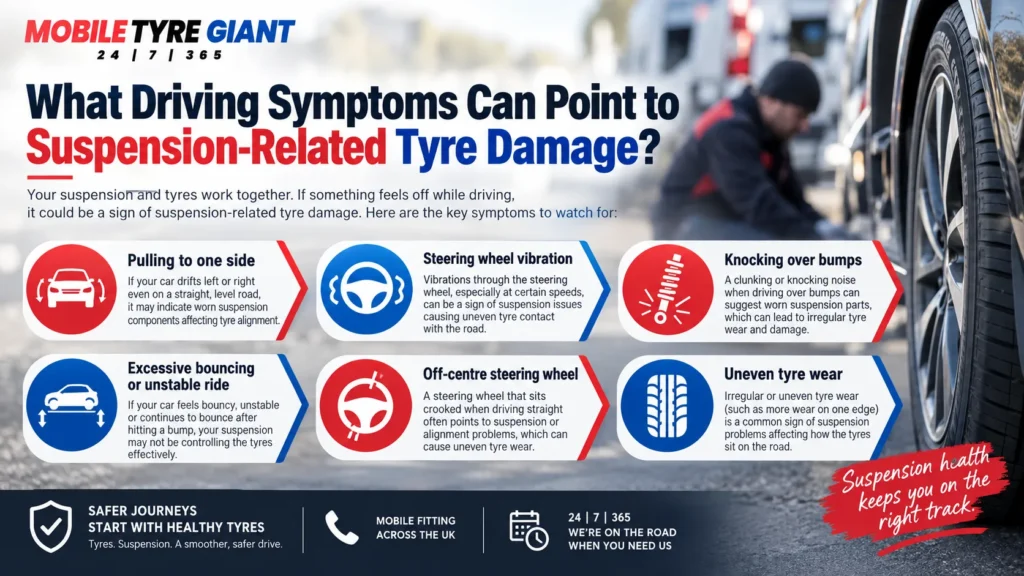
What Driving Symptoms Can Point to Suspension-Related Tyre Damage?
Tyre wear often develops gradually, but the vehicle may give you other clues before the tread becomes seriously damaged. Pulling to one side, an off-centre steering wheel, repeated vibration, knocking over bumps or a car that feels unusually floaty can all justify further inspection. You may also notice that the vehicle takes longer to settle after a speed hump or dips more noticeably during braking. None of these symptoms identifies one suspension component by itself. They simply tell you that the way the wheel is being controlled has changed. When those symptoms appear alongside uneven tyre wear, the connection becomes more important.
Listen to how the car behaves on roads you know well. If a familiar stretch suddenly feels rougher or the steering needs more correction than before, do not dismiss the change just because the vehicle still moves normally. Compare the tyres on the same axle and look for differences in tread depth, shoulder wear or scalloped patches. A vehicle that feels unstable and is also destroying one tyre faster than the others needs more than another replacement tyre. The suspension, alignment and tyre condition should all be assessed together. Early investigation can preserve usable tread and prevent the same wear pattern from appearing on the next set of tyres.
Is Suspension-Related Tyre Wear Dangerous?
Uneven tyre wear caused by suspension problems should not be dismissed as a cosmetic issue. The tyre may still have plenty of tread in one area while another shoulder or patch has worn much more heavily. That difference can affect how consistently the tyre contacts the road, particularly in wet conditions where tread depth becomes increasingly important. A suspension fault can also continue changing the wheel position every time the car brakes, accelerates or travels over bumps. This means the tread may keep deteriorating even after you first notice the problem. What looks like a small patch of abnormal wear today can become much more serious after several weeks of normal driving.
The suspension fault itself may also affect vehicle control, depending on which component is worn and how severe the problem has become. Excessive play in joints, damaged springs and badly worn dampers can all reduce the driver’s confidence in how the vehicle responds. UK drivers are responsible for keeping vehicles roadworthy throughout the year, not only on the day of an MOT. That makes unusual tyre wear worth investigating before it reaches the legal limit or another symptom becomes more obvious. Think of the tyre as the visible evidence of a problem that may be happening higher up in the suspension. Correcting that problem early protects both the tyre and the way the car behaves on the road.
Can Worn Suspension Reduce Tyre Grip?
Yes, suspension wear can indirectly reduce how effectively a tyre maintains consistent contact with the road. A healthy suspension keeps the wheel controlled as the surface rises, falls and changes direction beneath the car. If the shock absorber is weak, the wheel may continue bouncing after a bump instead of settling quickly. If a bush or joint has excessive movement, the tyre’s angle can change as the vehicle corners or brakes. In both situations, the tread may not stay loaded against the road as evenly as intended. This can make the car feel less settled and can contribute to irregular tyre wear.
The effect may be especially noticeable on wet or uneven roads where the tyre already has more work to do. A tyre that has developed deep cupping or severe shoulder wear also has less consistent tread available to deal with water and road texture. Do not assume that replacing the tyre alone will restore normal grip if the suspension continues allowing uncontrolled movement. The tyre and suspension work together every second the car is moving. If one part of that system is no longer functioning correctly, the other can suffer as a result. Restoring proper suspension control helps the replacement tyre use its tread more evenly.
Can Suspension Problems Damage New Tyres Quickly?
They can. A brand-new tyre does not protect itself from incorrect wheel movement simply because it has fresh tread. If a worn bush is allowing the wheel angle to change or a weak damper is letting the tyre bounce, the new rubber can begin developing the same abnormal pattern that damaged the previous tyre. Severe alignment changes can make this happen much sooner than drivers expect. It is frustrating to replace a tyre because of uneven wear and then notice the inner shoulder disappearing again a few months later. In that situation, the tyre was replaced but the cause remained.
This is why unusual wear on the old tyre should always be mentioned before the replacement is fitted. The technician can then consider whether alignment, suspension or steering components need investigation before the new tyre starts regular service. Photographing the old wear pattern can also be useful if the tyre is removed before further diagnosis takes place. A clear image of cupping, one-sided wear or feathering gives the technician additional context about how the previous tyre was contacting the road. New tyres are an investment, and fixing the mechanical fault first gives that investment a much better chance of lasting.
Will Wheel Alignment Fix Suspension-Related Tyre Wear?
Wheel alignment can correct incorrect wheel angles, but it cannot repair worn suspension components. If the suspension is mechanically sound and the alignment has simply moved outside specification, adjustment may stop further abnormal tyre wear. The situation is different when a worn joint, bush or spring is allowing the wheel to move unpredictably. An alignment machine can set the geometry correctly while the vehicle is stationary, but those measurements may change again once the worn component is placed under braking or cornering load. The car can then return to scrubbing the tyre even though the alignment was recently adjusted.
Alignment also cannot restore rubber that has already worn away. A badly worn inner shoulder or cupped tread remains physically uneven after the geometry is corrected. The important question is whether the tyre still has sufficient legal tread and remains structurally suitable for continued use. If it does, correcting the suspension and alignment may allow the remaining tread to wear more normally. If part of the tyre has already become excessively worn, replacement may still be necessary. Alignment protects future wear rather than reversing damage that has already happened.
Should Suspension Be Repaired Before Wheel Alignment?
In most cases, any worn suspension or steering component that affects wheel position should be repaired before final wheel alignment is carried out. There is little value in carefully setting toe or camber if a loose joint immediately allows those angles to move again. A technician may first inspect bushes, ball joints, track rod ends, springs and other relevant components for excessive movement or damage. Once the mechanical parts can hold the wheel securely in the correct position, alignment measurements become much more meaningful. This order helps prevent repeated adjustments that never solve the real problem.
There are also situations where suspension work itself changes wheel geometry. Replacing certain arms, joints, struts or bushes can alter the position of the wheel enough that alignment should be checked afterwards. That is why the process often makes more sense as inspection, repair and then alignment rather than alignment first. If the tyre has already developed unusual wear, tell the technician what you noticed and when it started. A complete history can make diagnosis faster and reduce the chance that the new tyre begins following the same damaging wear pattern.
Can You Keep Driving With Uneven Tyre Wear?
Whether you can continue driving depends on how severe the wear is, how much tread remains and whether the tyre or suspension has another serious defect. Mild uneven wear does not automatically mean the tyre will fail immediately, but it should still be investigated because the pattern can become worse quickly if the cause remains active. Measure the tread at several points across the tyre rather than checking only the deepest-looking groove. For most cars and light vans in the UK, the legal minimum is 1.6mm across the central three-quarters of the tread and around the entire circumference. One heavily worn area can therefore matter even when another section looks healthy.
Avoid unnecessary driving if the tyre shows exposed cords, a serious bulge, major structural damage or rapidly worsening wear. The same applies if the vehicle feels unstable or the suspension is making severe noises that suggest a component may be failing. A routine commute is not the right place to test whether a questionable suspension part will last another week. If the problem is mild and the vehicle remains stable, arrange inspection before additional mileage removes more useful tread. The sensible goal is to catch the cause while the tyre still has something left to save.

When Should Tyres Be Replaced Because of Suspension Damage?
A tyre should be replaced when suspension-related wear has reduced tread below the legal requirement, created severe irregular wear or left the tyre unsuitable for continued use. Replacement may also be necessary if the tyre has developed structural damage in addition to the wear pattern. Do not judge the entire tyre by whichever section still looks deepest. Measure several areas and pay particular attention to inner shoulders because they can be difficult to see while the vehicle is parked normally. If you are unsure whether the remaining tread or condition is acceptable, our guide on when to replace tyres explains the wider warning signs that should be considered.
The suspension problem should be addressed before or alongside replacement wherever possible. Fitting another tyre onto a wheel that still has uncontrolled movement can simply begin a new cycle of premature wear. Correct the worn parts, confirm the alignment and then monitor the replacement tyre during the following weeks. A quick tread inspection after some normal mileage can show whether the new tyre is beginning to wear evenly. That simple follow-up is especially useful when the previous tyre was badly cupped or worn on one edge. Replacement solves the damaged rubber, while the suspension repair prevents the same damage returning.
Should You Replace One Tyre or Both Tyres on the Same Axle?
You do not automatically need to replace both tyres simply because one has suffered suspension-related wear. The tyre on the opposite side should be inspected for tread depth, age, specification and overall condition before a decision is made. If it remains suitable and matches the required specification, replacing only the damaged tyre may be possible depending on the vehicle manufacturer’s guidance. However, a large difference in tread depth or condition across the axle may influence how evenly the pair behaves. Certain drivetrains can also have more specific tyre-matching requirements.
The key is to avoid two extremes. Replacing tyres that still have plenty of safe, usable life wastes money, while keeping a badly mismatched or heavily worn tyre beside a new one may not be sensible either. Inspect the whole axle and look for signs that the suspension problem has affected both sides. If both tyres show similar wear, the fault may have been influencing the axle for some time. Correct the mechanical cause first, then replace only what condition and vehicle requirements genuinely justify. That approach protects both safety and the value of the tyres you are fitting.
What Should You Do When You Notice Suspension-Related Tyre Wear?
If one tyre begins wearing much faster than the others, do not treat the tyre as the only problem. Start by checking tread depth across several points and comparing the inner, centre and outer areas of the tyre. Look at the tyre on the opposite side of the same axle as well, because similar wear on both sides can tell a different story from one isolated problem. Pay attention to whether the car also pulls, bounces, vibrates or makes knocking noises over rough roads. These symptoms can help show whether the tyre wear is connected to alignment, suspension movement or another mechanical issue. The aim is to understand the pattern before replacing anything unnecessarily.
Once abnormal wear is confirmed, arrange a proper suspension and steering inspection before fitting another tyre if the existing wear is severe. Worn dampers, bushes, ball joints, springs and control arms should be checked for damage or excessive movement. If the mechanical components are sound but the wheel angles are outside specification, alignment may then be the next step. Do not rely on a quick alignment adjustment if a loose component is still allowing the wheel to move under load. Replacing the cause first gives the alignment a better chance of staying correct. It also gives the next tyre a much better chance of wearing evenly.
Check the Tyre Before Blaming the Suspension
Not every uneven tyre is automatically caused by a suspension fault. Incorrect pressure, wheel imbalance, driving habits and previous impact damage can create wear that resembles a mechanical problem. Check the manufacturer’s recommended cold pressure and make sure the tyre is not repeatedly losing air. Look for embedded objects, cuts or sidewall damage that may explain why the tyre is behaving differently. A tyre that has spent months under-inflated can develop shoulder wear even when the suspension is perfectly healthy. Starting with the basic tyre checks prevents you from replacing suspension parts that were never responsible.
The wear pattern still provides useful information once those basic checks have been completed. Cupping can point towards uncontrolled wheel movement, one-sided wear may raise alignment questions, and feathering can suggest excessive toe scrub. None of those patterns should be used as a one-step diagnosis, but together with steering and suspension symptoms they help narrow the investigation. If the tyre is already badly damaged or no longer suitable for continued use, mobile tyre replacement can provide a replacement without requiring unnecessary driving on a tyre you are concerned about. The mechanical cause should still be corrected so the replacement does not begin following the same wear pattern.
Ask for Suspension Inspection Before Fitting New Tyres
If an old tyre has developed severe cupping, shoulder wear or feathering, show the wear pattern to the technician before it is removed. That tyre is effectively carrying a record of how the wheel has been contacting the road. Once it is discarded, some of that evidence disappears unless photographs or measurements have been taken. Mention any pothole impact, kerb strike, steering changes or suspension noises that appeared before the tread began wearing abnormally. The more context the technician has, the easier it becomes to decide whether the issue involves geometry, worn components or both. A few clear observations from the driver can prevent a lot of unnecessary guesswork.
The ideal sequence is usually diagnosis first, mechanical repair where required, alignment check and then tyre replacement if the existing tyre cannot continue safely. That sequence may vary depending on how damaged the tyre already is, but the principle remains the same. Do not fit a fresh tyre and assume the problem will disappear on its own. New rubber can begin wearing incorrectly as soon as it is placed back onto an unresolved suspension fault. Treat the tyre replacement as the final part of the repair rather than the entire repair itself. That approach protects both safety and the money spent on the new tyre.
How Can You Prevent Suspension Problems From Ruining Your Tyres?
Prevention starts with noticing changes before the tyres become badly worn. Check tread condition regularly and compare all four tyres rather than inspecting one wheel in isolation. A new patch of cupping, inner-edge wear or directional roughness should be treated as information rather than something to monitor indefinitely. Listen for knocking over bumps and notice whether the car takes longer to settle after a speed hump or rough section of road. A steering wheel that suddenly sits off-centre or a vehicle that begins drifting also deserves attention. These changes may appear long before the tread reaches the legal minimum.
Routine suspension maintenance also matters because worn components rarely improve on their own. If a service or MOT identifies play in bushes, joints or dampers, deal with the issue before it has months to influence tyre wear. Remember that an MOT is a point-in-time inspection, not a guarantee that suspension components will remain unchanged until the next test. Current UK MOT guidance specifically includes springs, shock absorbers, suspension arms, joints and bushes as part of the suspension inspection. Tyre tread and condition are also assessed separately, which shows how closely the two systems are connected in roadworthiness checks. Preventative attention between tests can catch problems much earlier.
Be More Careful After Pothole and Kerb Impacts
Potholes and hard kerb strikes can disturb wheel alignment or damage suspension components even when the tyre does not immediately go flat. After a significant impact, pay attention to whether the steering wheel position changes, the vehicle begins pulling or a new vibration appears. Check the affected tyre for cuts, bulges and pressure loss as well. If everything feels normal, there is no need to assume that serious damage definitely occurred. The reason to stay alert is that some alignment or suspension problems become obvious only after additional driving. Tread wear can then begin developing gradually.
London and other UK roads can expose tyres and suspension to repeated rough surfaces, especially when potholes are difficult to see in standing water. A single minor impact may not create an issue, but repeated knocks can eventually affect components that were already worn. If a tyre begins wearing differently after a known impact, mention that event during the inspection. Timing often helps make sense of the symptoms. Drivers do not need to become mechanics, but remembering when the vehicle started behaving differently can be surprisingly useful. Early inspection after a meaningful change can protect the tread before the pattern becomes severe.
Monitor New Tyres After Suspension Repairs
After suspension repairs and alignment work, do not assume the job is finished forever the moment the car leaves the workshop. Check the replacement or remaining tyres again after some normal driving to make sure the wear pattern is becoming consistent. Look at the same inner, centre and outer sections you were monitoring before the repair. If the tread continues developing the old pattern quickly, return for further investigation. There may be another worn component, an alignment issue or a separate tyre problem that still needs attention. Follow-up checks are especially useful when the original wear was severe.
Keeping an eye on the new tyre does not require specialist equipment beyond a simple tread gauge and pressure gauge. Taking an occasional photograph of the tread can also make gradual changes easier to compare. The goal is not to become obsessive about every tiny mark, but to confirm that the tyre is no longer being damaged in the same way. A successful suspension repair should help the tyre maintain more even contact with the road. If it does, the tread should stop developing the aggressive irregular pattern that led to the repair in the first place.
Final Words: Fix the Suspension Before It Destroys Another Tyre
Suspension problems and tyre wear are closely connected because the suspension controls how each wheel moves and how the tread meets the road. Worn dampers can contribute to cupping, weak springs can alter ride height and geometry, while worn bushes or joints can allow wheel angles to change under load. The tyre then records those problems through uneven wear. Replacing the damaged tyre may restore fresh tread, but it does not repair the reason the old tyre wore incorrectly. That is why proper diagnosis matters before another set of tyres is fitted.
The practical approach is simple: inspect the tread regularly, pay attention to changes in handling and investigate unusual wear early. Repair worn suspension or steering components first, check the wheel alignment and then replace tyres that have become unsafe or excessively worn. If the mechanical cause is corrected while useful tread remains, you may prevent further unnecessary wear. If replacement is needed, fixing the suspension protects the new tyre from suffering the same fate. A tyre can tell you a lot about the condition of the vehicle underneath it, so do not ignore the message when the wear pattern starts changing.
Suspension Problems Wearing Out Your Tyres?
If your tyres are wearing unevenly, cupping or showing signs of suspension damage, get the underlying problem checked before fitting another tyre.
Frequently Asked Questions
Find quick answers to the most common questions our customers ask.
Yes. Worn suspension components can change how the wheel moves or sits against the road, which can concentrate wear on particular parts of the tread. Weak shock absorbers, damaged bushes, worn joints and broken or sagging springs can all contribute to irregular tyre wear depending on how they affect wheel control and alignment.
Worn shock absorbers can contribute to cupping or scalloped tyre wear, where repeated high and low patches develop around the tread. This happens because the wheel may bounce more than it should after bumps, changing how consistently the tyre is loaded against the road. Other faults can cause similar wear, so the damper should be inspected rather than diagnosed from the tread pattern alone.
Yes. Worn bushes, joints, springs or other suspension components can alter wheel geometry and contribute to excessive inner-edge wear. Incorrect camber or toe may also be involved. If the inside shoulder is wearing faster than the rest of the tread, check alignment and suspension condition rather than simply replacing the tyre and assuming the problem is solved.
They can. Feathering is strongly associated with incorrect toe alignment, but worn suspension or steering components can allow the toe angle to change while the vehicle is moving. The tread then scrubs sideways against the road, creating a smooth edge in one direction and a sharper edge in the other.
Yes, suspension problems can contribute to vibration, particularly if they allow the wheel to move irregularly or create uneven tyre wear. However, vibration can also come from wheel imbalance, damaged tyres, bent wheels or other mechanical faults. The speed and conditions at which the vibration occurs can help with diagnosis, but a proper inspection is needed to identify the cause.
Alignment can correct wheel angles, but it will not repair worn suspension components or restore tread that has already worn away. If a loose bush, joint or damaged spring is allowing the wheel position to change, that fault should usually be repaired before the final alignment. Otherwise, the alignment may move out of specification again once the vehicle is driven.
The tread pattern can provide clues, but it rarely proves the cause on its own. Cupping can be linked with poor wheel control, feathering with toe problems and one-sided wear with alignment changes, but pressure and balance can create overlapping symptoms. The best diagnosis combines tread inspection with suspension checks, pressure readings and alignment measurements.
It depends on the severity of the wear and the condition of the suspension. Mild uneven wear may allow limited normal driving while an inspection is arranged, but serious tread loss, exposed cords, instability, severe knocking or structural tyre damage requires faster action. For most cars and light vans in the UK, the required tread must remain at least 1.6mm across the central three-quarters and around the entire circumference.
Yes. A new tyre can begin developing the same abnormal wear as the old one if the suspension or alignment problem remains unresolved. This is why severe or unusual wear should be diagnosed before or alongside tyre replacement. Repairing the mechanical cause first gives the new tyre a much better chance of wearing evenly.
Yes, especially when the wear pattern is severe, recurring or accompanied by pulling, vibration, knocking or excessive bouncing. Checking the suspension before fitting new tyres can reveal worn components that would otherwise continue damaging the replacement. Correct the mechanical fault, confirm the alignment and then monitor the new tyre to make sure the abnormal pattern does not return.