

Tyres rarely give a convenient warning before something changes. Pressure can fall, tread can wear unevenly, and damage can appear after a pothole or kerb strike. A practical tyre maintenance schedule helps you catch those changes before they turn into bigger problems. For most UK drivers, that means quick weekly checks, a fuller monthly inspection, seasonal reviews, and an annual assessment of overall tyre condition. The goal is not to turn you into a tyre technician.
Many drivers only inspect their tyres when a dashboard warning appears or the MOT is due. That leaves plenty of time for pressure, tread, or physical condition to change between checks. A better approach combines routine maintenance with extra inspections whenever the car feels or behaves differently. Our detailed tyre safety guide explains the wider pressure, tread, and wear checks that support this routine. Think of tyre care like checking the weather before leaving home: a quick look can prevent an unpleasant surprise later.
How Often Should You Check Your Tyres?
There is no single interval that covers every tyre maintenance task. The Highway Code advises drivers to check tyre pressures weekly, before a journey, and while the tyres are cold. A fuller inspection of pressure, tread, and general condition should also become part of your monthly routine. Seasonal changes can create extra reasons to inspect your tyres, particularly around colder weather, wet roads, potholes, and holiday travel. An annual check can then focus more closely on tyre age, persistent wear patterns, and changes that have developed over time.
The easiest approach is to separate calendar checks from checks triggered by something unusual. Weekly and monthly inspections belong on your calendar, while impacts, vibration, repeated pressure loss, or visible damage should never wait for a scheduled date. If you clipped a kerb yesterday, there is little sense waiting another three weeks for your monthly inspection. The same applies if one tyre repeatedly needs more air than the others. Understanding the effects of under-inflated tyres also shows why repeated pressure loss should be investigated rather than becoming a normal top-up routine.
What Should You Check Every Week?
A weekly tyre check should be quick enough that you can realistically keep doing it. Start by checking tyre pressures when the tyres are cold. Compare the readings with the vehicle manufacturer’s recommended pressures rather than copying a figure from another car or guessing what looks right. Front and rear pressures can differ, and some vehicles also specify different settings when carrying extra passengers or luggage. While checking the pressure, give each tyre a quick visual scan for obvious cuts, bulges, objects lodged in the tread, or one tyre sitting noticeably lower than the others.
Do not treat a tyre pressure monitoring system as a reason to stop looking at the tyres yourself. A dashboard pressure display or warning light can be useful, but it cannot inspect the tread or show you every type of sidewall damage. One useful habit is keeping a reliable pressure gauge or compact inflator somewhere easy to reach at home. That removes the need to wait until your next petrol station visit before checking the tyres. A recurring phone reminder can also turn something that is easy to forget into a simple weekly routine.
What Should You Check Every Month?
The monthly tyre check should go further than air pressure alone. Look across the tread and compare the inner, centre, and outer areas for signs of uneven wear. Inspect the tread and sidewalls for cuts, cracking, bulges, nails, screws, or anything else that looks different from the surrounding rubber. Pay attention if one tyre appears to be wearing noticeably faster than the others. Uneven wear can sometimes be associated with pressure, alignment, balancing, suspension, or other issues that deserve further investigation.
Your monthly routine should also cover the items drivers can easily forget until they actually need them. If your vehicle carries a spare tyre, check its pressure and visible condition instead of assuming an unused tyre is automatically ready for an emergency. If there is no spare, make sure the compressor and tyre sealant kit are present and that any expiry information remains readable. It is also sensible to confirm that the locking wheel nut key is where you expect it to be. When you need more detail on measuring the tread itself, our guide on how to check tyre tread depth explains the process in greater depth.
Should You Check Your Tyres Before a Long Journey?
Yes, even if you completed your normal tyre check recently. A long motorway journey keeps the tyres under sustained speed and load for much longer than a short local drive. Check the pressure, tread, visible condition, and the spare tyre or repair kit before setting off. If the car will carry several passengers, luggage, or other extra weight, check the manufacturer’s recommended pressures for that particular load. Measure the pressure while the tyres are cold so you are working from a useful and consistent reading.
Long journeys are also a good time to reconsider symptoms that may have seemed minor during short local trips. A new vibration, steering pull, repeated pressure top-up, or unfamiliar road noise deserves attention before several hours of motorway driving. If one tyre consistently loses air faster than the others, a long journey should not become the experiment that tells you whether the problem is serious. Inspect the tyre first and investigate why the pressure keeps changing. The purpose of a pre-journey check is not to create anxiety, but to start the drive knowing your tyres have been inspected for the conditions ahead.
Tyre Maintenance Schedule at a Glance
A useful tyre maintenance schedule should make sense within seconds. The table below separates normal routine checks from situations where your tyres deserve additional attention. Weekly checks focus on pressure and obvious visible condition, while the monthly inspection looks more closely at tread, sidewalls, and equipment. Seasonal and annual reviews then add another layer of preventative care. The final category is especially important because tyre damage and new symptoms do not follow a calendar.
Use this tyre maintenance schedule as a practical baseline rather than a reason to postpone action. Your vehicle handbook may include additional advice based on its tyre size, drivetrain, load, or pressure monitoring system. High-mileage drivers and vehicles regularly carrying heavier loads may also benefit from more frequent inspections. The important thing is to create a repeatable routine while remaining alert to changes between planned checks. If a tyre suddenly looks, feels, or behaves differently, that new information matters more than the date of your next scheduled inspection.
When to Check | What to Check | Main Purpose |
Weekly | Cold tyre pressure and quick visual condition | Spot pressure changes or obvious damage early |
Monthly | Pressure, tread, sidewalls, TPMS, spare or repair kit | Complete routine tyre inspection |
Before Long Journeys | Pressure for vehicle load, tread, visible damage, spare or kit | Prepare tyres for sustained driving and extra load |
Spring | Pressure, pothole damage, uneven wear | Identify damage that may have developed through winter |
Summer | Pressure, condition, tread, loaded vehicle settings | Prepare for holiday travel and longer journeys |
Autumn | Tread, pressure, sidewall condition | Prepare for colder temperatures and wetter roads |
Winter | Cold pressure, tread, visible damage | Monitor tyres through colder and wetter conditions |
Annually | Age, long-term wear patterns, overall condition | Review changes that develop over a longer period |
Immediately | Pressure loss, bulges, vibration, impacts or new damage | Investigate problems without waiting for the next routine check |
Your Monthly Tyre Maintenance Checklist
A good monthly tyre check does not need specialist equipment or half an hour on the driveway. Once you know where to look, the basic inspection can become as routine as checking the fuel level before a long trip. Start with pressure, then move around the car and look at tread depth, tyre condition, warning lights, and any emergency equipment carried in the vehicle. Try to inspect all four tyres in the same session because comparing them can reveal changes that are easy to miss when looking at one tyre in isolation. One tyre wearing faster, sitting lower, or developing different marks from the others deserves attention. The aim is to notice small changes while they are still easy to investigate.
A monthly tyre maintenance checklist also helps you avoid relying completely on memory. Drivers often remember pressure only when a warning light appears, or tread depth only when the MOT is approaching. A set routine removes some of that guesswork and gives you a useful baseline for how your tyres normally look and feel. If something changes between checks, you are more likely to notice it because you already know what normal looks like. Think of it like checking a familiar room after someone has moved a chair: the difference stands out immediately. The same principle applies when a tyre suddenly develops uneven wear, a new cut, or a repeated loss of pressure.
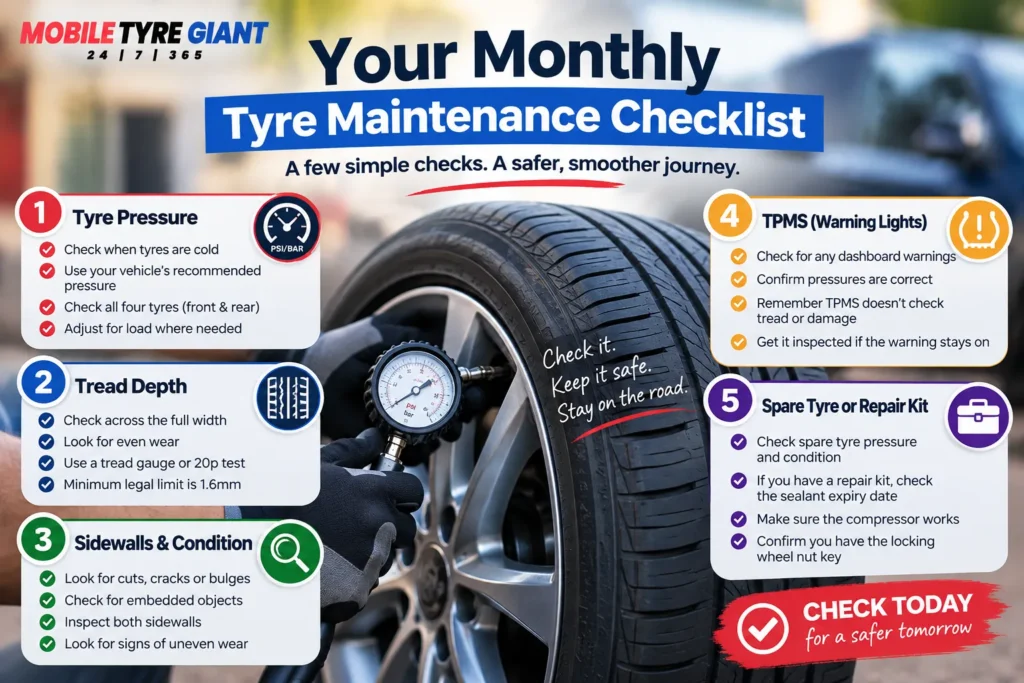
Check Tyre Pressure When the Tyres Are Cold
Tyre pressure is one of the simplest checks to perform, but it is also one of the easiest to do incorrectly. The recommended pressure should come from the vehicle manufacturer’s information, which may be shown in the handbook, inside a door opening, or around the fuel filler area depending on the vehicle. Do not assume every car should run the same PSI or bar reading. Front and rear pressures can differ, and the recommendation may change when the vehicle is heavily loaded. A family car carrying four passengers and luggage for a motorway trip may require a different setting from the same car carrying one person around town. Use a reliable gauge and check each tyre rather than assuming they have all changed by the same amount.
Pressure should also be viewed as a pattern rather than a single number taken once a month. If three tyres remain close to their expected readings while one repeatedly falls noticeably lower, that difference matters. Continually adding air may hide the symptom without dealing with its cause. Slow punctures, valve problems, wheel sealing issues, and physical tyre damage can all lead to repeated pressure loss. If you find yourself reaching for the inflator every few days, a professional mobile tyre repair assessment may be more useful than another temporary top-up. Regular pressure checks are meant to reveal problems, not become a way of living with them.
Should Tyre Pressure Be Checked Hot or Cold?
Tyre pressure should normally be checked when the tyres are cold. Driving creates heat in the tyre, and that heat can raise the pressure reading, which makes a recently driven tyre a poor reference for routine adjustment. Ideally, check the tyres before setting off or after the vehicle has been parked long enough for them to cool. That gives you a more consistent reading against the manufacturer’s cold-pressure recommendation. It is similar to weighing yourself at the same time of day rather than comparing one reading before breakfast with another after dinner. Consistency makes the number more useful.
If you stop after a long journey and notice the pressure is higher than the cold recommendation, do not automatically release air simply to bring the hot reading back to that figure. The tyre has warmed during driving, so a higher reading can be expected. Let the tyres cool and check them again under comparable conditions. This is especially useful when you are trying to monitor a suspected slow pressure loss over several days. Use the same gauge where possible and check under similar conditions, because changing both the equipment and the circumstances can make small differences difficult to interpret. What matters is identifying a repeatable pattern rather than reacting to one isolated reading.
Measure Tyre Tread Depth and Look for Uneven Wear
Tread depth needs more than a quick glance at the most visible part of the tyre. For most cars, the legal minimum tread depth is 1.6mm across the central three-quarters of the tyre and around its entire circumference. That means a tyre should be checked at several points rather than measured in one convenient groove. A tread depth gauge gives a clearer measurement, while the familiar 20p check can provide a quick indication when used correctly. Turn the steering where appropriate so the front tread is easier to inspect, and look across the width rather than only at the centre. A tyre can appear healthy from one angle while showing much heavier wear elsewhere.
The wear pattern can be just as informative as the remaining tread depth. Excess wear on one shoulder, both shoulders, or the centre of the tyre can point towards an issue that deserves investigation, although appearance alone should not be used to diagnose the exact cause. Pressure, alignment, suspension condition, driving use, and other factors can all influence how a tyre wears. Compare tyres on the same axle and look for changes from one monthly check to the next. If a section is wearing unusually quickly, do not simply wait until the whole tyre reaches the legal minimum. Finding out why the wear is happening can help prevent the same pattern appearing again on a replacement tyre.
Inspect the Sidewalls and Tread for Cuts, Cracks and Bulges
A tread measurement can tell you how much rubber remains, but it cannot tell you whether the entire tyre is physically healthy. Slowly run your eyes around the visible sidewall and tread, looking for fresh cuts, cracking, swelling, exposed material, nails, screws, or unusual distortion. A bulge is particularly important because it can indicate that the tyre structure has been damaged beneath the surface. Kerbs and potholes can sometimes cause damage even when the tyre does not immediately go flat. If you remember hitting something hard, use that event as a reason to inspect the tyre rather than waiting for the next calendar date. Fresh damage is a trigger for an extra check.
Embedded objects also need sensible handling. A nail or screw in the tread does not always produce an immediate flat tyre, and pulling it out yourself can sometimes turn a slow leak into a much faster one. Leave the object in place until the tyre can be assessed if the vehicle is safely parked and the tyre still holds pressure. Damage around the sidewall or shoulder generally raises different concerns from a small puncture in an appropriate tread area, which is why visual inspection alone cannot confirm that a tyre is repairable. The important monthly habit is recognising that something has changed. Once you spot that change, the next step is proper assessment rather than guessing from appearance.
Check TPMS Without Relying on It as Your Only Inspection
A tyre pressure monitoring system can be helpful because it alerts you when the system detects a pressure-related issue, but it does not replace a manual tyre inspection. TPMS cannot measure tread depth for you, inspect the sidewall for cuts, or tell you whether a nail is sitting in the tread. A driver who waits only for a warning light may therefore miss other forms of tyre wear or damage. Use the system as another source of information rather than as your entire maintenance routine. During your monthly check, make sure there are no unexplained tyre pressure warnings and compare the actual pressures with the manufacturer’s recommendation. If the warning disappears after correct inflation, continue monitoring the tyre for further loss.
A warning that remains or repeatedly returns after pressures have been checked deserves investigation. Depending on the vehicle, a sensor or valve issue can sometimes be involved rather than the tyre pressure itself. Do not assume that every warning means the tyre needs replacing, but do not cover the warning and forget about it either. Some vehicles also require a reset or recalibration procedure after tyre pressures have been corrected, so the vehicle handbook is useful here. Where the problem relates to the valve or monitoring hardware, a dedicated TPMS valve replacement service can address the faulty component. The useful rule is simple: trust the warning enough to investigate it, but not enough to stop checking the tyre yourself.
Check the Spare Tyre or Puncture Repair Kit
The spare tyre is easy to forget because it may spend months or years hidden beneath a boot floor without being used. Unfortunately, an unused tyre can still lose pressure or deteriorate over time. If your vehicle carries a spare, include it in the monthly routine by checking its pressure and visible condition. Space-saver tyres can have different pressure requirements from the road tyres, so use the vehicle manufacturer’s information rather than assuming the same setting applies. Make sure you also know where the jack, wheel brace, and locking wheel nut key are stored if the vehicle is supplied with them. Discovering that the key is missing at the roadside turns a simple tyre problem into a much more frustrating one.
Many newer vehicles use a compressor and sealant kit instead of a spare wheel. If that describes your car, check that the kit is actually present and that the sealant has not passed its stated expiry date. Read the instructions before an emergency rather than trying to understand tiny print beside a dark roadside. Remember that these kits are designed for limited situations and cannot repair every form of tyre damage. A split sidewall, major structural failure, or severely damaged tyre needs a different solution. Your monthly tyre maintenance checklist should therefore include not only the tyres touching the road, but also the equipment you would depend on if one of them suddenly could not continue the journey.
Seasonal Tyre Maintenance for UK Drivers
A good tyre maintenance schedule should change slightly with the seasons because your tyres do not experience the same conditions all year. Spring can reveal damage left by winter potholes, while summer often brings longer journeys, heavier loads, and motorway driving. Autumn usually means wetter roads and falling temperatures, and winter adds colder conditions that make pressure and tread checks especially important. None of this means you need four completely different maintenance routines. The basic checks remain pressure, tread, condition, and unusual wear. What changes is where you place the most attention.
Seasonal checks are also a useful opportunity to compare how the tyres have changed since your previous inspection. A mark that looked harmless in June may have developed by September, while a tyre that previously wore evenly may begin showing more wear on one shoulder. Treat each season like a progress photo rather than starting the inspection from zero. Look at all four tyres in similar light and compare them carefully. If one tyre looks noticeably different from the others, investigate the reason rather than assuming seasonal weather alone is responsible. This simple habit makes seasonal tyre maintenance far more useful than checking boxes on a calendar.

What Should You Check in Spring?
Spring is a sensible time to look closely for damage that may have developed during colder months. Winter roads can include potholes, broken surfaces, standing water, and repeated kerb contact when visibility is poor. Inspect the sidewalls and tread for cuts, bulges, cracking, or anything that appears different from your previous monthly check. Pay particular attention if you remember hitting a deep pothole during winter. A tyre may continue holding pressure even when the wheel or tyre has suffered impact-related damage. Steering that suddenly feels different is another reason to investigate sooner.
Spring is also a useful time to compare tread wear across all four tyres. Look at the inner, centre, and outer sections rather than judging condition from the most visible edge. If one shoulder is disappearing noticeably faster, do not automatically blame the tyre itself. Incorrect pressure, alignment, suspension issues, or other mechanical factors may influence the wear pattern. Run your hand visually along the tread rather than relying only on one measurement point. If the car has developed vibration or changed steering behaviour after a winter impact, include that information when arranging a professional inspection.
What Should You Check in Summer?
Summer often changes how the car is used rather than changing the basic rules of tyre care. Family holidays, airport trips, motorway journeys, and weekends away can mean more passengers and a boot packed tightly with luggage. Before a heavily loaded trip, check the manufacturer’s recommended tyre pressures for that load instead of automatically using the everyday setting. Measure them while the tyres are cold and inspect the tread and sidewalls at the same time. A tyre already showing damage or repeated pressure loss should be investigated before a long journey. Several hours of motorway driving is not the right environment for testing whether a suspicious tyre will be fine.
Long trips also make small problems much easier to notice. You may feel a vibration at motorway speed that was barely noticeable on short local journeys, or realise the steering no longer feels as smooth as it previously did. Do not assume every vibration is caused by the tyre, because wheel balance, wheel damage, alignment, and other components can also contribute. What matters is recognising that something has changed. If the steering wheel begins to shake consistently at certain speeds, a professional mobile wheel balancing check may help determine whether imbalance is involved. The goal is diagnosis rather than simply learning to tolerate the vibration.
What Should You Check in Autumn?
Autumn is the point where tread condition becomes especially difficult to ignore. UK roads can become consistently wet, darker journeys become more common, and falling leaves can make already damp surfaces slippery. Check tread depth across several parts of each tyre rather than concentrating on one easy-to-reach groove. Look for uneven wear while you are there, particularly if the tyres have covered substantial mileage through spring and summer. Check pressure again as temperatures begin changing because the readings you saw during warmer months may not remain identical. Use the manufacturer’s cold-pressure recommendation rather than guessing what feels right.
Autumn is also a good time to inspect sidewalls for damage that may have developed during summer travel. Long journeys, unfamiliar roads, parking against kerbs, and heavily loaded trips can all expose tyres to conditions different from normal commuting. Compare the four tyres rather than looking at each one in isolation. If one tyre repeatedly needs more pressure than the others, do not dismiss it as simply the weather changing. Temperature can influence tyre pressure, but persistent loss from one tyre deserves investigation. The seasonal check should help separate normal changes from patterns that keep returning.
What Should You Check in Winter?
Winter tyre maintenance should start with the same fundamentals: correct pressure, sufficient tread, and tyres free from obvious defects. Colder conditions make it particularly important to check pressure regularly rather than relying on a reading taken weeks earlier. Wet, icy, or slushy roads also make good tread condition increasingly important because the tyre needs to move water and maintain contact with the road surface. Inspect the tread across its width and look for damage after significant pothole or kerb impacts. If the car has been parked for several days during very cold weather, check the tyres before a longer journey. Do not assume the TPMS warning light is the only sign worth watching.
Winter is also a useful time to become more sensitive to changes in how the car behaves. New vibration, pulling, repeated pressure loss, or unusual road noise should not be ignored simply because roads are colder or rougher. Weather can explain some changes, but it should not become a convenient explanation for every new symptom. If a tyre looks visibly damaged, inspect it properly rather than waiting for spring. Your normal monthly checks should continue through winter rather than being replaced by one seasonal inspection. Seasonal maintenance adds extra attention to the regular routine, it does not replace it.
Do UK Drivers Need Winter Tyres?
For ordinary passenger cars, winter tyres are not generally a legal requirement in the UK. Whether they make sense depends on where you drive, the conditions you regularly encounter, your mileage, and the type of journeys you make. Someone regularly travelling through areas that experience colder, snowier conditions may make a different choice from a driver mainly making short urban journeys in milder weather. All-season tyres are another option some motorists consider where they want one set designed to handle a wider range of conditions. The important point is to choose tyres suitable for the vehicle and intended use rather than assuming every UK driver needs the same setup.
If you do switch between seasonal sets, inspection should happen before the tyres go back onto the car. Check tread, sidewall condition, tyre age, and any signs of damage that may have occurred before storage. Storage conditions also matter because tyres should not simply be thrown into a damp corner and forgotten for half the year. Make sure the correct tyre positions, direction of rotation, and manufacturer guidance are followed when refitting. Seasonal tyre changes are therefore another useful inspection opportunity. They should never become a simple swap where nobody looks closely at the tyre itself.
What Should Be Included in an Annual Tyre Inspection?
An annual tyre inspection should look beyond the things you can measure quickly with a gauge. Monthly checks are excellent for pressure, tread, and visible damage, but a yearly review allows you to consider the bigger picture. Look at how quickly the tyres have worn over the previous year, whether the wear is even, and whether the car has developed vibration or steering changes. Consider how much mileage the vehicle has covered and whether its use has changed. A car that recently began doing long motorway journeys may place different demands on its tyres from one mostly used for short local trips. The annual inspection is therefore about trends rather than one isolated reading.
It is also worth remembering that an annual MOT does not remove the driver’s responsibility to keep the vehicle roadworthy throughout the year. A tyre can develop damage the day after a successful MOT, and tread can continue wearing every time the vehicle moves. Use the annual tyre review as an additional maintenance milestone rather than treating the MOT certificate as twelve months of tyre protection. Compare current tread readings with older ones if you have recorded them. Look at pressure history if one tyre has needed repeated adjustment. Those patterns can reveal more than a single inspection performed once a year.
Check Tyre Age as Well as Tread Depth
Tyre condition is not determined by tread depth alone. Rubber ages, and a low-mileage car can therefore have tyres that look deeply treaded but have still spent many years exposed to temperature changes, sunlight, and normal environmental ageing. Check the manufacturing date marking on the tyre sidewall so you know how old the tyre actually is. The last four digits of the date code identify the week and year of manufacture. For example, a code ending in 2423 indicates production during week 24 of 2023. Age should then be considered alongside physical condition and manufacturer guidance.
Be careful with simplistic claims that every private-car tyre becomes illegal as soon as it reaches a particular age. UK tyre-age legislation specifically applies a 10-year restriction to certain heavier goods and passenger vehicles, not as a blanket maximum-age law for every private car tyre. That does not mean an old private-car tyre should automatically be considered healthy. Cracking, deterioration, damage, repeated pressure problems, and manufacturer recommendations still matter. If age or condition is making replacement uncertain, our guide on when to replace tyres explains the wider signs that should be considered. The sensible approach is inspection based on condition and guidance, not a made-up universal expiry date.
Can Uneven Wear Point to Alignment or Balancing Problems?
Uneven tyre wear is a clue, not a complete diagnosis. A tyre wearing heavily on one side can sometimes be associated with alignment, while patchy wear or vibration may raise questions about wheel balance. Incorrect tyre pressure, suspension condition, braking issues, and driving patterns can also influence how tread wears. That is why simply looking at a worn tyre cannot always tell you the exact cause. Compare the wear across tyres and note whether the car also pulls, vibrates, or feels different through the steering. The combination of symptoms gives a technician much more useful information.
The annual review is a good opportunity to investigate a wear pattern before fitting another tyre and repeating the same problem. Replacing worn rubber without understanding the reason it wore unevenly can address the visible result while leaving the underlying cause untouched. If the steering is smooth and the wear is even, there is no reason to invent a balancing problem simply because twelve months have passed. Alignment and balancing are better treated as condition and symptom-led checks rather than automatic annual replacements. Pay attention to what the tyres and vehicle are actually telling you. Preventative maintenance works best when it responds to evidence rather than arbitrary dates.
How Often Should You Rotate Your Tyres?
Tyre rotation means moving tyres between positions to help manage differences in wear, but there is no single rotation rule that suits every vehicle. Some manufacturers specify rotation intervals, while certain vehicles use different tyre sizes between the front and rear axles. Directional tyres must also maintain their intended direction of travel, which affects how positions can be changed. Front-wheel drive, rear-wheel drive, and all-wheel drive vehicles may create different wear patterns. This is why copying a generic mileage figure from another driver’s maintenance routine can be misleading. Start with the vehicle handbook and tyre manufacturer’s instructions.
Rotation can be useful where the vehicle and tyre configuration allows it, particularly when the aim is to manage uneven wear rates between axles. It should not be used to hide abnormal wear caused by another fault. If one tyre is wearing strangely, investigate the cause before simply moving it somewhere else on the car. Also remember that tyre pressures may need to be adjusted after positions change where front and rear specifications differ. A professional can also confirm whether directional, asymmetric, or staggered tyres allow the rotation pattern you have in mind. The best rule is simple: rotate when appropriate for the vehicle, not because every car has reached the same calendar date.
Tyre Problems That Should Not Wait Until Your Next Scheduled Check
A tyre maintenance schedule gives you a reliable routine, but tyres do not wait politely for the first weekend of the month before developing a problem. A sudden pressure drop, new vibration, visible bulge, deep cut, or unusual tread wear should move the inspection forward immediately. The same applies after a heavy pothole or kerb impact, particularly if the steering begins to feel different afterwards. Think of the schedule as your normal health check rather than permission to ignore symptoms between appointments. A tyre can look perfectly normal during one inspection and suffer damage the following day. What matters is recognising when something has changed and responding to that change.
Drivers sometimes continue using a suspicious tyre because it has not gone completely flat. That is not a reliable way to judge condition. Some tyre problems develop gradually, while others involve damage that cannot be assessed simply by looking at how much air remains inside. Your routine checks should help establish what normal looks like, making new symptoms easier to notice. Listen to the car, watch the pressure readings, and look closely at the tyres whenever the vehicle behaves differently. A warning sign should trigger investigation rather than become something you plan to revisit next month.
Why Does One Tyre Keep Losing Pressure?
A tyre that repeatedly loses more pressure than the others deserves attention. Small pressure changes across all four tyres can happen as temperatures and driving conditions change, but one tyre consistently dropping while the others remain stable suggests there may be another cause. Possibilities include a slow puncture, leaking valve, sealing issue between the tyre and wheel, wheel damage, or another form of tyre deterioration. Recording the pressure over several checks can help reveal the pattern. Try to use the same pressure gauge and check when the tyres are cold so the readings are easier to compare. Continually adding air may keep the tyre usable temporarily, but it does not explain why the pressure is disappearing.
The useful question is not simply, “Can I put more air in?” but, “Why does this tyre need more air again?” If a tyre loses pressure soon after being inflated correctly, arrange an assessment rather than building repeated top-ups into your normal routine. Avoid pulling out a visible nail or screw yourself because the object may currently be slowing the air loss. If the tyre is already badly deflated, visibly damaged, or unsafe to drive on, do not continue the journey simply to reach a garage. The maintenance schedule has done its job once it reveals the problem. From that point, diagnosis becomes more important than the calendar.
What Should You Do If You Find a Bulge, Cut or Serious Sidewall Damage?
A visible bulge should be treated very differently from normal surface marks on a tyre. A lump or bulge can indicate structural damage inside the tyre, particularly after a pothole or kerb impact. Deep cuts, exposed internal material, or obvious structural deformation also deserve prompt professional attention. Do not press aggressively on the damaged area, try to glue it, or assume that maintaining pressure proves the tyre is safe. Tyres carry the vehicle’s weight while flexing continuously as they rotate, so damage beneath the outer rubber can matter even when the tyre has not deflated. If you are uncertain about significant sidewall damage, avoid taking unnecessary risks with further driving.
Sidewall damage also differs from the type of small tread puncture that may sometimes be repairable after proper inspection. A technician needs to consider where the damage is located, how severe it is, and whether the tyre’s internal structure has been affected. Where the tyre is beyond safe repair, mobile tyre replacement can provide a replacement at the vehicle’s location instead of requiring you to drive on a tyre you are concerned about. The important lesson is that damage should be assessed according to its condition, not according to how close you are to the next scheduled maintenance date. A monthly checklist helps find problems, but it cannot make structural damage safe.
What Does New Steering-Wheel Vibration Mean?
A steering wheel that begins vibrating when the car previously drove smoothly deserves investigation. Wheel imbalance is one possible cause, but it is not the only one. A damaged wheel, tyre deformation, uneven wear, alignment problems, or suspension-related faults can sometimes produce similar symptoms. Pay attention to when the vibration occurs because that information may help during diagnosis. For example, a vibration that becomes noticeable at certain road speeds is useful information to pass on to a technician. Do not automatically assume a new vibration is simply the road surface if it appears repeatedly on different roads.
Your annual and monthly tyre checks provide a useful reference because you may already know whether the tread has been wearing evenly. If vibration appears alongside unusual wear or after a pothole impact, those details should be considered together rather than separately. Avoid trying to diagnose the exact mechanical cause from a tread pattern or steering sensation alone. Instead, treat the vibration as evidence that something has changed and needs checking. Continuing to drive for months while becoming accustomed to the shaking defeats the purpose of preventative maintenance. Early investigation is usually more useful than waiting until another symptom appears.
What Should You Do About Rapid or Uneven Tyre Wear?
Uneven tyre wear is easy to overlook when only the visible outer edge of the tyre gets checked. The inner shoulder may be wearing more quickly, or one tyre may be losing tread significantly faster than its partner on the same axle. Incorrect pressure can contribute to unusual wear, but alignment, suspension condition, wheel balance, and vehicle use can also be involved. This is why a tyre maintenance checklist should include comparing the entire tread pattern where it can be inspected safely. Measure at several points and note whether the pattern changes between monthly checks. A tread gauge and a few recorded measurements can make gradual changes easier to spot.
Do not respond to rapid wear by simply replacing the tyre and forgetting about the cause. If an underlying problem remains, a new tyre may begin developing the same pattern. Tell the technician what you have noticed, including any steering pull, vibration, recent impact, or history of incorrect pressure. These details provide useful context for the inspection. Preventative tyre care is not only about keeping enough tread on the car. It is also about understanding why the tread is disappearing in the way it is. That approach can help you make better replacement and maintenance decisions over the longer term.
When Should Tyres Be Replaced Rather Than Monitored?
Tyre replacement should be based on condition, legality, and safety rather than one isolated factor. For most cars and light vans in the UK, the legal minimum tread depth is 1.6mm across the central three-quarters of the tread and around the entire circumference. However, a tyre can require attention before reaching that limit if it develops serious physical damage. Structural bulges, exposed cords, major deterioration, or damage that cannot be safely repaired should not be ignored simply because plenty of tread remains. Repeated pressure loss and abnormal wear can also lead to a professional assessment of whether repair or replacement is appropriate. Tread depth is important, but it is not the whole tyre.
Replacement decisions should also account for how the tyre fits into the rest of the vehicle setup. Correct tyre size, specification, load capability, and manufacturer requirements all matter when a new tyre is selected. Avoid buying purely on price without checking that the tyre is suitable for the vehicle. If one tyre needs replacement, the condition and tread of the other tyres should also be inspected so you understand the overall picture. That does not automatically mean all four tyres need changing. Good maintenance is about replacing what genuinely needs replacement while keeping the rest of the vehicle safe and correctly matched.
Can You Wait Until Your MOT to Check Your Tyres?
No. An MOT certificate confirms that the vehicle met the required test standards at the time of the inspection, but it does not guarantee that the tyres will remain roadworthy until the next test. A tyre can pick up a nail, suffer a pothole impact, lose pressure, or develop a bulge shortly after an MOT. Tread also continues wearing every time the vehicle is driven. Waiting for the next annual test could therefore mean ignoring a developing tyre problem for months. Routine driver checks are necessary throughout the year regardless of when the MOT is due.
This is why weekly, monthly, seasonal, and symptom-triggered checks all have a place in a sensible tyre maintenance schedule. The MOT should be viewed as another inspection point rather than the only time somebody looks closely at your tyres. If you notice damage or unusual behaviour, deal with it when it appears. A current MOT does not make a damaged tyre safe to continue using. Regular checks allow you to identify changes much earlier and take the appropriate action before the next annual test arrives.
A Simple Tyre Maintenance Routine You Can Actually Follow
The best maintenance routine is one you will genuinely remember. Check pressures regularly when the tyres are cold, then choose one consistent day each month for the fuller inspection. Look at tread depth, sidewalls, unusual wear, TPMS warnings, and the spare tyre or repair equipment. Before a long journey, repeat the important checks and consider whether extra passengers or luggage require a different manufacturer-recommended pressure. Review the tyres again as the seasons change and use the annual inspection to look at age and longer-term wear patterns. If something changes between scheduled checks, investigate it then rather than waiting.
Making the routine easy can help it become a normal part of vehicle ownership. Keep a reliable pressure gauge or inflator somewhere accessible instead of buried beneath boxes in the garage. Set a recurring phone reminder if you regularly forget the monthly inspection. Record pressures or tread measurements when you are monitoring a developing issue so you can compare them rather than relying on memory. The entire process should feel more like checking smoke alarms than carrying out a mechanical service. Small, consistent checks are easier to maintain than waiting until a tyre problem forces you to pay attention.
Final Words: Keep Small Tyre Problems From Becoming Bigger Ones
A practical tyre maintenance routine does not require you to inspect every component of the wheel every morning. What matters is combining simple regular checks with the judgement to act when something changes. Pressure deserves regular attention, tread and physical condition belong in the monthly check, seasonal inspections help account for changing driving conditions, and the annual review lets you look at age and longer-term wear. None of those intervals should stop you checking sooner after an impact, warning light, repeated pressure loss, or new vibration. The calendar gives you structure, while the symptoms tell you when that structure needs to be interrupted.
The biggest benefit of routine checks is knowing your tyres well enough to recognise when something is different. A pressure reading that suddenly changes, a new bulge, rapidly disappearing tread, or unfamiliar vibration becomes much easier to notice when you already have a baseline. If your inspection identifies a tyre that needs professional attention or replacement, mobile tyre fitting allows the work to be carried out at your location rather than requiring you to keep driving on a tyre you are concerned about. Keep the routine simple, check consistently, and treat new warning signs as information worth acting on.
Found a Tyre Problem During Your Check?
If your tyre shows damage, pressure loss or unsafe wear, arrange professional mobile tyre help before the problem gets worse.
Frequently Asked Questions
Find quick answers to the most common questions our customers ask.
Check tyre pressures regularly, with the Highway Code recommending weekly checks, before journeys, and when the tyres are cold. A fuller inspection of pressure, tread, sidewall condition, visible damage, TPMS warnings, and the spare tyre or repair kit should form part of a monthly routine. Additional checks are sensible before long journeys, after significant pothole or kerb impacts, and whenever the car develops new vibration, pressure loss, or unusual tyre wear.
Tyre pressure should ideally be checked weekly when the tyres are cold, while the monthly check should be treated as the more detailed tyre inspection. During the monthly inspection, check pressure alongside tread depth, wear patterns, cuts, bulges, embedded objects, and other visible damage. Thinking of weekly checks as the quick routine and monthly checks as the deeper inspection makes the schedule easier to follow.
Tyre pressure should normally be checked when the tyres are cold because driving heats the tyre and can increase the pressure reading. Checking under similar cold conditions makes it easier to compare the result with the vehicle manufacturer's recommended pressure. If the tyres are hot after a journey, do not automatically release air simply because the reading is higher than the stated cold pressure.
For most cars and light vans in the UK, the legal minimum tread depth is 1.6mm across the central three-quarters of the tyre's tread and around the entire circumference. Check several points because tread can wear unevenly rather than reaching the limit everywhere at the same time. The tyre must also be free from defects that make it unsafe, so legal tread depth alone does not prove that the tyre is in good condition.
No. A tyre pressure monitoring system is useful for alerting you to certain pressure-related problems, but it does not replace manual pressure and condition checks. TPMS cannot inspect tread depth, sidewall cracking, bulges, embedded objects, or uneven wear. Continue checking pressures with a reliable gauge and visually inspect the tyres even when there is no warning light on the dashboard.
Repeated pressure loss from one tyre can have several possible causes, including a slow puncture, valve problem, sealing issue between the tyre and wheel, damaged wheel, or physical tyre damage. Temperature can affect pressure, but one tyre consistently losing more air than the others deserves investigation. Keep track of the readings under similar cold conditions and arrange an assessment rather than making repeated top-ups part of your normal routine.
No. Tyre rotation depends on the vehicle, drivetrain, wheel sizes, tyre design, and manufacturer guidance. Directional tyres, staggered front and rear sizes, and other configurations can restrict how tyres may be moved between positions. Check the vehicle handbook rather than assuming every car should follow the same mileage or annual rotation schedule, and do not use rotation to disguise abnormal tyre wear caused by another problem.
Tyre pressure can change as ambient temperatures rise or fall, which is why seasonal changes are a useful reminder to take another pressure reading. Do not guess how much air should be added simply because the weather has become colder or warmer. Check the tyres when cold and adjust them to the vehicle manufacturer's recommended pressure for the normal or loaded condition in which the vehicle will be used.
There is no blanket UK rule that makes every private-car tyre automatically illegal at one fixed age, so tyre age should be considered alongside condition and manufacturer guidance. Check the manufacturing date code and pay attention to cracking, deterioration, repeated pressure problems, or other signs of ageing. Older tyres may benefit from professional inspection even when they still have substantial tread because tread depth alone does not describe the complete condition of the tyre.
No. Your tyres can lose pressure, wear, pick up punctures, or suffer impact damage at any point between annual MOT tests. A valid MOT certificate reflects the vehicle's condition at the time it was tested and does not remove the need for routine roadworthiness checks afterwards. Regular weekly and monthly tyre checks are therefore important throughout the year, with additional inspections whenever something changes.