

Tyre upsizing can make a car look sharper and may change how it feels on the road, but bigger is not automatically better. The important point is that changing tyre size affects more than the appearance of the wheel. Width, sidewall height, rim diameter and the complete rolling diameter all work together. Change one measurement carelessly and the result can affect comfort, steering or vehicle clearance. A well-planned setup feels deliberate, while a badly chosen one can feel wrong almost immediately.
For UK drivers, tyre upsizing should therefore start with understanding the dimensions rather than choosing the largest wheel that looks good. Think of it like changing footwear for a long walk: a more aggressive design may look better, but the wrong fit quickly becomes uncomfortable. The same principle applies to wheels and tyres. Before considering an alternative setup, it is worth checking the correct tyre size for your car and understanding what each number on the sidewall represents. Once those basics are clear, the benefits and trade-offs of upsizing become much easier to judge.
What Is Tyre Upsizing?
Tyre upsizing means changing from the vehicle’s original tyre or wheel dimensions to a larger or wider alternative. It does not always mean fitting a physically taller tyre. In many cases, the wheel diameter increases while the tyre sidewall becomes shallower. The aim is often to retain a similar complete rolling diameter while changing the wheel and tyre proportions. This approach can alter appearance and steering feel without dramatically changing the height of the complete wheel-and-tyre assembly.
A typical example would be moving from a smaller alloy wheel with a taller tyre sidewall to a larger alloy with a lower-profile tyre. The wheel looks bigger, but the outside diameter of the tyre may remain relatively close to the original specification. Wider tyres can also be used in some setups, although tyre width has to suit the wheel and vehicle. Tyre upsizing therefore needs to be considered as a complete fitment rather than a single number change. Drivers comparing options should also understand how width, profile and rim diameter interact before ordering replacement tyres.
Wider Tyres on the Same Wheel
Fitting a wider tyre does not necessarily mean increasing the wheel diameter. A driver might keep the same 17-inch wheel but consider a wider tyre that is compatible with the rim. Visually, the tyre may appear fuller across the wheel and could provide a different steering feel. However, simply choosing a wider number because it physically fits around the wheel is not enough. Rim width, tyre profile and available space around the suspension and wheel arch still matter.
A wider tyre can also change the shape of the tyre’s footprint on the road, but this should not be confused with guaranteed extra grip. Tyre compound, pressure, tread design and road conditions remain extremely important. Imagine swapping from ordinary trainers to wider shoes: there may be more material underneath you, but that alone does not guarantee better traction on a wet floor. The same caution applies when comparing tyre widths. When choosing an alternative, the goal should be compatibility and balanced performance rather than simply fitting the widest tyre available.
Larger Wheels With Lower-Profile Tyres
This is the form of upsizing many drivers picture first. The wheel diameter increases, while a lower-profile tyre is used to prevent the complete wheel-and-tyre assembly becoming excessively large. A 17-inch setup might therefore be replaced with an 18-inch combination using a shallower sidewall. From the kerb, the larger alloy becomes more prominent and the car can look noticeably sportier. Behind the appearance change, however, the tyre is also losing some of the rubber cushioning between the road and wheel.
That lower sidewall can make steering inputs feel more immediate because there is generally less sidewall movement. The trade-off is that bumps and sharp road imperfections may also feel more noticeable inside the car. On a smooth road the setup can feel crisp, while a broken surface can expose the difference quickly. This is why factory wheel options often pair each larger rim with a carefully selected tyre profile. If you are comparing different combinations, a broader guide to choosing the right tyres for your car can help put size alongside grip, efficiency and everyday driving needs.
Increasing the Complete Tyre Diameter
Increasing the complete tyre diameter is different from simply fitting a larger wheel with a lower-profile tyre. In this case, the outside circumference of the tyre itself becomes larger. That means each wheel revolution can cover a different distance compared with the original setup. It can also move the tyre closer to the wheel arch, suspension or other nearby components. This is where a visually small size change can create a much bigger mechanical difference than expected.
For example, increasing wheel diameter and keeping a similar tyre profile can make the entire assembly noticeably taller. The car may sit slightly differently, and clearance that looked generous when parked may reduce as the suspension moves or the steering turns. Rolling circumference can also become important because the vehicle was designed around particular wheel-speed relationships. Tyre upsizing should therefore never be judged only by whether the new wheel can physically bolt onto the car. The complete tyre dimensions and vehicle compatibility need to make sense together.
Is Tyre Upsizing the Same as Plus Sizing?
Tyre upsizing and plus sizing are closely related, but they are not always identical. Plus sizing normally describes increasing wheel diameter while reducing tyre sidewall height so the overall tyre diameter stays relatively similar. Tyre upsizing is a broader term and can also describe increasing tyre width or moving to another alternative specification. Understanding that difference prevents one of the most common sources of confusion when drivers compare wheel sizes online. A bigger number printed on the wheel does not automatically mean the complete tyre has become bigger.
You may also see terms such as Plus Zero, Plus One or Plus Two when researching alternative sizes. Plus Zero generally refers to increasing tyre width without increasing wheel diameter, while Plus One or Plus Two describe progressively larger wheel diameters paired with suitable tyre profiles. The exact dimensions still need to suit the specific vehicle rather than being chosen from a generic rule. This is why tyre upsizing works best when the complete specification is considered together. Wheel diameter is only one part of the equation.

Why Do Drivers Upsize Their Tyres?
Appearance is one of the biggest reasons drivers consider tyre upsizing. Larger wheels can fill the wheel arches more visibly and give some cars a cleaner or more purposeful stance. Performance-oriented trim levels also often use larger alloys, which can make an upsized setup feel like a natural visual upgrade. Other drivers are more interested in steering response and the firmer feel associated with lower-profile tyres. In both cases, the motivation is usually a mixture of how the car looks and how it feels from behind the wheel.
There are also practical situations where a driver may be comparing alternative manufacturer-approved wheel and tyre combinations rather than creating a custom modification. The same vehicle model can sometimes be offered from the factory with several different wheel sizes. That does not mean every larger size is automatically interchangeable, but it shows why the question is more nuanced than simply staying with one wheel diameter forever. Availability can matter too, especially when comparing different tyre brands, specifications and budgets. Checking the available tyre brands and sizes before committing to an unusual setup can prevent an awkward search for replacements later.
What Are the Potential Benefits of Tyre Upsizing?
A correctly planned upsized setup can provide several benefits, depending on the vehicle and the tyres chosen. The most obvious is visual, because a larger wheel with a lower-profile tyre can give the car a more modern or performance-focused appearance. Steering can also feel sharper because a shorter sidewall generally flexes less during direction changes. Some drivers enjoy that firmer, more immediate connection with the road, especially on smooth surfaces. Wider tyre options may also become available with certain wheel combinations, although width alone should never be treated as a guarantee of better grip.
The important word is correctly. Tyre upsizing does not transform an ordinary tyre into a performance tyre, and a poor-quality wider tyre may perform worse than a well-designed standard-size option. Think of the wheel and tyre as a team rather than separate upgrades. Wheel weight, tyre construction, pressure, suspension setup and road conditions all influence the final result. The best upsized setup is therefore one that improves the characteristics the driver actually values without creating unnecessary compromises elsewhere.
What Are the Risks of Tyre Upsizing?
Tyre upsizing can work well when the new wheel and tyre combination has been properly matched to the vehicle, but a poorly planned setup can introduce several problems. One of the most noticeable is reduced ride comfort, particularly when a larger wheel requires a much lower-profile tyre. With less sidewall between the rim and the road, sharp bumps can feel more pronounced through the cabin. Larger or wider wheel-and-tyre packages can also be heavier, which may affect how quickly the suspension responds to uneven surfaces. Clearance is another concern because a wider or taller tyre may sit closer to the wheel arch, suspension components or inner bodywork. What looks fine while the car is parked may behave differently when the steering is turned or the suspension compresses.
Running costs can change as well. Larger wheels often use tyre sizes that cost more to replace, and some unusual sizes may offer fewer choices when you need a tyre urgently. Wider tyres can also influence road noise, steering feel and fuel consumption depending on their construction and the vehicle. The biggest mistake is assuming that because a wheel physically bolts onto the hub, the complete setup must be suitable. Tyre width, rim width, rolling diameter, wheel offset, load capability and available clearance all need to work together. A sensible upgrade is one that preserves the vehicle’s everyday usability rather than sacrificing comfort or reliability purely for appearance.
Do Wider Tyres Actually Give You More Grip?
Wider tyres can change how a vehicle feels on the road, but they do not automatically create more grip in every situation. Grip depends heavily on the tyre compound, tread pattern, temperature, tyre pressure, road surface and the way the suspension keeps the tyre in contact with the road. A high-quality standard-width tyre can therefore outperform a wider but lower-quality tyre. Width changes the shape of the contact area, but that is only one part of the overall traction equation. On a dry road, a suitable wider performance tyre may provide useful benefits for some vehicles, particularly during cornering. On wet roads, however, the relationship becomes more complicated because water needs to be cleared effectively from beneath the tread.
This is why tyre choice matters at least as much as tyre width. Imagine two pairs of shoes, one wider but with a hard, smooth sole and another slightly narrower with a soft, grippy tread. The wider pair is not automatically the safer one on a wet pavement. Tyres behave in a similar way, although the engineering is far more complex. Drivers who regularly face heavy rain should pay attention to wet braking, tread design and aquaplaning resistance rather than focusing only on width. Our guide to what matters when choosing tyres for wet weather explains these factors in more detail. Upsizing should therefore be treated as part of the complete tyre decision, not as a shortcut to better grip.
How Can Tyre Upsizing Affect Braking?
Changing tyre size can influence braking behaviour, but there is no simple rule saying that a wider tyre always stops a car sooner. The tyre still has to generate usable grip under braking, and that depends on compound, tread condition, temperature, pressure and road conditions. A larger or heavier wheel can also add rotating mass, which means the braking system has more mass to control. On some carefully engineered setups, the change may be small or balanced by other performance benefits. On a poorly planned setup, the driver may gain a sportier appearance without gaining any meaningful braking advantage.
Wet conditions make the issue even more important. A tyre that performs strongly on dry tarmac may behave very differently when there is standing water, worn tread or low temperatures. This is why braking performance should be judged using the complete tyre specification rather than simply measuring width. Tyre condition and tread depth remain critical regardless of whether the car is running standard or upsized wheels. If you want a deeper explanation of how tread, pressure, tyre quality and road conditions interact, read our guide on how tyres affect braking distance. The key point is that tyre upsizing should never be treated as a guaranteed braking upgrade.
Do Bigger Wheels Make the Ride Harder?
Bigger wheels often make the ride feel firmer when they are paired with lower-profile tyres. The reason is simple: the tyre sidewall forms part of the cushioning between the road surface and the wheel. With a taller sidewall, the tyre can absorb more of the small impacts created by rough tarmac, joints and pothole edges. Reduce that sidewall and more of the impact can be transferred through the wheel and suspension. On a freshly surfaced road, the difference may feel minor and the steering may even feel pleasantly crisp. On a broken urban road, however, the cabin can feel noticeably busier and sharper over imperfections.
Wheel weight can add another layer to the problem. The wheel and tyre are part of the vehicle’s unsprung mass, meaning the suspension has to control their movement directly as they travel over bumps. If the new package is significantly heavier, the suspension may have a harder time keeping the ride composed over uneven surfaces. This does not mean every 18-inch wheel rides badly or every 16-inch wheel rides comfortably. Wheel construction, tyre design, pressure and suspension tuning all matter. The practical lesson is that the largest wheel option is not automatically the best choice for everyday UK roads, especially if comfort is one of your main priorities.
Are Low-Profile Tyres More Vulnerable to Pothole Damage?
Low-profile tyres can be more vulnerable to harsh pothole impacts because there is less sidewall available to absorb the force between the road and the wheel. When a taller tyre hits a sharp edge, the sidewall has more room to flex before the impact reaches the rim. With a shallow sidewall, that protective cushion is reduced. A severe impact can therefore place more stress on both the tyre and the alloy wheel. Drivers may notice sidewall bulges, cuts, wheel damage or sudden loss of pressure after hitting a deep pothole. The risk depends on impact speed, tyre pressure, wheel design and the severity of the road defect.
This is one of the most practical trade-offs to think about before upsizing. A large alloy can look excellent when freshly fitted, but repeated journeys over broken surfaces may make the setup less attractive over time. Correct tyre pressure becomes particularly important because an underinflated low-profile tyre has even less protection against hard impacts. Drivers should also consider where the vehicle is normally used rather than choosing purely by appearance. A car spending most of its time on smooth motorways may suit a different compromise from one driven daily through heavily patched urban streets. Tyre upsizing should match the real roads the car uses, not just how the car looks when parked.
Can Tyre Upsizing Affect Fuel Economy, Noise and Acceleration?
Tyre upsizing can affect fuel economy when the new setup increases tyre width, rolling resistance or wheel weight. A wider tyre may create more resistance as it rolls, while a heavier wheel requires more energy to accelerate. The exact difference varies from one vehicle and tyre combination to another, so claims that upsizing always reduces fuel economy by a fixed percentage should be treated cautiously. Tyre pressure also matters because an incorrectly inflated tyre can increase rolling resistance regardless of wheel size. Road noise may change too, particularly when wider or stiffer tyres use tread patterns that generate more sound at speed.
Acceleration can also feel different if the complete wheel-and-tyre package becomes significantly heavier or if the overall rolling diameter changes. A larger rolling diameter can alter the effective gearing, while additional rotating mass requires more energy every time the vehicle accelerates. Steering may become heavier with some wider tyre setups, particularly at lower speeds, while lower-profile tyres can make road feedback feel more direct. These changes are not automatically good or bad because some drivers actively prefer a firmer, more connected feel. The important question is whether the change suits the vehicle and the way it is driven. A successful upsized setup should feel balanced rather than making one characteristic better while noticeably weakening several others.
Can Different Tyre Sizes Affect ABS, Traction Control or Stability Systems?
Modern vehicles use wheel-speed information for systems such as ABS, traction control and electronic stability control. If the rolling dimensions of the tyres change significantly, the relationship between wheel rotation and vehicle speed can also change. This is one reason manufacturers specify particular tyre dimensions rather than treating every tyre that fits the wheel arch as interchangeable. Small differences may be accommodated within an approved vehicle setup, but a major mismatch can create behaviour the vehicle was not designed around. Problems may be particularly relevant where different rolling circumferences are used incorrectly across the vehicle.
This does not mean that every alternative tyre size will immediately trigger warning lights or cause electronic faults. Many vehicles are designed with several approved wheel-and-tyre combinations from the factory. The important distinction is whether the proposed setup is appropriate for that specific vehicle. Drivers should avoid using electronic systems as a test of whether a tyre size is correct because the absence of a dashboard warning does not prove that the fitment is suitable. In Part 3, the focus moves from these performance considerations to the UK legal checks, including MOT requirements, the commonly quoted 3% guideline, speedometer accuracy and insurance.
Is Tyre Upsizing Legal in the UK?
Tyre upsizing can be legal in the UK, but there is no single rule saying that any larger wheel or tyre is automatically acceptable. The complete setup still needs to be suitable for the vehicle and safe for normal road use. Tyre size, load capability, speed capability, wheel compatibility and available clearance all matter. The tyres should not foul the wheel arch, suspension or other parts of the vehicle while being driven. They also need to sit correctly on the rims and follow any fitting instructions marked on the sidewalls. A wheel that looks right when the car is parked can still create problems once the steering turns or the suspension moves. That is why legality and suitability cannot be judged by appearance alone. Drivers also need to consider whether the modification changes other characteristics, including rolling circumference and speedometer behaviour. In practical terms, tyre upsizing should be treated as a vehicle-specific modification rather than a simple cosmetic change.
The safest starting point is to check whether the vehicle manufacturer already approves alternative wheel and tyre combinations for your model. Many cars leave the factory with different wheel sizes depending on trim level, engine or equipment package, so a larger wheel is not automatically unusual. The important difference is that those combinations have been selected to work with the vehicle’s weight, brakes, suspension and electronic systems. Problems usually arise when drivers create their own combination without checking the full specification. This is also why tyre condition remains important after any size change, because an appropriate size does not make a damaged or badly worn tyre roadworthy. Our tyre safety guide for UK drivers explains the wider checks around tread, pressure and tyre condition. Upsizing should therefore be approached as one part of overall tyre safety, not as a separate styling decision.
Is the 3% Tyre Size Rule Actually UK Law?
The commonly quoted 3% tyre rule is best understood as a sizing guideline, not as a blanket UK law that automatically approves an alternative tyre size. Online tyre calculators often compare the overall diameter or rolling circumference of an original tyre with a proposed replacement and highlight differences within a certain percentage. This can be useful as an initial comparison because large changes in rolling diameter can affect how the vehicle behaves. However, being within 3% does not prove that the tyre is suitable for the wheel, clears the suspension or carries the required load. It also does not confirm that the vehicle manufacturer approves the size. A tyre can therefore look acceptable in a calculator while still being a poor fitment in the real world. The percentage is only one part of the decision. Rim width, wheel offset, clearance, speed rating and load index still need attention. Treating a calculator result as legal approval is one of the easiest mistakes to make when researching tyre upsizing.
The opposite is also worth understanding because a percentage difference by itself does not tell the complete story. Two wheel-and-tyre combinations can have similar outside diameters while using very different widths, profiles and rim specifications. Imagine two shoes with the same overall length but completely different widths and shapes. Matching one measurement does not guarantee that both will fit the same foot properly. Tyres work in a similar way because the complete wheel and vehicle combination matters. For this reason, the manufacturer-approved specification should carry more weight than an isolated percentage calculation. A sizing calculator can help drivers understand how dimensions compare, but it should not replace proper fitment checks. In Part 4, we will look at the individual measurements that should be checked before buying an alternative tyre or wheel. The key point for now is simple: the 3% figure is a useful comparison reference, not automatic permission to fit any tyre that falls inside it.
Can Upsized Tyres Cause an MOT Failure?
Upsized tyres do not fail an MOT simply because they are larger than the vehicle’s original tyres. Problems arise when the changed setup creates a defect that falls within the MOT inspection requirements. One important example is using different tyre sizes on the same axle where that combination is not acceptable, which can result in a major defect. A tyre that is actually fouling part of the vehicle at the time of the test can also result in failure. The tyre must have adequate load capacity and the required speed capability for the vehicle. It also needs to be correctly seated on the wheel rim and fitted according to the manufacturer’s sidewall instructions. These checks make sense because an unsuitable tyre can affect more than appearance. It can interfere with steering, suspension movement and the tyre’s ability to carry the vehicle safely. The MOT therefore looks at the condition and suitability of the fitted tyres rather than asking only whether they match the original wheel diameter.
Tyre upsizing can also expose existing problems that become more noticeable with less clearance or a lower-profile tyre. A wheel arch that never came close to the original tyre may become much tighter with a wider setup, especially under steering lock or suspension compression. Poor tyre pressure can make matters worse and may contribute to uneven wear or reduced protection from road impacts. Tread depth, cuts, bulges and general tyre condition remain subject to the same safety requirements regardless of whether the wheels are factory standard or modified. Drivers preparing for an MOT should therefore inspect the whole tyre rather than concentrating only on its size. The guide on how to check tyre tread and UK legal limits can help with the condition side of that inspection. A correctly selected larger wheel should not be treated as an MOT shortcut or an automatic MOT problem. What matters is whether the final setup remains safe, suitable and compliant.
Why Same-Axle Tyre Size and Clearance Matter
Tyres fitted across the same axle need particular attention because mismatched dimensions can affect how the two sides of the vehicle behave. If one tyre has a different rolling size from the other, the wheels may rotate differently even when the car is travelling straight. That can create unwanted differences in handling and wheel-speed information. It is therefore not sensible to treat one tyre on an axle as an isolated component. Where a car uses different front and rear sizes from the factory, that is a different situation because the setup has been designed around those dimensions. The important distinction is between an approved staggered setup and an accidental mismatch on the same axle. Drivers replacing only one tyre after an upsizing project should remember this. Ordering the wrong profile or width can leave one side different even when both wheels look almost identical. Checking the full sidewall markings before fitting is a simple way to avoid that mistake.
Clearance needs the same level of attention because tyre movement is not limited to what you can see while the vehicle is stationary. The front tyres move as the steering turns, and the suspension allows the wheel to travel vertically as the car passes over bumps. Extra passengers or luggage can also change how far the suspension compresses. A tyre may therefore clear the bodywork on a flat driveway but touch something during a tight turn or over a deep road depression. That light scraping sound from inside a wheel arch is not something to dismiss as part of having bigger wheels. It can indicate that the size, offset or width combination needs investigating. Any tyre that is actually contacting another part of the vehicle can be damaged over time. Proper clearance should therefore be considered through the vehicle’s normal range of steering and suspension movement, not simply checked with the wheels pointing straight ahead.
Do Bigger Tyres Affect Speedometer Accuracy?
Bigger tyres can affect speedometer accuracy when the overall rolling diameter changes. The reason is that the vehicle estimates road speed using information related to wheel rotation, while the tyre determines how far the vehicle travels during each revolution. If the new tyre has a larger circumference, one complete revolution carries the car farther than it did with the original tyre. Imagine drawing a mark on two circles, one small and one large, then rolling each circle for exactly one turn. The larger circle finishes farther down the road. That same principle is why increasing the complete tyre diameter can change the relationship between wheel rotation and actual vehicle speed. The wheel itself can become larger without creating the same effect if a suitably lower-profile tyre keeps the outside diameter close to the approved setup. This is one of the main purposes of correct plus sizing. It also explains why wheel diameter and complete tyre diameter should never be treated as the same measurement.
A significant change in rolling circumference may also affect the odometer and other systems that use wheel-speed information. The practical concern is not that every small change instantly makes the speedometer unusable, but that drivers should avoid creating an unnecessary discrepancy. This is especially important when moving to a genuinely taller tyre rather than simply using a larger rim with a lower sidewall. The original specification provides the reference point for comparing any proposed combination. Drivers should calculate the complete tyre dimensions rather than assuming that moving from a 17-inch wheel to an 18-inch wheel automatically creates a particular speedometer error. The tyre profile may compensate for much of the wheel-size increase. Conversely, retaining too much sidewall with the larger wheel can increase the overall diameter substantially. Correct planning therefore involves looking at width, profile and rim diameter together. Speedometer accuracy is another reason tyre upsizing needs more thought than choosing the wheel that looks best.
Do You Need to Tell Your Insurer About Bigger Wheels or Tyres?
If you are fitting non-standard wheels or changing the tyre setup away from the vehicle’s normal specification, you should check with your insurer before making the modification. Insurers can treat changes to alloy wheels and other non-standard vehicle components as modifications, and different companies may apply different conditions. One insurer may accept a particular change with little effect, while another may alter the premium or impose specific requirements. Assuming that a wheel change is too minor to mention can therefore create unnecessary risk. The fact that an alternative setup passes an MOT does not automatically tell you how your insurance provider will treat it. MOT roadworthiness and insurance policy conditions are separate issues. Drivers should describe the proposed change accurately rather than simply saying they are buying new tyres. If the wheel diameter, tyre size or other specification is changing, that is the information the insurer may need. Checking before spending money is far easier than trying to resolve a problem after an accident or claim.
This is particularly important when buying a used car that may already have aftermarket wheels fitted. A new owner might assume the wheels are standard simply because they were on the vehicle at the time of purchase. If you are unsure, comparing the fitted wheel and tyre specification with the manufacturer’s original options can reveal whether something has been changed. Receipts, previous modification records and vehicle documentation can also be useful. Insurance questions should be answered based on the actual car in front of you rather than assumptions about what normally came on that model. There is no benefit in hiding a modification to save a small amount on a premium if it creates a much larger dispute later. For most drivers, a quick check with the insurer is one of the easiest parts of the entire upsizing process. It should happen before the wheels are fitted, not after.
Do You Need to Tell the DVLA About Tyre Upsizing?
A straightforward change of wheel or tyre size should not automatically be treated as a universal requirement to notify the DVLA. Tyre upsizing can range from using another manufacturer-approved wheel option to carrying out a much broader vehicle modification, so the surrounding circumstances matter. It would therefore be misleading to tell every driver that fitting a larger wheel automatically requires the same paperwork. What matters is whether the wider modification changes vehicle details that have separate registration or approval requirements. Most drivers simply considering an alternative wheel-and-tyre combination should focus first on correct fitment, roadworthiness, MOT requirements and their insurer’s conditions. If the vehicle has undergone more extensive structural or specification changes, separate checks may become relevant. The exact vehicle and modification should always guide the answer. General internet advice is not a good substitute for checking the requirements that apply to the specific change.
This is also a good example of why tyre modification advice needs to avoid dramatic blanket statements. One driver may be moving between two factory wheel options for the same car, while another may be changing suspension height, wheel offset and overall tyre diameter at the same time. Those are not equivalent situations. The second vehicle may require substantially more consideration because several systems and dimensions are changing together. Keeping records of wheel specifications, tyre sizes and any supporting manufacturer information is sensible regardless. It makes future tyre replacement easier and gives the next technician a clearer picture of what has been fitted. If you are uncertain about the wider legal implications of a heavily modified vehicle, check the current official requirements for that specific modification. For ordinary tyre upsizing, the immediate priorities remain safe fitment, appropriate specification and correct insurance disclosure.
Why Manufacturer-Approved Alternative Tyre Sizes Are the Safest Starting Point
Manufacturer-approved alternative tyre sizes are normally the best place to begin because they remove much of the guesswork from tyre upsizing. A car may be available from the factory with several wheel diameters, each paired with a specific tyre size and load requirement. Those combinations have been selected with the vehicle’s weight, brakes, steering, suspension and electronic systems in mind. Using one of those approved options is very different from finding a tyre online that happens to have a similar overall diameter. The manufacturer’s information may be available in the owner’s handbook, tyre placard or official vehicle specification. You should still check the exact model, engine and trim because different versions of the same car can have different requirements. Performance models may have larger brakes, while heavier versions may need a different load rating. A wheel that works perfectly on one version of a model may therefore be unsuitable for another. Vehicle-specific information should always beat a generic size recommendation.
If an approved alternative cannot be confirmed, that does not necessarily mean another setup is impossible, but it means more checks are required before purchasing. Rim width, offset, brake clearance, suspension clearance, load index, speed rating and rolling circumference all become part of the decision. This is where tyre upsizing moves from a simple factory alternative into a genuine fitment exercise. Drivers should resist the temptation to order first and measure later, especially when buying expensive alloys or uncommon tyre sizes. The wrong setup can leave you paying twice, once for the attractive wheels and again for the correct ones. A methodical approach is much cheaper than correcting rubbing, vibration or unsuitable tyre specifications afterwards. Part 4 will turn these considerations into a practical pre-purchase checklist and explain how to decide whether upsizing is actually worthwhile for your vehicle. It will also cover what should be checked once the new wheels and tyres have been fitted.
What Should You Check Before Upsizing Your Tyres?
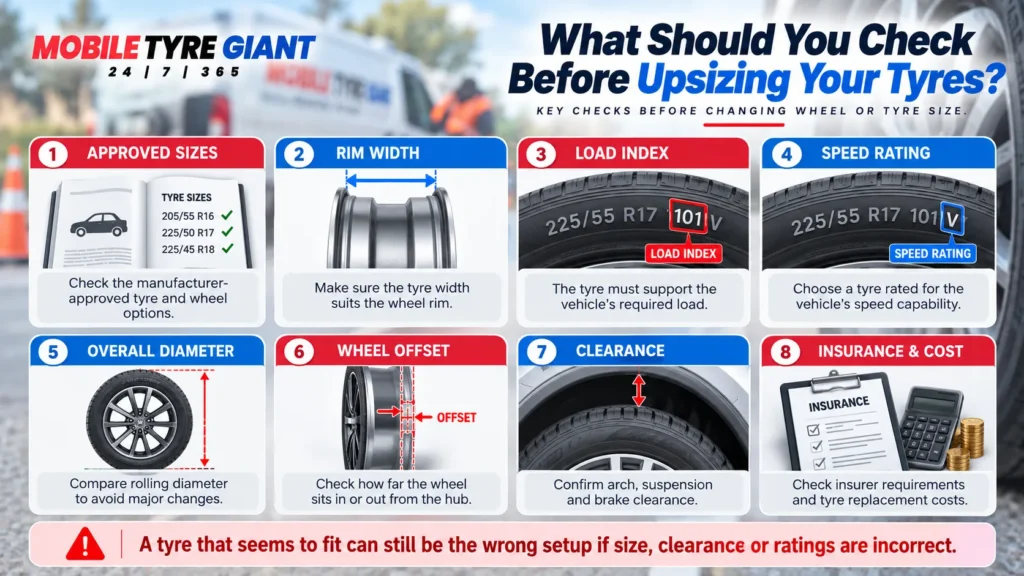
Before buying larger wheels or alternative tyres, start with the vehicle manufacturer’s approved specifications rather than working backwards from a wheel you like. Check the current tyre size, wheel diameter, rim width, load index and speed rating, then compare them with the proposed setup. Overall tyre diameter and rolling circumference also need attention because they can influence clearance and speedometer behaviour. Wheel offset matters because it determines how far the wheel sits inward or outward relative to the hub. Brake calipers, suspension components and wheel arches all need enough space around the new combination. These checks become even more important if the proposed tyre is both wider and lower in profile. A combination can look almost identical in an online photograph yet behave very differently once fitted to the car. Checking everything before ordering is much easier than discovering an expensive incompatibility afterwards.
Running costs should also be part of the decision. Check whether replacement tyres in the proposed size are widely available and whether you have a realistic choice between different brands and price levels. An unusual size can be technically possible but frustrating when a damaged tyre needs replacing quickly. Think about the roads you use as well. A very low-profile setup may suit a driver who spends most journeys on smooth roads but prove tiring on broken urban surfaces and pothole-heavy routes. If the current tyres are already worn or damaged, it may be more sensible to arrange mobile tyre replacement in the correct specification rather than rushing into an unverified upgrade. Tyre upsizing should solve a genuine preference or requirement, not create a new set of problems.
Pre-Upsizing Checklist
A useful pre-purchase checklist should cover the manufacturer’s approved tyre sizes, wheel diameter, rim width, tyre width, aspect ratio, load index, speed rating, overall diameter, rolling circumference and wheel offset. You should then check clearance around the suspension, wheel arch and brakes. If aftermarket wheels are involved, confirm that the wheel itself is suitable for the vehicle rather than assuming the correct diameter is enough. The proposed setup should also be considered at full steering lock and under normal suspension movement. Insurance requirements should be checked before fitting rather than afterwards. Finally, look at replacement tyre availability because a rare size can make future ownership unnecessarily expensive. These checks may seem detailed, but each protects against a different type of mistake.
The aim is not to make tyre upsizing sound complicated for the sake of it. It is simply a reminder that a wheel and tyre operate as one assembly. Think of changing a door in a house: matching the height alone does not help if the width, hinges and frame are wrong. Tyre fitment works in much the same way. One matching measurement cannot compensate for several incorrect ones. If all the important dimensions and specifications are suitable, upsizing can be straightforward. If several details remain uncertain, that uncertainty is a good reason to stop before spending money.
Can You Fit Wider Tyres to the Same Wheels?
Sometimes you can fit a wider tyre to the same wheel, but the tyre needs to be approved for the rim width and suitable for the vehicle. Two tyres can share the same wheel diameter while requiring different rim widths. This is why seeing the same final number in a tyre size, such as R17 or R18, does not prove that both tyres belong on the same wheel. A tyre that is too wide for the rim can have an unsuitable sidewall shape and may not behave as intended. Going wider can also reduce clearance between the tyre and suspension or bodywork. The correct decision therefore depends on more than whether the tyre can physically be mounted.
The tyre profile may need to change as width changes so that the complete diameter remains appropriate. Load index and speed rating also continue to matter. If the vehicle uses particularly tight wheel arches, even a modest width increase can make clearance more important. Drivers should avoid the common approach of choosing the widest tyre they believe will fit because appearance is only one part of a safe setup. A correctly matched tyre should sit properly on the rim, clear nearby components and remain appropriate throughout normal steering and suspension movement. Wider can be suitable, but wider is not automatically better.
How Do You Know If an Upsized Tyre Will Rub?
Tyre rubbing is not always obvious while the car is parked. Start by checking the distance between the tyre and the wheel arch, suspension strut, liners and other nearby components with the wheels pointing straight ahead. Then consider what happens when the steering moves from lock to lock. The tyre changes position significantly during a tight turn, particularly at the front of the vehicle. Suspension movement also reduces or changes available clearance as the car travels over bumps, dips and uneven surfaces. Additional passengers or luggage can compress the suspension further. This is why a few millimetres of apparent clearance on a driveway may not be enough to prove that the setup is suitable.
Listen for scraping or rubbing sounds after any wheel or tyre change and inspect the inner sidewalls and wheel-arch liners for fresh marks. Do not assume that light contact is harmless simply because the tyre still turns. Repeated rubbing can damage the tyre or surrounding components over time. If rubbing appears after an upsizing change, the cause may involve tyre width, overall diameter, wheel offset or a combination of them. The answer should be to diagnose the fitment rather than simply accepting the noise as a consequence of having larger wheels. A properly selected setup should operate without the tyre contacting the vehicle through normal steering and suspension movement.
Can Front and Rear Tyres Be Different Sizes?
Yes, some vehicles are designed to use different tyre sizes on the front and rear axles. This is known as a staggered setup and is common on certain performance and rear-wheel-drive cars. The rear tyres may be wider than the fronts, or the complete specifications may differ according to the manufacturer’s design. That does not mean drivers should create their own staggered arrangement simply because wider rear tyres look good. Factory staggered setups are designed around the vehicle’s handling, wheel widths, suspension and electronic systems. The approved specification remains the safest reference.
The key distinction is between different front-to-rear sizes that are intentionally specified and mismatched tyres across the same axle. When replacing tyres, drivers should read the complete sidewall markings rather than relying on a quick visual comparison. Two tyres can look similar while having different widths or profiles. This becomes especially important after purchasing a used car with aftermarket wheels because the existing setup may not be original. If different sizes are fitted intentionally, keep a record of the correct front and rear specifications so future replacements do not accidentally introduce a mismatch.
When Should You Avoid Tyre Upsizing?
Avoid tyre upsizing when the proposed fitment cannot be confidently verified. If the wheel width is unsuitable, the tyre has inadequate load or speed capability, clearance is questionable or the tyre rubs anywhere during normal operation, appearance is not a good enough reason to proceed. The same applies if the change creates an unsuitable difference in rolling dimensions or if you cannot establish whether the wheels themselves are correct for the vehicle. An insurer refusing or restricting the modification is another obvious reason to reconsider. Uncertainty should be treated as a warning sign rather than something to solve after fitting.
You should also think carefully about whether the supposed benefits actually match your driving priorities. If comfort, pothole resistance and lower replacement costs matter more than sharper steering or larger-looking alloys, the original size may be the better choice. The largest available factory option is not automatically the best one for everyday driving. A middle-sized approved setup can sometimes provide a better balance between appearance and sidewall cushioning. Tyre upsizing should therefore be a deliberate compromise. If you cannot identify what you are gaining or the trade-offs are unacceptable, staying with the approved original specification is a perfectly sensible decision.
What Should Be Checked After New Wheels or Tyres Are Fitted?
After fitting, check tyre pressures against the appropriate specification and make sure there are no warning lights or obvious clearance problems. Drive carefully at first and pay attention to steering feel, unusual noises or vibration. Recheck whether the tyres clear the arches and suspension during normal turns rather than inspecting them only while stationary. If the vehicle uses TPMS, make sure the system is functioning correctly and that the new setup has not introduced valve or sensor issues. The tyres should also be visually inspected after initial use for any fresh rubbing marks or abnormal contact.
Wheel balancing is especially important after a tyre has been removed or a new tyre has been fitted. Even a small imbalance can produce steering vibration that becomes more noticeable as road speed rises. If vibration appears after fitting, do not immediately assume the larger wheels themselves are responsible. The assembly may simply need professional mobile wheel balancing. Correct balancing helps the wheel and tyre rotate smoothly and reduces an avoidable source of vibration and uneven wear. The first drive after an upsizing change should therefore be treated as a final check of how the complete setup behaves.
Final Words: Is Tyre Upsizing Worth It?
Tyre upsizing can be worthwhile when the proposed setup is suitable for the vehicle and the driver understands the trade-offs. Larger wheels and lower-profile tyres can change appearance and steering response, while wider tyres may offer different performance characteristics when correctly selected. Those potential benefits need to be balanced against ride comfort, pothole vulnerability, cost, wheel weight, clearance and possible changes in rolling circumference. The most important lesson is that bigger does not automatically mean better. A successful setup is one that works as a complete package rather than simply filling the wheel arch more dramatically.
Start with manufacturer-approved alternatives whenever possible, then verify the complete tyre and wheel specification before buying. Check rim width, load index, speed rating, offset, rolling dimensions, clearance and insurance requirements rather than relying on a percentage calculator alone. Once the correct tyre specification has been confirmed, mobile tyre fitting can provide a practical way to have suitable tyres fitted and balanced at your location. If there is uncertainty about compatibility, staying with the original approved specification is safer than experimenting. Good tyre upsizing is measured by how well the car works afterwards, not simply by how large the wheels look.
Thinking About Upsizing Your Tyres?
Make sure the new tyre size is suitable for your vehicle before fitting. Once the correct specification is confirmed, arrange professional mobile tyre fitting at your location.
Frequently Asked Questions
Find quick answers to the most common questions our customers ask.
Tyre upsizing can be legal in the UK provided the final wheel and tyre setup remains suitable and roadworthy. The tyres must have appropriate load and speed capability, fit correctly on the wheels and avoid fouling other parts of the vehicle. Manufacturer-approved alternative sizes are the safest starting point because suitability cannot be determined from wheel diameter alone.
No, the commonly mentioned 3% figure should not be treated as a blanket UK legal rule. Percentage differences are commonly used as a practical way of comparing overall tyre diameter or rolling circumference, but they do not prove that a tyre is suitable for a particular vehicle. Rim width, load index, speed rating, clearance and manufacturer specifications still need to be checked.
Bigger tyres do not automatically cause an MOT failure simply because they differ from the original size. Problems can arise if the tyres create issues such as fouling another part of the vehicle, unsuitable fitment, inadequate load or speed capability, or incorrect sizing across the same axle. The condition and roadworthiness of the tyres still matter regardless of wheel size.
They can if the complete rolling diameter changes. A tyre with a larger circumference travels farther during each wheel revolution, which can change the relationship between actual road speed and the speedometer reading. Correct plus sizing normally uses a lower tyre profile with the larger wheel to keep the complete outside diameter closer to the suitable specification.
You should check with your insurer before fitting non-standard wheels or changing the tyre specification because insurers may treat the change as a vehicle modification. Policies and requirements can differ, so do not assume that an MOT-compliant setup automatically satisfies your insurance conditions. Declaring the proposed change before buying is the safest approach.
Sometimes, but the wider tyre must be suitable for the wheel's rim width as well as the vehicle. Sharing the same wheel diameter does not automatically make two different tyre widths interchangeable. Clearance, tyre profile, load capability and the complete rolling dimensions should also be considered before fitting a wider tyre.
Not automatically. Tyre width can influence handling and the shape of the tyre's contact area, but grip also depends heavily on compound, tread design, pressure, temperature, road surface and wet-weather performance. A well-designed standard-width tyre may provide better usable grip than a wider tyre that is poorly matched to the vehicle or conditions.
They often can when the larger wheel is paired with a lower-profile tyre. A shorter sidewall provides less cushioning between the road and rim, so sharp bumps and potholes may be felt more clearly inside the vehicle. Wheel weight, tyre construction, pressure and suspension tuning also affect ride quality, so the result varies between vehicles.
Low-profile tyres generally provide less sidewall cushioning during a hard pothole impact, which can place greater stress on both the tyre and alloy wheel. The actual risk depends on tyre pressure, impact speed, wheel design and road conditions. Drivers regularly using rough roads should consider this trade-off carefully before choosing a very low-profile setup.
Check the manufacturer's approved sizes, current tyre specification, rim width, wheel diameter, tyre width, profile, load index, speed rating, overall diameter, rolling circumference and wheel offset. You should also confirm wheel-arch, suspension and brake clearance, check insurance requirements and consider replacement tyre availability before spending money on the new setup.