

A cracked alloy wheel can be easy to underestimate, especially when the tyre is still inflated and the car appears to drive normally. You may notice the problem after hitting a pothole, clipping a kerb, seeing a thin line across the wheel, or repeatedly topping up one tyre without finding an obvious puncture. The immediate question is usually simple: can you keep driving with a cracked alloy wheel? A wheel with a confirmed or suspected structural crack should not be treated as safe for normal continued driving until its condition has been professionally assessed. The crack may affect the strength of the wheel even if it has not yet caused obvious air loss or severe vibration. Road loads, cornering forces and another sharp impact can place additional stress on the damaged area. This is why judging the wheel only by how it looks while the car is parked can give false reassurance. A small-looking line on the inner barrel may matter more than a large cosmetic scrape on the outer face. The safest approach is to treat a genuine fracture differently from ordinary kerb rash or superficial marks. Finding out exactly what has been damaged should come before deciding whether the vehicle is ready for another journey.
The tyre also needs attention because the same impact that damages an alloy can affect the sidewall, bead or internal tyre structure. Imagine striking a deep pothole hard enough to make the cabin shake for a moment. The wheel takes part of that impact, but the tyre is compressed at the same time, so looking only at the alloy does not tell the whole story. If the tyre starts losing pressure afterwards, the cause could be a puncture, valve problem, damaged bead area or the wheel itself. If impact damage means the tyre can no longer be safely used, a mobile tyre replacement may be required once the condition of the wheel has also been established. The important point is not to assume that replacing or reinflating the tyre automatically solves a cracked-wheel problem. Likewise, a repaired or replaced wheel does not automatically mean a tyre that suffered the same impact is undamaged. Both components work together to support the vehicle, maintain pressure and keep the tyre correctly seated. This guide explains the warning signs, risks, pressure-loss symptoms and practical decisions that matter after discovering a cracked alloy wheel. It will also help you understand when the problem is more than cosmetic damage and why professional assessment matters before normal driving continues.
Is It Safe to Drive With a Cracked Alloy Wheel?
A cracked alloy wheel should not be considered safe for ordinary continued driving simply because the vehicle still moves, the steering feels normal or the tyre remains inflated. An alloy wheel carries significant loads while the vehicle accelerates, brakes, corners and travels over uneven road surfaces. A fracture interrupts the wheel’s structure, and the exact effect depends on factors such as where the crack is located, how far it extends and whether the wheel has suffered other damage. A driver standing beside the car may see only a narrow hairline crack, but that visual impression alone cannot establish how the wheel will behave under road load. The situation becomes even harder to judge if the crack is on the inner barrel, where it may be partly hidden while the wheel remains fitted. Continued driving can expose the damaged area to further impacts and repeated loading. If the crack affects the area where the tyre seals against the wheel, pressure loss may also develop or become worse. New vibration, unusual handling or a pressure warning after an impact should therefore be treated as useful warning signs rather than minor annoyances. There is no sensible universal distance such as “five miles is safe” because two visually similar cracks can differ significantly in location and severity. The practical answer is to avoid using a known cracked wheel for a normal journey until it has been properly inspected.
There is an important difference between continuing a journey and moving a vehicle only as necessary to get out of immediate danger. For example, if you discover a possible wheel problem while stopped somewhere exposed to moving traffic, your first priority is personal safety and the road situation around you. That does not turn the damaged wheel into a safe component, but roadside decisions sometimes involve choosing the least risky immediate action. Once the vehicle is in a safer position, the next step should be assessment rather than experimenting with different speeds to see whether the vibration disappears. Drivers sometimes assume that if a crack was genuinely dangerous, the tyre would already be flat or the car would feel obviously unstable. That assumption is unreliable because some cracks can exist without creating dramatic symptoms straight away. A wheel can remain apparently usable while still requiring repair or replacement. The same applies when the car only vibrates at certain speeds, since vibration may come from wheel damage, tyre damage, imbalance or another mechanical issue. If structural wheel damage has been ruled out but vibration remains, mobile wheel balancing may then be appropriate to correct an imbalance. Balancing itself does not repair a cracked alloy wheel, so it should never be treated as a substitute for dealing with the structural problem. A proper diagnosis separates those issues instead of trying one service after another until the symptoms temporarily disappear.
Can a Cracked Alloy Wheel Still Hold Air?
Yes, a cracked alloy wheel can sometimes continue holding tyre pressure, which is one reason drivers may not realise how serious the damage could be. The tyre does not seal against every part of the wheel, so a fracture in one area may not immediately create a path for air to escape. The tyre bead sits against the wheel’s bead-seat area to form the seal that contains inflation pressure. If a crack develops elsewhere on the wheel, the pressure can appear completely normal at first. Even some damage closer to the sealing area may create only a very slow leak rather than an instantly flat tyre. This can lead to a frustrating pattern where the tyre looks normal in the morning but gradually needs more air every few days or weeks. Drivers often search for a nail in the tread because repeated pressure loss feels exactly like a slow puncture. Sometimes the problem is indeed a puncture, but the tyre, valve, bead seal and wheel all need to be considered. The key point is that pressure retention tells you whether air is escaping at that moment, not whether the alloy has full structural strength. A tyre pressure gauge cannot therefore be used as a structural test for a cracked wheel.
Repeated pressure loss deserves investigation even if adding air seems to make the problem disappear temporarily. A tyre that continually needs reinflating is giving you evidence that something in the tyre-and-wheel assembly is not sealing or functioning as expected. The leak could come from tread damage, a valve, a TPMS-related seal, corrosion around the bead area or damage to the alloy itself. If a normal puncture is responsible and the tyre is otherwise suitable for repair, mobile tyre repair can address the tyre problem, but that service does not repair a structurally cracked wheel. This distinction matters because treating the wrong component may leave the original cause unresolved. For example, repeatedly repairing or reinflating a tyre will not solve pressure loss caused by a fractured wheel. On the other hand, replacing a wheel without properly examining the tyre could miss impact damage that happened during the same pothole strike. Pay particular attention when pressure loss begins shortly after a heavy road impact, especially if it is accompanied by vibration or a visible mark on the wheel. A returning TPMS warning should also be investigated rather than repeatedly reset without identifying why the pressure changed. The fact that an alloy still holds air can be reassuring in the short term, but it should never be used as proof that a visible or suspected crack is safe to ignore.
What Happens If You Keep Driving on a Cracked Alloy Wheel?
Continuing to drive on a cracked alloy wheel can expose the damaged area to repeated loads from braking, acceleration, cornering and uneven road surfaces. A crack that looks unchanged while the car is parked may behave differently once the wheel is rotating and supporting the vehicle’s weight. Another pothole, raised drain cover or sharp road edge can place additional stress on an already damaged section of alloy. This does not mean every small crack will suddenly become much larger, but there is no reliable way for a driver to predict how quickly structural damage might progress. If the crack reaches an area involved in sealing the tyre, air pressure may begin to fall gradually or more noticeably. The car may also develop vibration or a different feel through the steering if the wheel has become distorted as well as cracked. Continuing to drive can therefore turn a wheel-only problem into a situation involving the tyre or other components affected by the same impact. The longer the vehicle is used without knowing the condition of the wheel, the more uncertainty you are accepting. That is why the sensible response is inspection rather than trying to judge severity from how the car feels during another journey. A wheel that seems manageable at low speed should not automatically be assumed capable of handling motorway speeds, heavy braking or another impact.
There is also a risk of misreading the symptoms and treating the wrong problem. For example, a driver might notice vibration and assume the wheels simply need balancing, while the real issue is a bent or cracked alloy caused by a pothole. Another driver may repeatedly inflate a tyre because it loses a small amount of pressure each week, believing the problem is only a slow puncture. In both cases, the symptoms may temporarily appear manageable while the underlying damage remains unresolved. Tyre pressure loss can also change the way the vehicle handles and increase stress on the tyre if it is driven significantly underinflated. If a tyre has been compressed heavily during the same impact that cracked the wheel, damage may exist even if the sidewall looks normal from the outside. This is why the wheel and tyre should be considered as a complete assembly rather than two unrelated components. The goal is not to assume the worst after every pothole strike, but to respond properly when a confirmed crack or meaningful new symptom appears. A professional inspection can identify whether the wheel is cracked, bent, leaking or affected in more than one way. Once the actual fault is known, the correct repair or replacement decision becomes much easier. Guessing based on appearance alone usually creates more uncertainty rather than solving the problem.
What Are the Signs of a Cracked Alloy Wheel?
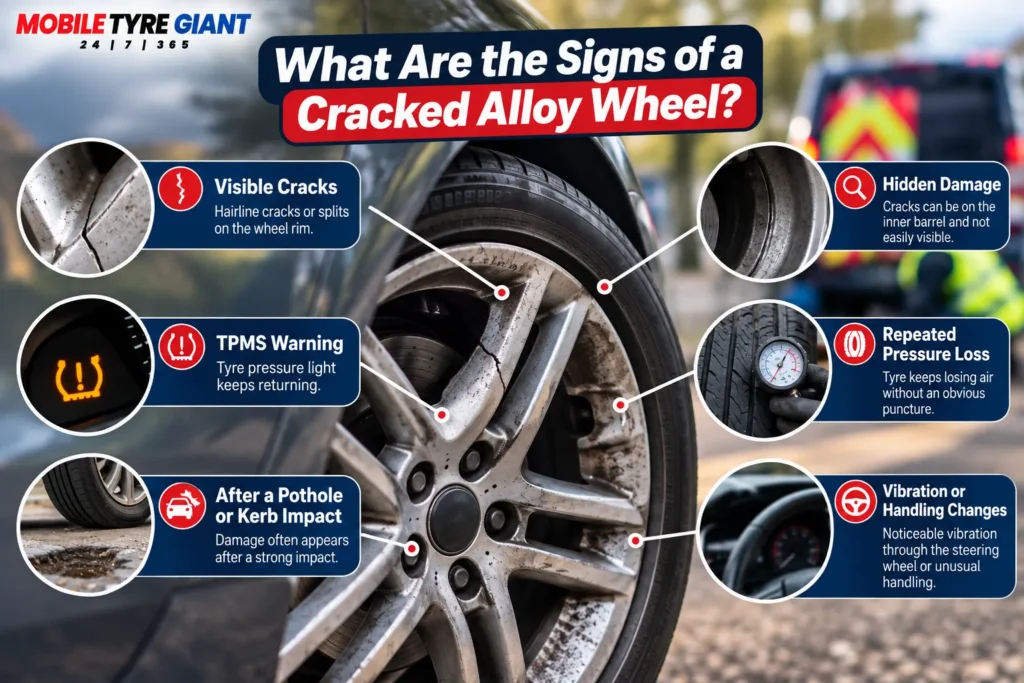
The most obvious sign is a visible fracture, but cracked alloy wheel symptoms are not always easy to spot from outside the vehicle. A crack can appear as a thin line running through part of the rim, wheel lip or inner barrel, and it may be partly hidden by dirt, brake dust or the position of the wheel. Repeated tyre pressure loss is another common warning sign because a crack can interfere with the seal between the tyre and wheel. You may notice that one tyre regularly needs more air while the other three maintain pressure normally. A TPMS warning that returns after inflation can provide another clue, although the warning itself cannot tell you whether the cause is a puncture, valve problem or damaged wheel. Vibration through the steering wheel, seat or floor may also appear after a strong pothole or kerb impact. In some cases, the vehicle may feel less smooth even though there is no obvious flat tyre. Unusual noise or a change in handling can also justify inspection when it starts immediately after a significant wheel impact. None of these symptoms alone proves that the alloy is cracked, so diagnosis should consider the tyre, wheel and surrounding components together. The important pattern is a new symptom that appears after impact or keeps returning despite normal tyre-pressure checks.
A visual inspection can help, but it has limitations because some of the most important damage may be on the inward-facing side of the wheel. The outer face may look almost untouched while the inner barrel has absorbed most of a pothole impact. That is one reason drivers can experience repeated pressure loss without finding an obvious problem when looking at the wheel on the driveway. Fresh scuffing, deformation or impact marks can provide useful clues about where the force was applied. If you see a possible crack, do not poke, grind or attempt to open the damaged area to determine how deep it is. The apparent width of a fracture does not provide enough information to decide whether the wheel is safe. It is also worth looking at the tyre sidewall for bulges, cuts or exposed material because these may indicate separate impact damage. If the tyre pressure has dropped substantially, reinflating it may help establish that a leak exists, but it does not identify the cause or make the wheel roadworthy. A returning warning or continuing vibration should be treated as a reason for further inspection rather than something to monitor indefinitely. Catching the issue at this stage can prevent weeks of repeated inflation, unexplained vibration and uncertainty about whether the tyre or wheel is responsible. Clear diagnosis is more useful than relying on one symptom in isolation.
What Causes Alloy Wheels to Crack?
Potholes are one of the most familiar causes of alloy wheel damage because the wheel and tyre can experience a sharp impact in a fraction of a second. When the tyre drops into a deep pothole and strikes the far edge, it is compressed between the road and the wheel, transferring a significant load into the rim. Larger wheels with relatively low-profile tyres can leave less tyre sidewall between the road and alloy, although actual damage still depends on impact severity, tyre condition, pressure and wheel design. Kerb strikes can create a similar problem when the wheel hits hard enough to do more than scrape the surface. A light parking scuff may only damage the finish, while a stronger impact can deform the wheel or contribute to a fracture. Raised road edges, broken surfaces and unexpected debris can also create concentrated impact loads. A previous bend, crack or repair may be relevant when assessing a newly damaged wheel because its history helps the specialist understand what the wheel has experienced. However, it would be misleading to claim that every older or previously repaired alloy is automatically likely to crack. The actual condition of the individual wheel matters more than broad assumptions about age. After any significant impact, new pressure loss, vibration or visible damage should be taken more seriously than the fact that the vehicle still seems driveable.
Tyre pressure also matters because the tyre provides part of the cushioning between the road and wheel. Driving with pressure substantially below the vehicle manufacturer’s recommendation can leave the tyre less able to perform as intended when it encounters a sharp road edge. That does not mean correct pressure makes an alloy immune to potholes, because a severe impact can damage a properly maintained wheel and tyre as well. Overloading the vehicle, striking road hazards at speed or repeatedly travelling over badly damaged surfaces may also increase the forces being transferred through the wheel assembly. Corrosion can sometimes exist around damaged areas of an alloy, but it should not be presented as the explanation for every fracture without inspection. Manufacturing defects are another possibility in the broad mechanical sense, yet they should never be assumed just because a wheel has cracked after years of normal use. For most drivers, the practical concern is identifying what changed immediately before the symptoms started. If the tyre began losing pressure the morning after a hard pothole impact, that timing is useful information for whoever inspects the vehicle. The same applies if vibration appeared immediately after hitting a kerb or rough road edge. Describing the impact, speed range where vibration is felt and pressure-loss pattern can make diagnosis more efficient. Understanding the cause also helps determine whether the tyre, wheel or both need further attention.
Cracked, Bent or Kerbed Alloy Wheel: What Is the Difference?
A cracked wheel contains an actual fracture in the alloy, while a bent or buckled wheel has been distorted from its intended shape. Kerb damage usually describes scraping, gouging or cosmetic damage caused when the wheel contacts a kerb, although a sufficiently hard strike can also cause bending or cracking. These problems can overlap, which is why judging everything from one visible mark is unreliable. A buckled wheel may create vibration because it no longer rotates perfectly true, while a crack may be more closely associated with structural concerns or air leakage depending on its position. Cosmetic kerb rash may look dramatic because the paint and alloy surface are scraped, but appearance alone does not establish structural severity. On the other hand, a narrow crack on the inner barrel can look minor while requiring much more careful assessment. Drivers sometimes assume the biggest-looking mark must be the most serious problem, which is not always the case. The shape, location and depth of damage matter more than how noticeable it looks from a few feet away. If the wheel has suffered a strong impact, checking for both cracking and distortion gives a more complete picture. This distinction also matters because different types of damage require different solutions.
Type of Wheel Damage | Typical Signs | Main Concern |
Cracked alloy wheel | Visible fracture, pressure loss, possible vibration | Structural integrity and air sealing |
Bent or buckled wheel | Wheel runs out of true, vibration, possible bead leak | Rotation, sealing and handling |
Kerb damage | Scrapes, gouges or damaged finish | Often cosmetic, but deeper impact damage must be ruled out |
A wheel can also have more than one type of damage at the same time, particularly after a severe pothole strike. For example, the rim may be slightly distorted and also contain a crack near the damaged area. That combination can explain why balancing alone does not always remove vibration after an impact. A tyre may also lose pressure because the bent rim no longer seals correctly even when no fracture is present. This is why the terms cracked, buckled and kerbed should not be used interchangeably. If the damage is purely cosmetic, the vehicle may require a very different type of attention from one with structural wheel damage. A specialist can check wheel runout, visible fractures and the condition of the sealing surfaces rather than relying on appearance. The tyre should still be examined because a hard impact can create sidewall or bead damage even when the alloy problem is obvious. Understanding the difference between these conditions helps prevent unnecessary repairs and reduces the chance of overlooking a more significant problem. It also explains why a wheel that looks badly scraped may sometimes be structurally sound while a cleaner-looking wheel has damage hidden on its inner surface. The correct next step always depends on what inspection actually finds rather than the label a driver gives the damage at first glance.
Can a Cracked Alloy Wheel Cause Tyre Pressure Loss?
Yes, a cracked alloy wheel can contribute to tyre pressure loss if the damage affects the area where the tyre seals against the wheel or creates a path for air to escape. The leak may be obvious and rapid, or it may be slow enough that the tyre only needs topping up every few days or weeks. That slow pattern is one reason cracked-wheel problems are sometimes mistaken for an ordinary puncture. A driver may check the tread for a nail, find nothing, reinflate the tyre and assume the issue has gone away. If the pressure drops again, the wheel itself needs to be included in the diagnosis alongside the tyre, valve and bead seal. The location of the crack matters because damage near the bead-seat area can interfere with the seal more directly than damage elsewhere. Corrosion, distortion or previous impact damage around the same part of the wheel can also contribute to leakage. A TPMS warning that repeatedly returns after inflation is another clue that the pressure loss has not been resolved. However, the warning only tells you that pressure has changed, not which component is responsible. The safest approach is to identify the source of the leak rather than repeatedly adding air and continuing to drive.
Pressure loss can also become confusing when more than one problem exists at the same time. For example, a pothole impact may crack the alloy and damage the tyre sidewall or bead, leaving two possible sources of leakage. In another case, the wheel may be cracked while the tyre itself has a completely separate tread puncture. This is why a leak test and proper inspection are more useful than assuming the most visible damage must be the only fault. If the issue is a repairable tyre puncture and the wheel itself is structurally sound, a mobile tyre repair service may be appropriate. If the tyre has suffered non-repairable impact damage, replacement may be needed instead. The important point is that tyre repair does not fix a fractured wheel, and wheel repair does not automatically address damage inside the tyre. A complete inspection should consider the tyre tread, sidewall, bead area, valve and wheel condition together. That reduces the chance of solving one symptom while leaving another fault behind. It also gives the driver a clearer explanation for why pressure has been dropping instead of relying on guesswork. When a tyre keeps losing air after a heavy road impact, the wheel should never be excluded from the investigation just because the tread looks clean.
Can a Cracked Alloy Wheel Cause Vibration?
A cracked alloy wheel can be associated with vibration, especially if the wheel has also been bent or distorted by the same impact that caused the fracture. The vibration may be felt through the steering wheel, seat or floor depending on which wheel is affected and how the damage influences rotation. It may also become more noticeable at certain speeds because wheel-related vibration often changes as rotational speed increases. However, vibration alone does not prove that the alloy is cracked. An unbalanced wheel, damaged tyre, bent rim, suspension problem or steering issue can produce similar symptoms. That is why it is important not to jump straight to one diagnosis based only on what the driver feels through the cabin. A heavy pothole impact can create several faults at once, so the sequence of events matters. If the vibration started immediately after the impact and pressure loss or visible wheel damage also appeared, the wheel and tyre deserve closer attention. If the wheel is structurally damaged, adding balancing weights will not repair the crack. The damaged component must be assessed first so the vibration is not simply masked or misdiagnosed.
Once the wheel and tyre have been confirmed structurally suitable for use, balancing can then address any remaining weight imbalance. A mobile wheel balancing service can help where vibration is caused by uneven weight distribution around the rotating wheel and tyre assembly. This distinction is important because balancing and structural repair solve completely different problems. Imagine a shopping trolley wheel that has a chunk missing from one side: adding weight elsewhere might change how it spins, but it does not restore the missing structure. A cracked alloy is more complex than that example, but the principle is similar. If the wheel itself is damaged, the root cause needs attention before balance is treated as the main issue. Drivers should also be cautious if vibration gets progressively worse, appears after every pothole strike or is accompanied by pressure loss. Those combinations suggest that inspection should look beyond simple imbalance. A proper diagnosis may reveal one fault or several, such as wheel distortion plus tyre damage. Understanding which problem is actually creating the vibration helps prevent wasted repairs and repeated visits. It also makes it easier to decide whether the next step is wheel assessment, tyre replacement, balancing or another mechanical check.
Should You Check the Tyre After Hitting a Pothole or Kerb?
Yes, the tyre should be checked whenever a pothole or kerb impact is strong enough to damage the wheel. The tyre is the first part of the wheel assembly to contact the road, so it can absorb a large amount of force before that load reaches the alloy. A hard strike may compress the sidewall sharply between the road edge and wheel rim, and some types of tyre damage are not immediately obvious from the outside. A visible bulge, cut or split is a clear warning sign, but internal damage can exist even when the tread still looks normal. The bead can also be affected where the tyre seats against the wheel, especially if the rim has bent or cracked nearby. Pressure loss after the impact is another sign that the tyre-and-wheel assembly needs more than a quick visual check. Drivers should also pay attention to new vibration, pulling or unusual noise because these symptoms may indicate more than cosmetic wheel damage. If the tyre looks obviously deformed or the pressure is dropping quickly, the vehicle should not be treated as ready for a normal journey. The tyre and wheel need to be assessed together because they were exposed to the same event. Checking only the alloy risks missing damage that could create a separate problem later.
The same principle applies even if the tyre has not gone flat. A sidewall bulge, for example, may indicate damage to the internal structure of the tyre and should not be ignored because pressure is still present. Cuts, exposed cords or severe bead damage are also signs that the tyre may no longer be suitable for continued use. If inspection shows that the tyre has been damaged beyond safe repair, mobile tyre replacement can be the appropriate next step once the wheel condition has also been addressed. The sequence matters because fitting a new tyre onto a structurally damaged wheel would not solve the underlying problem. Likewise, repairing or replacing the wheel while leaving a damaged tyre in place can create another safety issue. A useful habit after a major pothole or kerb strike is to think in pairs: wheel and tyre, not one or the other. This approach is more realistic because both components share the impact and work together to carry the vehicle. It also explains why a driver may notice more than one symptom after the same incident. Pressure loss, vibration and visible alloy damage may all be connected, but they do not necessarily come from exactly the same fault. A complete inspection is the fastest way to separate those possibilities and decide what actually needs repair or replacement.
Can a Cracked Alloy Wheel Be Repaired?
Some cracked alloy wheels may be repairable, but the answer depends on the individual wheel and should not be decided from a photograph or the apparent size of the crack alone. Crack location is one of the most important factors because different parts of the wheel carry different loads and have different structural roles. The length and direction of the fracture also matter, as does whether the wheel has been bent at the same time. Previous repairs can be relevant because repeated damage in the same area may affect the overall assessment. The condition of the surrounding alloy, the presence of corrosion and the wheel’s general history should also be considered. This is why simple rules such as “small cracks can always be welded” are unreliable. A narrow-looking fracture may be in a critical area, while another crack may be more straightforward to assess. Specialist wheel repairers use inspection and their own repair criteria to decide whether work is appropriate. The goal should be to restore safe serviceability, not simply make the crack disappear from view. If there is uncertainty about the wheel’s structural condition, replacement may be the more sensible option.
Repair decisions should also consider whether the wheel has any additional distortion or sealing problems. A crack that is accompanied by a buckle, repeated air loss or multiple previous repairs may lead to a different recommendation from an isolated defect on an otherwise sound wheel. Cosmetic refurbishment is not the same thing as structural repair, so a freshly painted wheel should never be assumed safe simply because it looks new. The same applies to welding: the fact that welding is technically possible does not mean it is automatically appropriate for every crack. Specialist assessment is needed to decide whether the wheel can be repaired to a suitable standard. Drivers should also ask whether the tyre needs to be removed for full inspection, particularly when the crack is near the bead or inner barrel. A complete assessment gives a clearer picture of both the wheel and any damage caused to the tyre during the original impact. It is also useful to ask whether the repaired wheel will need balancing after the tyre is refitted. The important part is to avoid treating repair as a cosmetic shortcut or a guaranteed alternative to replacement. A sound decision comes from the condition of the wheel, not from the desire to save the cost of a new one. If the damage is unsuitable for safe repair, replacement is the correct outcome rather than pushing for a repair that should not be attempted.
Cracked Alloy Wheel: Repair or Replace?
Choosing between repair and replacement depends on the severity, location and history of the wheel damage rather than a single visual measurement. A small suspected crack on an otherwise sound wheel may justify specialist assessment, while multiple fractures or complex structural damage may push the decision toward replacement. Repeated pressure loss can also influence the decision because it suggests the wheel may no longer be sealing reliably. Previous repairs are relevant because a wheel that has already been repaired several times may need closer scrutiny before more work is considered. The presence of a bend or buckle alongside the crack can also make the situation more complicated. Cost matters to most drivers, but it should not be the only factor because a cheap repair is not good value if the wheel remains unsuitable for use. Availability of a correct replacement wheel can influence practical decisions as well, especially on less common vehicles. The tyre condition must be included in the overall cost because the same impact may have damaged both components. A proper comparison therefore considers safety, repairability, wheel history, tyre condition and long-term reliability. The table below gives a general decision framework rather than a fixed repair rule.
Situation | Likely Next Step |
Small suspected crack with no obvious additional damage | Professional wheel assessment |
Repeated pressure loss after impact | Inspect both wheel and tyre |
Crack combined with a bend or buckle | Specialist structural assessment |
Multiple, complex or repeated cracks | Replacement may be more appropriate |
Previous repairs around the same area | Extra caution and specialist review |
Tyre damaged during the same impact | Tyre repair or replacement as required |
The important word in the table is “likely” because no general guide can inspect the wheel in front of you. One driver may have a repairable defect, while another with a similar-looking crack may have damage in a location that makes replacement the safer choice. That uncertainty is why professional assessment is more valuable than relying on internet photos or forum opinions. Drivers should also avoid choosing repair purely because the wheel still holds air, since pressure retention does not confirm structural condition. Replacement may initially cost more, but it can remove uncertainty where the damage is extensive or unsuitable for repair. On the other hand, replacing every cracked wheel without assessment can be unnecessary if a specialist determines that an appropriate repair is possible. The right decision is therefore neither “always repair” nor “always replace.” It is based on evidence from the actual wheel, its history and the damage found during inspection. Once the correct wheel solution has been chosen, the tyre should be refitted or replaced as necessary and the assembly checked before the vehicle returns to normal use. If vibration remains afterwards, balancing may also need attention. A complete repair path deals with the original cause and the related symptoms rather than focusing on one visible crack alone.
Will a Cracked Alloy Wheel Fail an MOT?
A cracked alloy wheel can result in an MOT failure because a fracture in a road wheel is treated as a serious safety issue rather than ordinary cosmetic damage. The important distinction is between surface marks such as kerb rash and an actual structural fracture in the wheel material. A wheel can look scratched or badly scuffed without necessarily having a structural defect, while a narrow crack may be much more significant even if it is harder to see. MOT inspection focuses on the condition and safety of the wheel, not simply how attractive it looks. A visible fracture, serious damage or a defective previous repair can therefore create a roadworthiness problem. Drivers should not wait until the MOT appointment to investigate an alloy they already know or suspect is cracked. If the wheel has been losing pressure, vibrating or showing visible damage after a pothole impact, inspection should happen sooner. The MOT test is not intended to replace diagnosis of a known wheel problem. It is also important not to assume that every wheel that has previously been welded automatically fails simply because welding has taken place. What matters is the actual condition of the wheel and whether a fracture or repair defect is present.
If you notice wheel damage before an MOT, dealing with it early also gives you time to check the tyre and related components properly. A heavy impact that cracks an alloy may also damage the tyre sidewall, bead or internal structure, so replacing or repairing only the wheel may not complete the job. If the wheel needs to be removed but the locking wheel nut key is missing, damaged or unusable, professional locking wheel nut removal may be needed before the damaged assembly can be taken off safely. This is another reason not to leave the problem until the day of the test. A rushed repair can lead to poor decisions, while a proper inspection gives time to assess the wheel, tyre, pressure loss and any remaining vibration. Once the damaged components have been dealt with, the vehicle should be checked again before returning to normal use. The aim should be roadworthiness, not simply passing the MOT on that particular day. A wheel that has been made cosmetically presentable but still has unresolved structural damage is not a satisfactory outcome. Likewise, a new tyre fitted to a damaged rim does not solve the underlying wheel problem. Treating the wheel and tyre as one assembly gives a more complete and sensible approach.
What Should You Do If You Find a Crack in Your Alloy Wheel?
If you discover a visible or suspected crack, the first step is to avoid treating the vehicle as ready for normal driving. Where the car is already parked safely, there is little benefit in taking it out for a test drive simply to see whether the crack causes vibration. If you are stopped in a dangerous roadside position, personal safety comes first, and any movement of the vehicle should be limited to what is necessary to reach immediate safety. Once safe, check for obvious signs such as a deflated tyre, sidewall bulge, cut, severe wheel distortion or rapid air loss. Do not touch or manipulate the crack in an attempt to judge how deep it is. A thin fracture can be difficult to assess visually, especially if it continues into an area hidden by the tyre or lies on the inner barrel. If the tyre pressure has fallen, note how quickly it is dropping and whether the TPMS warning has appeared. This information can help during diagnosis, but it should not be used to decide that the wheel is safe because the loss is slow. The next step should be professional inspection of the wheel and tyre rather than repeated reinflation. A clear diagnosis allows repair, replacement or recovery decisions to be made based on the actual damage.
It also helps to think about what happened before the crack was found. If the issue appeared immediately after a deep pothole, kerb strike or sudden vibration, tell the technician because that timing may help identify related damage. If the tyre has been losing a small amount of pressure for weeks, mention how often it needs topping up and whether any puncture checks have already been carried out. If vibration only appears at certain speeds, that detail is also useful because the wheel may be cracked, bent, unbalanced or affected by more than one problem. Take a photo of any visible damage if it can be done safely, especially before the wheel is removed or transported. However, a photo should support inspection rather than replace it. Avoid relying on social media comments that say a crack is safe based only on appearance, because crack location and structural condition cannot be confirmed through a screen. The practical goal is to stop guessing and identify exactly what needs attention. Once the wheel condition is known, the tyre can also be assessed for repairability or replacement. That approach is safer and usually more efficient than trying several unrelated fixes one after another.
When Should You Get Professional Help?
Professional help should be arranged whenever a wheel has a confirmed crack, repeated unexplained pressure loss or new symptoms after a significant impact. A visible fracture is the clearest reason, but it is not the only one. A returning TPMS warning, vibration that began after hitting a pothole, or a tyre that continually needs reinflating can all justify further inspection. The urgency increases if pressure is dropping quickly, the wheel is visibly distorted, the tyre has a bulge or cut, or the vehicle feels unstable. These signs suggest that the issue may involve more than cosmetic wheel damage. It is also sensible to seek help when you cannot confidently identify whether the problem is in the tyre, valve, bead area or wheel itself. Guessing at the cause can lead to unnecessary repairs or leave the original fault untouched. A tyre that repeatedly loses air deserves diagnosis rather than another temporary top-up. The same applies to vibration that returns after balancing or appears immediately after a hard impact. If something changed suddenly, there is usually value in finding out why.
Professional assessment is also important before deciding whether a cracked wheel should be repaired or replaced. Internet photographs, forum comments and general rules cannot show the full condition of the alloy, especially around the inner barrel or bead seat. A specialist can assess the fracture together with any distortion, corrosion or previous repair work. The tyre may need to be removed to inspect hidden areas and check whether the same impact caused internal damage. If the wheel is unsuitable for repair, replacement should be considered rather than repeatedly trying to extend its use. If an appropriate repair is possible, the wheel and tyre assembly should still be checked before normal driving resumes. Pressure retention, correct seating and balance may all need attention after the repair process. This is not about turning every small mark into an emergency; it is about distinguishing a real structural defect from cosmetic damage. The sooner that distinction is made, the sooner the driver can stop worrying about whether the next journey is safe. Clear diagnosis removes uncertainty and makes the repair decision more straightforward.
Final Words: Can You Drive With a Cracked Alloy Wheel?
A cracked alloy wheel should not be treated as safe for normal continued driving until it has been properly assessed. The fact that the tyre is still inflated does not prove that the wheel has retained its full structural strength. Some cracks can exist without causing immediate pressure loss, while others may lead to a slow leak that looks like an ordinary puncture. Vibration, TPMS warnings, visible fractures and repeated pressure loss are all signs that deserve investigation, especially after a pothole or kerb impact. The tyre should also be checked because the same impact can damage the sidewall, bead or internal tyre structure. A cracked wheel may sometimes be repairable, but that decision depends on the location, extent and history of the damage. Replacement may be more appropriate when the damage is complex, repeated or unsuitable for safe repair. Balancing can help with imbalance, but it cannot repair structural wheel damage. Similarly, tyre repair or replacement does not fix a fractured alloy. The correct solution starts with identifying every component that has been affected.
The most useful rule is simple: do not judge a cracked alloy by appearance alone. A dramatic scrape may be cosmetic, while a small fracture on the inner barrel may require much more attention. If the car is already in a safe place, avoid using another journey as a test of whether the wheel will cope. Arrange proper inspection and let the actual condition of the wheel and tyre guide the next step. If you are dealing with pressure loss, vibration or a recent road impact, describe those symptoms clearly when seeking help because they can make diagnosis easier. Once the wheel has been repaired or replaced as appropriate, the tyre and complete assembly should be checked before the vehicle returns to normal use. That approach avoids treating symptoms separately and reduces the chance of overlooking related damage. A cracked alloy wheel is not just a cosmetic issue when the structure of the wheel has been affected. Taking it seriously early is far easier than repeatedly dealing with pressure loss, vibration or uncertainty about whether the vehicle is roadworthy.
Found a Cracked Alloy Wheel or Losing Tyre Pressure?
If you notice a wheel crack, repeated pressure loss or vibration after a pothole impact, avoid unnecessary driving and arrange professional tyre assistance at your location.
Frequently Asked Questions
Find quick answers to the most common questions our customers ask.
A small crack should not be assumed safe simply because it looks minor. The location, depth, direction and surrounding wheel condition all matter, and these cannot be judged reliably from visual size alone. A professional inspection is the safest way to determine whether the wheel can be repaired or needs replacement before normal driving continues.
Yes, a cracked alloy wheel can sometimes continue holding tyre pressure if the fracture has not created a direct leak through the tyre-to-wheel sealing area. However, holding air only shows that pressure is being retained at that moment and does not confirm that the wheel is structurally sound or suitable for continued driving.
A hairline crack can be significant because even a narrow fracture represents damage to the wheel material. The seriousness depends on its location, extent and the overall condition of the alloy, so the fact that the crack is thin or difficult to see should not be used as proof that it is harmless.
Yes, wheel damage can create gradual pressure loss that feels similar to a slow puncture, particularly if the crack or distortion affects the bead-seat area. However, punctures, valves, TPMS seals and bead problems can produce similar symptoms, so the leak source should be properly identified before deciding what needs repair.
A cracked or impact-damaged wheel can be associated with vibration, especially if the wheel has also become bent or distorted. However, vibration can also come from imbalance, tyre damage, steering or suspension faults, so vibration alone cannot confirm that an alloy wheel is cracked.
Yes, a severe pothole impact can damage an alloy wheel and may also affect the tyre at the same time. If pressure loss, vibration, visible damage or unusual handling begins soon after hitting a pothole, both the wheel and tyre should be inspected rather than assuming the issue is only cosmetic.
Some cracked alloy wheels may be repairable, but the decision depends on the location and extent of the fracture, previous repair history and the overall condition of the wheel. A specialist should assess the individual wheel because not every crack is suitable for repair and appearance alone is not enough to decide.
Repair may be possible in some cases, while replacement may be more appropriate for extensive, repeated or structurally unsuitable damage. The safest decision is based on specialist inspection of the wheel, including crack location, distortion, previous repairs and any tyre damage caused by the same impact.
A genuine fracture in a road wheel can lead to an MOT failure because structural wheel damage is treated as a roadworthiness issue rather than ordinary cosmetic wear. A wheel with a known or suspected crack should therefore be inspected and dealt with before the MOT instead of waiting for the test to identify the problem.
Yes, the tyre should be inspected because the same pothole, kerb or road impact that damages an alloy wheel can also affect the sidewall, bead or internal tyre structure. Even if the tyre still holds pressure and looks normal from the outside, associated impact damage should be ruled out before the vehicle returns to normal use.