

When you press the brake pedal, it is easy to think the braking system alone decides how quickly the car stops, but that is only part of the picture. Your brakes slow the rotation of the wheels, while the tyres still have to transfer that braking force to the road. This is why understanding how tyres affect braking distance matters for everyday driving, not just emergency stops or performance testing. A tyre with suitable grip can help the braking system work effectively, while reduced grip can limit how quickly the vehicle slows. Tread depth, tyre pressure, tyre condition, tyre design and the road surface can all influence the amount of grip available when you brake.
Think of it a little like trying to stop suddenly while wearing shoes on different surfaces. The strength in your legs may be exactly the same, but stopping on dry concrete feels very different from stopping on a wet, slippery floor. Your car works on a similar principle because the tyres are the final connection between the vehicle and the road. This becomes particularly important in rain, when worn tread or unsuitable tyres may have less ability to maintain effective road contact. Drivers often notice very little difference during an easy dry commute, yet demanding conditions can expose differences that were almost invisible before. That is why this guide focuses not only on legal tyre condition, but also on the practical relationship between tyres, grip and braking performance.
How Do Tyres Affect Braking Distance?
Tyres affect braking distance by controlling how effectively the braking force generated by the vehicle can be transferred to the road. When the brakes are applied, the braking system resists wheel rotation, but the vehicle can only slow properly while the tyres maintain sufficient traction with the surface underneath them. If the available grip is reduced, the tyres cannot transmit the same braking force as effectively. Wet roads, worn tread, inappropriate tyre pressure and differences in tyre construction can all change that relationship. This is why two cars with healthy braking systems can still behave differently during a hard stop if their tyres provide different levels of grip.
The important point is that tyres should not be viewed as separate from the braking system when thinking about real-world stopping performance. Brakes, tyres, suspension, road surface and vehicle speed all work together, and weakness in one area can affect the final result. A driver may rarely notice these differences during gentle braking because the tyres are operating well inside their available grip. The gap becomes more important when braking hard, driving in rain or dealing with an unexpected hazard. This also explains why tyre performance should not be judged only by whether a tyre feels acceptable during normal driving. Understanding how tyres affect braking distance means looking at what happens when the vehicle demands much more grip than it does during an ordinary journey.
Braking Distance vs Stopping Distance: What Is the Difference?
Braking distance and stopping distance are often used as though they mean exactly the same thing, but there is an important difference. Stopping distance includes the distance travelled while the driver recognises a hazard and reacts, plus the distance travelled after the brakes are applied. Braking distance begins only once the braking process has actually started. Tyres mainly influence this second stage because this is when grip between the tyre and road becomes critical. A tyre cannot shorten the time it takes a distracted driver to notice a hazard, but it can influence what happens after braking force reaches the road.
| Term | What it means | Main factors involved |
|---|---|---|
| Thinking or reaction distance | Distance travelled before the driver begins braking | Speed, attention, fatigue and reaction time |
| Braking distance | Distance travelled from brake application until the vehicle stops | Speed, tyre grip, brakes, road surface, weather and vehicle condition |
| Stopping distance | Thinking distance plus braking distance | Driver reaction plus the complete physical braking process |
This distinction matters because saying that tyres affect stopping distance without explanation can create the impression that they control every part of the stopping process. They do not control reaction time, but they can have a major influence once braking begins. Imagine spotting a queue of stationary traffic ahead: the first part of the distance is travelled while your brain registers the problem and your foot moves toward the brake. The second part begins when braking force is actually applied and the tyres have to maintain grip while the vehicle decelerates. Poor conditions can make that braking phase more demanding even if your reaction time stays exactly the same. Keeping these terms separate also makes later discussions about worn tread, rain and tyre pressure much easier to understand.
Why Tyre Grip Matters When You Brake
The simplest way to understand how tyres affect braking distance is to remember one principle: your brakes can only use the grip your tyres provide. A powerful braking system cannot create friction between the tyre and road if that friction is not available in the first place. When grip is good, the tyres can transmit substantial braking force without losing effective contact with the surface. When grip is reduced, the vehicle has less traction available for braking, steering and stability. This is why road conditions and tyre condition become particularly important during sudden or heavy braking.
You can feel a similar effect when walking quickly across different surfaces. Your shoes may be identical, but your confidence changes immediately when dry pavement becomes wet tile because the available friction has changed. Tyres experience the same basic challenge, although the forces involved in stopping a moving vehicle are far greater. Modern systems such as ABS can help manage wheel lock, but they still depend on the grip available between the tyre and road. Electronic systems cannot turn a low-grip surface into a high-grip one. The safest way to think about braking performance is therefore not “good brakes versus bad brakes”, but how the whole vehicle works together with the tyres and the road.
What Happens at the Tyre Contact Patch?
The contact patch is the relatively small area of each tyre that is actually touching the road at any given moment. Although the tyre may look large when viewed from the side, only a limited part of its tread is carrying and transferring forces to the road. Braking, acceleration and steering all depend on what happens within these contact areas. When you brake, forces pass through the tyre structure and into the contact patch, where grip with the road helps slow the vehicle. This makes the condition of the tread, the tyre’s inflation pressure, its construction and the road surface particularly important.
In dry conditions, maintaining road contact is generally easier because there is no significant layer of water separating the tread from the surface. In rain, the tread must also help move water away so that the tyre can continue making useful contact with the road. As conditions become more demanding, differences in tread depth and tyre design can become much more noticeable. This is one reason drivers sometimes report that a tyre felt perfectly normal in dry weather but inspired much less confidence once heavy rain arrived. It also explains why looking only at the visible amount of rubber on a tyre does not tell you everything about braking performance.
How Does Tyre Tread Depth Affect Braking Distance?
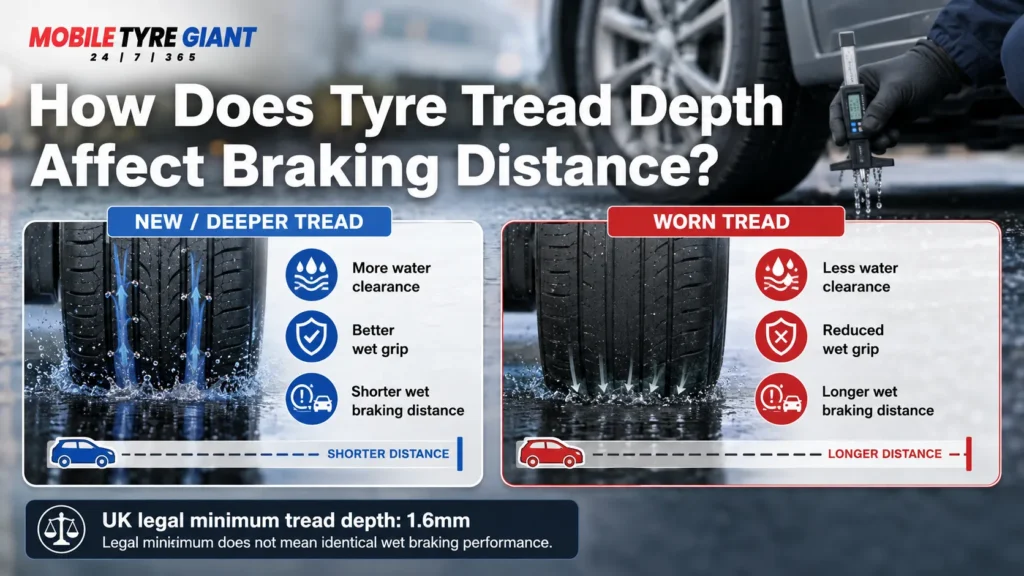
Tyre tread depth becomes especially important when braking on a wet road because the grooves in the tread help move water away from the area where the tyre meets the surface. When those grooves are deeper, they have more space to channel water away and help the tyre maintain useful contact with the road. As the tread wears down, that ability gradually reduces, particularly when rain becomes heavier or water begins collecting on the carriageway. This does not mean that every worn tyre suddenly loses grip at a particular tread depth, because braking performance also depends on tyre design, speed, pressure, road surface and vehicle condition. It does mean that tread condition deserves much more attention when discussing wet braking than it might during an easy journey on a dry road.
This is why checking tread should be treated as more than an MOT-related task. A driver may look at a tyre, see visible grooves and assume everything is fine, yet the depth and condition of those grooves still matter. If you are unsure how much tread remains, our guide on how to check tyre tread explains the practical checks you can carry out. Regular inspection can also reveal uneven wear, damage or one section of the tyre wearing faster than another. These issues can change the way a tyre interacts with the road even before the tread reaches its legal minimum. When thinking about how tyres affect braking distance, tread depth is therefore best understood as part of the tyre’s ability to maintain consistent grip, especially when water is present.
Why Do Worn Tyres Matter More on Wet Roads?
A worn tyre can feel surprisingly normal during everyday dry driving, which is one reason drivers may underestimate how much tread condition matters. On a dry road, the tyre does not have to clear a layer of water before making effective contact with the surface. Once rain arrives, however, the tread grooves have another job to perform because they need to move water away as the tyre rolls forward. Shallower tread provides less space for that water to escape, and the challenge becomes greater as speed or water depth increases. This helps explain why differences between tyres can become more obvious during wet braking than during gentle dry-road driving.
Imagine driving the same familiar route on two different mornings. On the first morning the road is dry, visibility is clear and every braking input feels predictable, while on the second morning rain is hitting the windscreen and water is gathering in the wheel tracks. The car has not changed, but the amount of grip available at the tyre and road interface can be very different. Worn tread does not automatically mean the tyre will lose control, but it can reduce the margin available when the tyre has to manage water and braking force at the same time. This is also why judging tyres only by how they feel during calm, dry journeys can be misleading. Emergency braking is rare, yet it is exactly the type of situation where the available grip matters most.
What Happens at the UK Legal Minimum of 1.6mm?
For cars and light vans in the UK, the legal minimum tread depth is 1.6mm across the central three-quarters of the tyre’s tread breadth and around the entire circumference. That figure is an important legal threshold, but it should not be misunderstood as a promise that a tyre at 1.6mm will perform exactly like the same tyre when it had much deeper tread. Tyre performance changes gradually as a tyre wears rather than falling off a cliff at one exact measurement. In wet conditions, reduced groove depth can mean less capacity to clear water from beneath the tyre. The actual change in braking performance will vary according to the tyre, vehicle, speed, road surface and weather conditions.
This distinction between legality and performance is one of the most important points in this guide. A tyre can meet the legal tread requirement while no longer delivering the same wet-weather characteristics it had earlier in its life. Controlled tyre testing has demonstrated that worn tyres can require more distance to stop in wet conditions than comparable tyres with deeper tread, although the exact number should never be treated as universal. A test conducted with one tyre, one vehicle and one road surface cannot tell every driver exactly how many metres their own car will need. What it can show is the underlying relationship between tread condition and wet grip. Drivers should therefore see 1.6mm as a legal minimum rather than a guaranteed measure of identical braking performance throughout the tyre’s life.
Why Does Braking Distance Increase on Wet Roads?
Wet roads create a more difficult braking environment because water reduces the amount of grip available between the tyre and the road surface. In dry conditions, the tyre can make relatively direct contact with the road, while in rain the tread must continuously manage water as the wheel rotates. The UK’s Highway Code advises drivers that total stopping distances in wet weather can be at least double those required on dry roads because tyres have less grip. That guidance refers to overall stopping distance, so it should not be confused with a claim that tyre-related braking distance always doubles in every wet situation. Rain intensity, vehicle speed, road texture, tread condition and tyre design all influence what actually happens.
The practical lesson is simple: the same speed that feels comfortable on a dry road can require much more caution once the surface becomes wet. A shiny stretch of road covered by rain may look harmless from inside the car, but the tyres are dealing with a completely different contact environment underneath. Worn tread can make that environment harder to manage because there is less groove depth available for water evacuation. Drivers can compensate for the increased risk by reducing speed, leaving a larger gap to the vehicle ahead and avoiding sudden inputs where possible. Good tyre condition helps, but it does not remove the need to drive according to the weather. Even a high-performing tyre still has less available grip on a wet road than it would have under ideal dry conditions.
How Does Tyre Tread Clear Water From the Road?
As a tyre rolls across a wet surface, its tread grooves provide channels through which water can move away from the contact area. You can picture those grooves a little like drainage channels on a road: when there is enough capacity, water can move away more effectively, but when the channels become shallower or the volume of water becomes too great, clearing it becomes harder. Tyre tread patterns are designed differently, so the amount and direction of water movement can vary from one tyre to another. The tyre also needs the correct pressure and suitable condition to work as intended. Tread depth is therefore important, but it is not the only characteristic involved in wet grip.
This is one reason comparing tyres solely by how many millimetres of tread remain does not tell the whole story. Two tyres with the same measured tread depth may still use different compounds, groove layouts and construction, which can affect their behaviour in the wet. Speed matters as well because the tyre has less time to move water away as it travels faster across a wet surface. Standing water makes the challenge even greater because the tyre may need to displace a much larger volume in a very short period. In normal rain, the tyre may continue maintaining effective road contact while clearing water through its grooves. When the tyre can no longer disperse enough water to maintain that contact, the situation can develop into aquaplaning.
What Is Aquaplaning and Why Does It Affect Braking?
Aquaplaning happens when water builds up between the tyre and road faster than the tyre can disperse it, causing the tyre to lose normal contact with the surface. When this happens, available steering and braking control can reduce sharply because the tyre is no longer interacting with the road in the usual way. Drivers sometimes describe the sensation as the steering suddenly becoming light or the car feeling as though it is floating across the surface. Speed, standing-water depth, tread condition and tyre design can all influence the likelihood of aquaplaning. It is important, however, not to use the term for every situation in which wet roads reduce grip.
Ordinary wet braking and aquaplaning are related but different. A tyre can have reduced grip on a wet surface while still maintaining contact with the road, whereas aquaplaning involves water significantly interfering with that contact. If standing water is visible ahead, reducing speed before reaching it gives the tyres a better chance of managing the water rather than demanding a sudden braking response while already in it. Smooth steering and braking inputs are also more appropriate when grip is uncertain. Tyre tread cannot make deep standing water harmless, but adequate tread helps the tyre perform the water-clearing job it was designed to do. This is why tread depth, rain and braking distance belong in the same conversation, while still needing to be explained as separate parts of the wider tyre-grip picture.
Does Tyre Pressure Affect Braking Distance?
Tyre pressure can affect braking behaviour because inflation influences the shape of the tyre, how it carries the vehicle’s weight and how consistently it interacts with the road. A tyre that is significantly below the manufacturer’s recommended pressure can flex more than intended, generate extra heat and respond less precisely during steering or braking. Pressure that is too high can also change the way the tyre behaves because the tyre is no longer operating at the specification intended for the vehicle and load. The exact effect on braking distance is not identical in every situation, which is why simple claims such as “lower pressure always adds a certain number of metres” should be avoided. Wet and dry surfaces can produce different results, and tyre construction also matters. The most reliable approach is therefore to use the pressure specified by the vehicle manufacturer rather than deliberately altering pressure in an attempt to improve grip.
Pressure should also be checked regularly rather than only when a dashboard warning appears. A tyre can lose pressure gradually, and the change may be subtle enough that the car still feels normal during gentle driving. If you want to understand the wider effects, our guide to under-inflated tyres explains how low pressure can affect tyre wear, handling and overall vehicle behaviour. Pressure should normally be checked when the tyres are cold and adjusted for the vehicle and load according to the manufacturer’s instructions. This matters even more before long journeys or when carrying extra passengers and luggage. Correct inflation will not guarantee a particular braking distance, but it helps the tyre operate in the condition its designers intended.
What Happens When Tyres Are Underinflated?
An underinflated tyre can deform more as it rolls, which changes how the tread and sidewalls respond to the road. The steering may feel less precise, the tyre can build up more heat and the shoulders may wear faster over time. In wet conditions, pressure that is too low can also affect the tyre’s ability to maintain predictable contact while the tread is trying to clear water. The result is not simply a smaller or larger contact patch, because tyre behaviour involves pressure distribution, tread movement and construction as well. This is why relying on visual inspection alone is unreliable, as a tyre can be underinflated without looking dramatically flat. A pressure gauge gives a much better indication than trying to judge the tyre from across the driveway.
Underinflation is also a good example of why tyre safety should be viewed as a system rather than a single measurement. A driver may have plenty of tread remaining yet still experience compromised behaviour because the tyre is not operating at the correct pressure. The problem can become more noticeable during heavy braking, fast direction changes or wet-weather driving. It is also possible for pressure loss to indicate another issue such as a slow leak, valve problem or puncture. If a tyre repeatedly loses pressure after being adjusted correctly, topping it up again and again is not a proper long-term solution. The cause should be identified so the tyre can be assessed safely.
What Does a Tyre’s Wet-Grip Rating Tell You About Braking?
The wet-grip rating on a tyre label is designed to help drivers compare a tyre’s performance during specified wet-braking testing. Current tyre labels use grades from A to E, with the rating providing a useful indication of how the tyre performs in the particular wet-grip test used for classification. For a driver researching how tyres affect braking distance, this is one of the most useful pieces of information available before purchase because it relates directly to wet braking performance. It is especially relevant in the UK, where rain and wet roads form a regular part of everyday driving. A stronger wet-grip grade can indicate better performance in the standardised test, but it should not be treated as a complete description of the tyre. Dry grip, aquaplaning resistance, wear, road noise, comfort and seasonal suitability are separate characteristics.
This is why the tyre label works best as a comparison tool rather than a final buying decision on its own. A driver choosing replacement tyres should consider the correct specification first, then look at wet grip and other characteristics relevant to how the vehicle is actually used. Our guide to choosing the right tyres for your car explains the wider factors involved when selecting replacements. For someone commuting regularly in wet weather, wet-braking performance may deserve greater priority than it would for someone comparing tyres only by price. The important point is to make an informed comparison between actual tyre models rather than assuming that every tyre in one price category behaves in the same way. That approach is more useful than relying on brand reputation alone.
Is an A-Rated Wet-Grip Tyre Always the Best Choice?
An A-rated wet-grip tyre can be very strong in the wet-braking test used for the label, but that does not automatically make it the best tyre for every driver or every condition. Tyres are designed around different compromises, and improving one characteristic does not tell you everything about another. A tyre may provide excellent wet braking while another performs better for tread life, snow, comfort or road noise. Vehicle type also matters because a small hatchback, heavy SUV and electric vehicle can place very different demands on a tyre. The correct size, load rating and speed rating must therefore come before simply choosing the highest wet-grip grade available. A strong label result is valuable, but it still belongs inside a wider buying decision.
This is similar to choosing footwear for different weather. A shoe that gives excellent grip on wet pavement may not be the best choice for deep snow, long-distance comfort or hot summer use. Tyres follow the same general idea because their tread patterns and rubber compounds are designed for particular compromises. Drivers should therefore avoid searching for a single label that supposedly proves one tyre is “best”. Instead, wet-grip rating should be used alongside the tyre’s specification, seasonal suitability and credible performance information. This makes the decision more balanced and reduces the risk of buying a tyre that scores well in one area but is poorly matched to the vehicle’s actual use.
Does Tyre Quality Affect Braking Distance?
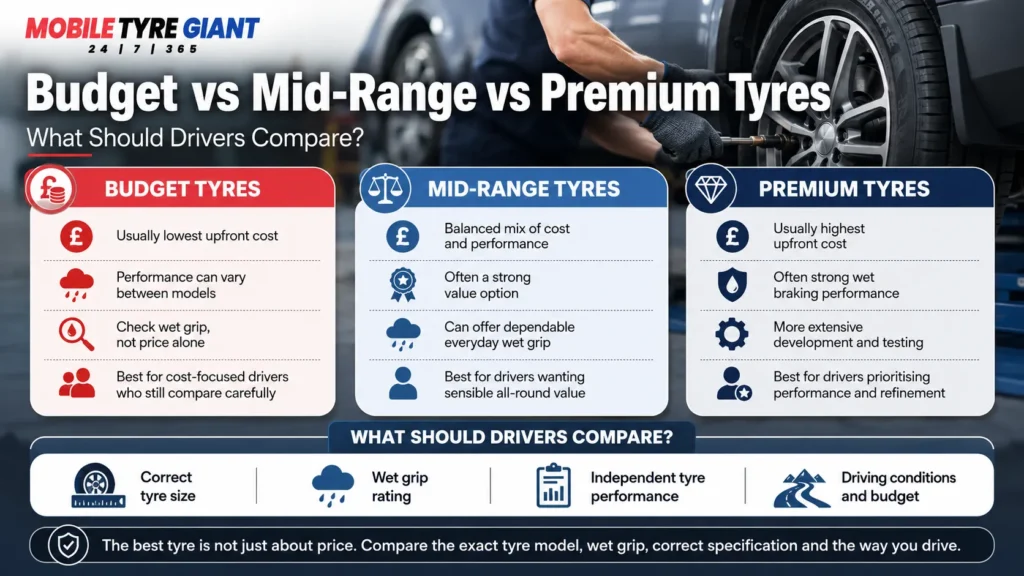
Tyres that fit the same wheel and meet the same basic specification can still perform differently under braking. Differences in rubber compound, tread design, construction and development can change how effectively a tyre generates grip on wet or dry surfaces. This is why independent tyre tests often record measurable differences between products that are all legally suitable for road use. Those differences can become particularly noticeable during wet braking, where water clearance and compound behaviour are being tested at the same time. Price can sometimes correlate with development and overall performance, but it is not a perfect measurement of braking ability. A high price does not guarantee that one particular tyre will outperform every cheaper alternative in every condition.
The best way to compare tyre quality is to look at the individual tyre rather than reducing the market to “cheap equals bad” and “premium equals good”. Mid-range products can perform competitively, while some budget tyres may be stronger in one test and weaker in another. Drivers should also consider what they value most, because braking, longevity, comfort and noise do not always rank in the same order from one tyre to the next. This is particularly important for drivers who are trying to balance safety and affordability. A sensible buying decision is one that matches the tyre’s proven characteristics to the vehicle and the conditions in which it will be used. That is far more useful than paying for a badge without understanding the actual performance.
Budget vs Mid-Range vs Premium Tyres: What Should Drivers Compare?
The categories budget, mid-range and premium are useful for describing price positioning, but they should not be treated as safety grades. A budget tyre may meet legal requirements and perform adequately in some conditions, while a premium tyre may offer more consistent results across a wider range of tests. Mid-range tyres can provide a strong compromise for drivers who want dependable performance without paying the highest price. The most important comparison is between specific tyre models, especially their wet-braking performance, correct specification and suitability for the vehicle. This becomes particularly relevant when a driver spends most of the year on wet UK roads rather than ideal dry surfaces. The cheapest tyre is not automatically the worst choice, but the cheapest price should not be the only reason for buying it.
The practical lesson from this comparison is that braking performance should be evaluated using evidence rather than assumptions. Drivers sometimes discover that a tyre they considered “good enough” during dry commuting feels far less predictable once heavy rain arrives. Others are surprised to find that a well-reviewed mid-range tyre provides the level of wet grip and comfort they actually need without moving to the most expensive option. The goal is not to convince every reader to purchase premium tyres. It is to encourage them to think about the conditions in which braking performance matters most. For UK drivers, wet braking deserves serious consideration when comparing replacement options.
Do Summer, Winter and All-Season Tyres Brake Differently?
Summer, winter and all-season tyres use different tread designs and rubber compounds because they are intended to work across different temperature ranges and road conditions. Summer tyres are generally designed to perform strongly in warmer conditions, while winter tyres use compounds and tread features intended to remain more effective in colder weather. All-season tyres aim to provide a compromise between those two categories rather than being the outright specialist in every condition. These differences can influence braking because the tyre compound needs to remain suitable for the temperature and surface underneath it. A tyre that performs extremely well in warm, dry conditions may behave differently when temperatures fall sharply. This is why tyre type should be discussed in context rather than declaring one category universally superior.
For most drivers, the correct choice depends on climate, mileage, vehicle use and the conditions they regularly encounter. Someone driving through colder areas during winter may prioritise different characteristics from a driver who mainly travels in mild urban conditions. All-season tyres can be attractive to drivers who want one set of tyres for varied British weather, but they still involve compromises compared with specialist seasonal tyres. The key is to choose tyres that match the vehicle and realistic driving conditions rather than buying based on one impressive test result. Braking performance is only meaningful when the tyre is being used in the environment for which it is suited. Part 4 will bring these factors together by looking at uneven wear, tyre damage, ABS, legal tread versus real braking performance, practical safety checks and when replacement may be appropriate.
Can Uneven Wear or Tyre Damage Affect Braking?
Uneven tyre wear can affect how consistently a tyre maintains contact with the road, particularly during heavy braking or poor weather. A tyre may still have acceptable tread in one area while another section is significantly more worn. This can happen because of alignment problems, suspension issues, incorrect pressure or prolonged driving with an underlying mechanical fault. The result is not always obvious during gentle driving, which is why visual checks around the full tyre matter. Shoulder wear, localised bald areas and irregular tread patterns can all indicate that the tyre is no longer wearing as intended. If part of the tread has less ability to clear water, wet grip may also become less consistent across the tyre. That can make braking behaviour less predictable when the vehicle needs maximum traction. A tyre should therefore be assessed by its overall condition rather than one convenient tread measurement.
Physical damage deserves the same attention because adequate tread depth does not make a damaged tyre acceptable. Cuts, bulges, exposed cords, cracking or significant impact damage can affect the tyre’s structure and may require professional assessment or replacement. A tyre that has struck a pothole or kerb can sometimes appear usable from a distance while damage is developing around the sidewall or internal structure. Drivers should also pay attention to repeated pressure loss because it can indicate a puncture, valve issue or other fault. None of these problems should be ignored simply because the tyre remains above the legal tread limit. Braking performance depends on the tyre remaining structurally sound as well as maintaining suitable tread and pressure. If a tyre looks damaged or behaves differently from the others, it is safer to have the cause checked rather than waiting for the next MOT.
Can ABS Make Up for Worn or Low-Grip Tyres?
ABS is an important safety system, but it cannot replace the grip provided by healthy tyres. During hard braking, the anti-lock braking system can rapidly manage brake pressure to reduce the chance of the wheels remaining locked. This can help preserve steering control and allow the driver to continue directing the vehicle while braking. What ABS cannot do is create friction between the tyre and road where little grip is available. If the surface is wet, icy or contaminated, or if the tyres have limited grip, the system still has to work within those physical limits. The same applies when tread is heavily worn or the tyre is unsuitable for the conditions. Modern technology can manage the available grip more effectively, but it cannot manufacture extra grip from nowhere.
This is an important distinction because drivers sometimes assume electronic safety systems make tyre condition less important. In reality, systems such as ABS, stability control and traction control depend on the tyres being capable of transferring forces to the road. Think of ABS as a skilled manager rather than a source of additional traction. It can control how braking force is applied, but the tyres still determine what can ultimately be achieved at the road surface. This becomes especially relevant in heavy rain, where worn tread and standing water may already be reducing available grip. Good electronic systems and good tyres complement each other rather than replacing one another. Keeping tyres in appropriate condition therefore remains essential even on vehicles equipped with advanced braking and stability technology.
Does Legal Tread Depth Mean Good Braking Performance?
Legal tread depth and maximum braking performance are not the same thing. The UK legal minimum for most car tyres is 1.6mm across the required portion of the tread, but that figure is a legal threshold rather than a guarantee that a tyre will behave exactly as it did when new. As tread wears, the tyre has less groove depth available to manage water during wet driving. This can reduce the margin available during demanding braking conditions even though the tyre may remain legal. The change is gradual rather than happening suddenly at one specific measurement. Tyre design, compound, road surface, temperature, vehicle speed and water depth all influence the final braking result. This is why it would be misleading to give every driver one universal stopping-distance increase for a tyre at 1.6mm.
The more useful approach is to separate two questions. The first is whether the tyre meets the legal requirement, and the second is whether its current condition provides the level of grip appropriate for the way and conditions in which the vehicle is being used. A commuter driving regularly in heavy rain may think about remaining wet-weather performance differently from someone whose vehicle covers very little mileage. Drivers should also look beyond tread depth and consider age, damage, pressure and uneven wear. A tyre can be legal in one respect while still having another condition that requires attention. This balanced approach avoids unnecessary replacement while also avoiding the assumption that legality automatically means unchanged braking performance. Understanding that difference is one of the most important parts of learning how tyres affect braking distance.
Can Two Road-Legal Tyres Have Different Braking Distances?
Yes, two road-legal tyres can produce different braking results because legal compliance does not make every tyre identical. Different products use different rubber compounds, tread patterns, internal constructions and design priorities. One tyre may perform particularly well in wet braking while another may focus more heavily on wear life, efficiency or comfort. Their condition also matters because two tyres of the same model can perform differently if one has deeper tread or more even wear. Road temperature and surface conditions can increase those differences further. This is why tyre comparisons should focus on the actual product and its tested characteristics rather than assuming that all legal tyres offer the same braking capability. Price category alone is also not enough to predict every result.
The practical lesson for drivers is not that every tyre needs to be the most expensive option available. It is that replacement tyres should be selected using more than the legal minimum specification. Correct size, load rating, speed rating, wet-grip performance, tyre type and vehicle use should all be considered together. A tyre that suits a small city car may not be the right choice for a heavier SUV even if both products appear similar at first glance. Drivers should also remember that performance changes as tyres wear. Choosing carefully at the buying stage and monitoring condition afterwards gives the braking system a better chance of working with consistent road grip throughout the tyre’s usable life.
How Can You Help Keep Braking Distance as Short as Conditions Allow?
There is no maintenance trick that can guarantee a particular braking distance, but several simple habits can help tyres operate as intended. Check tyre pressure using the vehicle manufacturer’s recommended figures rather than relying on appearance alone. Inspect tread depth regularly and look across the full width of the tyre for uneven wear. Pay attention to cuts, bulges, cracking or repeated pressure loss, because these may indicate a problem that needs assessment. Choose replacement tyres that meet the correct specification for the vehicle and consider wet-grip performance when comparing suitable options. Reduce speed when roads are wet, icy or covered with standing water because even good tyres have less grip in poor conditions. Leave a larger gap to the vehicle ahead so that additional stopping distance can be accommodated safely.
Drivers should also avoid viewing tyre maintenance as something that only matters before an MOT. A few minutes spent checking tyres periodically can identify changes long before they become obvious from behind the steering wheel. The steering may still feel normal during a short dry journey even when tread is wearing unevenly or pressure is slowly dropping. Long journeys, heavy loads and seasonal weather changes are particularly good times to check tyre condition. If one tyre repeatedly looks or behaves differently from the others, investigating the cause is more sensible than simply correcting the symptom. Braking performance is influenced by the complete vehicle, so brakes, suspension and tyres all need to be maintained properly. The goal is not to chase the shortest theoretical stopping distance, but to preserve predictable performance and an appropriate safety margin for real-world conditions.
When Should Worn or Damaged Tyres Be Replaced?
A tyre should be replaced when it no longer meets legal requirements, has damage that makes continued use unsuitable, or has deteriorated to a condition where professional inspection indicates replacement is necessary. Drivers should not wait for tread to disappear completely before paying attention to tyre condition. Uneven wear, visible structural damage, persistent pressure loss and reduced wet-weather confidence can all justify further investigation. There is no single replacement depth above the legal minimum that automatically applies to every driver and every tyre. The correct decision depends on the tyre’s overall condition, how the vehicle is used and the environments in which it regularly travels. This is why a proper inspection is more reliable than making a decision from tread depth alone.
If replacement is required, the new tyre should match the vehicle’s correct specification and be suitable for its intended use. Mobile Tyre Giant provides mobile tyre replacement for drivers who need worn or damaged tyres replaced at a suitable location. A mobile service can be particularly useful when a tyre is not appropriate to continue driving on or when visiting a workshop is inconvenient. The important part is to address the underlying problem rather than continuing to drive simply because the tyre still holds air. Correct replacement restores an essential part of the connection between the braking system and the road. Once fitted, regular pressure and tread checks can help maintain that performance as the new tyre begins to wear.
Final Words: Why Tyre Condition Matters Every Time You Brake
Understanding how tyres affect braking distance comes down to one simple principle: your brakes can only work with the grip available between the tyres and the road. Tread depth influences how effectively water can be managed, tyre pressure affects how the tyre operates, and tyre design can influence performance across different surfaces and temperatures. Wet roads make these differences more important because available grip is already reduced. ABS and other electronic systems can help manage braking forces, but they cannot compensate completely for worn, damaged or unsuitable tyres. Legal tread depth is also only one part of the picture because a road-legal tyre does not necessarily perform exactly as it did when new. Braking performance should therefore be considered alongside tyre condition, weather, speed, road surface and the condition of the wider vehicle.
The practical response does not need to be complicated. Check tyre pressure, monitor tread, inspect for damage and choose suitable replacement tyres when they are genuinely needed. Leave more space in poor weather and adjust speed to the conditions rather than relying on technology to correct every problem. Drivers who understand the relationship between tyres and braking are better placed to recognise when something deserves attention. The aim is not to make every journey feel like a safety test, but to make sure the tyres are ready for the rare moment when maximum grip is suddenly required. That is when differences that are almost invisible during normal driving can matter most.
Worried Your Tyres Could Be Affecting Your Braking?
Mobile Tyre Giant can check worn or damaged tyres and provide the correct replacement at your home, workplace, or another suitable location.
Frequently Asked Questions
Find quick answers to the most common questions our customers ask.
Tyres affect braking distance by determining how much grip is available between the vehicle and the road when the brakes are applied. Tread depth, tyre pressure, tyre condition, tyre design, weather and road surface can all influence that grip. If available grip is reduced, the vehicle may require more distance to slow or stop, particularly during hard braking or on wet roads.
Worn tyres can increase braking distance, especially in wet conditions where reduced tread depth limits the tyre's ability to move water away from the contact area. The exact increase depends on the tyre, vehicle, speed and road conditions, so there is no universal number that applies to every car.
Tread grooves help clear water from beneath the tyre so that useful contact with the road can be maintained. As tread becomes shallower, water clearance can become less effective, which may reduce wet grip and increase braking distance. The effect is generally more important in rain and standing water than during ordinary dry driving.
Yes, wet roads reduce the grip available between tyres and the road, which can increase the distance required to slow or stop. Drivers should reduce speed and leave a larger gap to the vehicle ahead because wet conditions can affect tyre grip even when the tyres themselves are in good condition.
Incorrect tyre pressure can affect grip, handling and braking behaviour because it changes how the tyre operates under load. The effect can vary between wet and dry conditions, so drivers should use the pressure recommended by the vehicle manufacturer rather than deliberately overinflating or underinflating tyres.
No. The 1.6mm tread requirement is a UK legal minimum for most car tyres, but it does not guarantee that a worn tyre will provide the same wet braking performance it had when new. Tyre design, tread condition, speed, road surface and weather all affect the final braking result.
No. ABS can help prevent wheel lock and preserve steering control during heavy braking, but it cannot create additional grip between the tyres and road. If tyre grip is limited because of wear, water, ice or other conditions, ABS still has to operate within that available level of traction.
Premium tyres often perform strongly in comparative braking tests, particularly in wet conditions, but price alone does not guarantee the shortest braking distance. Individual tyre models can behave differently, so drivers should consider actual performance, wet-grip ratings, correct specification and suitability rather than assuming every expensive tyre is automatically better.
Yes. Two tyres can both meet legal requirements while using different compounds, tread designs and constructions that produce different braking characteristics. Their tread depth and condition can also differ, so legal status should not be interpreted as proof that every tyre offers identical braking performance.
Tyres should be replaced when they no longer meet legal requirements, have significant damage, or have deteriorated to a condition where continued use is inappropriate. Tread depth is important, but drivers should also consider uneven wear, pressure loss, structural damage and the tyre's overall condition rather than relying on one measurement alone.