

Yes, properly equipped mobile tyre fitters can balance wheels on-site, and the process is much closer to professional garage balancing than many drivers expect. The wheel is normally removed from the vehicle, mounted on a balancing machine carried in the mobile unit, checked for uneven weight distribution, corrected with small balancing weights, and then refitted. This means a driver does not always need to visit a tyre centre simply because the wheels need balancing. Equipment varies between providers, however, so balancing should be confirmed when booking rather than assumed. For drivers who notice vibration after a tyre change, at motorway speeds, or after a pothole impact, wheel balance is one of the sensible things to investigate.
That does not mean every steering vibration is automatically a balancing problem. Tyres, wheels, alignment, suspension and other vehicle components can sometimes create similar sensations, which is why good diagnosis matters more than guessing from one symptom. Think of it like a washing machine that shakes during the spin cycle: uneven weight distribution can make the whole system feel rough even though nothing looks obviously broken. A correctly balanced wheel should rotate smoothly without one part of the wheel-and-tyre assembly repeatedly creating more force than another. In this first part, we will look at what wheel balancing actually does, how drivers can recognise common clues, and why even new tyres normally need balancing after fitting.
What Does Wheel Balancing Actually Do?
Wheel balancing corrects uneven weight distribution around the complete wheel-and-tyre assembly. A tyre and rim may look perfectly round, but tiny differences in materials, construction and weight can create a heavier point as the wheel rotates. A professional balancer measures where that imbalance exists and tells the technician where small counterweights should be fitted. Those weights are positioned to offset the heavier area so the assembly rotates more evenly. Mobile Tyre Giant’s mobile wheel balancing service uses this same principle with on-site digital balancing equipment.
The easiest way to picture it is to imagine a ceiling fan with one blade slightly heavier than the others. At low speed you might barely notice the difference, but as the fan speeds up the wobble becomes easier to see and feel. A vehicle wheel is more complex, yet the same basic idea applies because uneven rotating mass creates repeated forces as speed rises. Correct balancing reduces those forces and can make the vehicle feel smoother through the steering wheel, seat and floor. It is also important to remember that balancing does not straighten a bent rim, repair a damaged tyre or correct wheel alignment.
Why Can a Small Wheel Imbalance Cause Noticeable Vibration?
Drivers are often surprised that such small balancing weights can make a noticeable difference. The reason is speed. A small heavy point on a stationary wheel may seem insignificant, but once the wheel is rotating rapidly, that uneven force is repeated again and again. As road speed increases, the driver may begin to feel a buzz, tremor or shake that was barely noticeable around town. This is why an imbalance can feel like a faint pulse through the steering at one speed and a much stronger vibration a little faster.
The sensation can also vary depending on which wheel is affected and how the vehicle transfers vibration into the cabin. One driver may notice the steering wheel trembling in their hands, while another may feel a rhythmic shake through the seat or floor. Vibration within a particular speed range can make wheel balancing worth checking, but it is not proof by itself. A damaged tyre, buckled wheel or another mechanical issue may create a similar feeling, especially after an impact. If you are also checking tread, pressure or unusual wear, Mobile Tyre Giant’s tyre safety guide provides a useful broader tyre-checking reference.
How Do You Know If Your Wheels Need Balancing?
The most familiar clue is vibration that becomes noticeable at certain road speeds. You may feel it through the steering wheel, seat, or as a light shudder through the floor that becomes clearer as the car goes faster. Some drivers first notice it after a tyre has been replaced, while others become aware of it after hitting a pothole or kerb. A missing wheel weight can also change the balance of an assembly that previously felt smooth. These symptoms give a fitter a useful starting point, especially if you can explain roughly when the vibration begins and whether it changes with speed.
There is an important mistake to avoid: do not treat every unusual steering sensation as proof that the wheels are unbalanced. A car that consistently pulls to one side may need its tyre condition, pressures, alignment or other components checked instead. Vibration that happens mainly under braking may also point away from a simple wheel-balance issue. Pay attention to when the sensation appears, where you feel it, and whether anything changed shortly before it started. When symptoms are clear but the cause is not, inspection should come before assuming that wheel balancing alone will fix everything.
Do New Tyres Need to Be Balanced?
Yes, a newly fitted tyre should normally be balanced with the wheel because fitting a new tyre changes the weight distribution of the complete assembly. A brand-new tyre may be manufactured to tight tolerances, but that does not mean the tyre and rim will automatically be perfectly balanced once combined. The balancing machine checks the assembly after fitting and identifies whether corrective weights are needed. This is why proper mobile tyre fitting should not be thought of as simply removing one tyre and putting another on the rim. Balancing helps ensure the newly fitted wheel rotates smoothly when the vehicle returns to the road.
If a car begins vibrating after new tyres have been installed, the timing matters. A sensible first step is to have the balance and fitting checked rather than immediately assuming there is a major suspension or steering fault. At the same time, a rebalance should not be used to hide a damaged rim, an irregular tyre or another issue that needs separate attention. A professional fitter can inspect the wheel-and-tyre assembly and decide whether straightforward balancing is appropriate or whether the symptoms suggest further investigation. For the driver, the practical lesson is simple: new does not automatically mean balanced, and smooth driving depends on the tyre and wheel working correctly as one rotating assembly.
Can Mobile Tyre Fitters Really Balance Wheels On-Site?
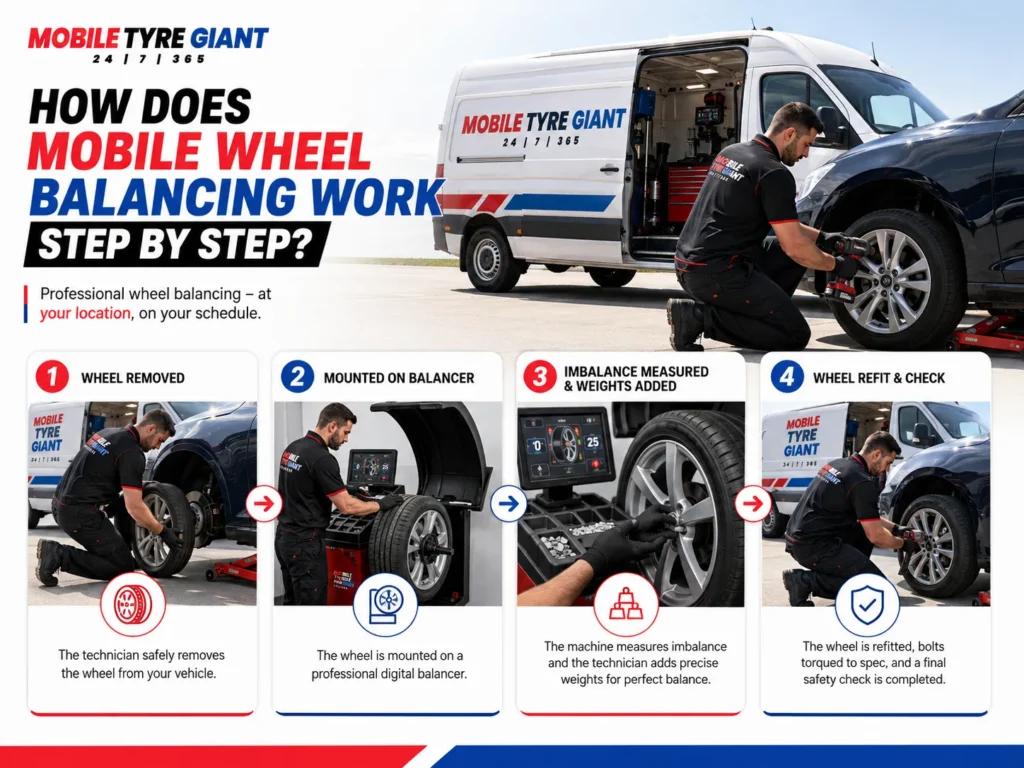
Yes, mobile tyre fitters can balance wheels on-site when their vans are equipped with the correct balancing machinery. The job is not done by guessing where a weight should go or by spinning the wheel and judging the result by eye. The technician normally removes the wheel from the car and mounts the complete wheel-and-tyre assembly onto a professional balancer carried in the mobile unit. The machine measures where the rotating assembly is heavier and tells the fitter how much corrective weight is needed and where it should be placed. Once the weights are fitted, the wheel is checked again before it goes back on the vehicle. In practical terms, this allows the balancing process to come to the driver instead of forcing the driver to visit a tyre bay.
The important qualification is that not every mobile fitter offers exactly the same equipment or level of service. Some vans may be set up mainly for emergency tyre replacement, while others carry a fuller range of fitting and balancing equipment. That is why drivers should confirm what is included before booking rather than assuming every mobile service works in exactly the same way. For a properly equipped service, wheel balancing can be carried out at the same location as the tyre work, helping the driver avoid arranging a separate garage visit. This can be particularly useful when the car is at home, at work, or somewhere else where moving it is inconvenient. The real advantage is not that mobile balancing uses a completely different method, but that a professional balancing process can be brought directly to a suitable location.
How Does Mobile Wheel Balancing Work Step by Step?
The balancing process starts with the wheel being safely removed from the vehicle and checked for obvious damage or anything that could interfere with the result. The complete wheel-and-tyre assembly is then mounted centrally on the balancing machine so it can rotate in a controlled way. The machine spins the assembly and measures differences in weight distribution around the wheel. It then shows the technician where corrective weights should be added and how much weight is required. After those weights are fitted, the assembly is spun again to confirm that the imbalance has been corrected to an acceptable level. Only after that verification is the wheel refitted to the vehicle and the wheel fixings secured correctly.
A good balancing process is therefore much more than simply attaching a few small weights to the rim. Correct centring on the machine matters because an incorrectly mounted wheel can produce a misleading reading. The surface where adhesive weights are fitted also needs to be prepared properly so the weights remain securely attached. Wheel design matters too because different rims may require different weight positions or attachment methods. This is one reason a properly equipped technician is important, particularly with modern alloy wheels where appearance and correct weight placement both matter. When drivers ask whether mobile tyre fitters balance wheels on-site properly, understanding this process helps explain why professional technique matters just as much as the machine itself.
What Equipment Does a Mobile Tyre Fitter Use for Wheel Balancing?
The key piece of equipment is a wheel-balancing machine designed to measure imbalance in the complete wheel-and-tyre assembly. Depending on the mobile setup, this may be a compact computerised or digital balancer installed securely inside the van. The fitter also needs suitable cones, adaptors, or mounting hardware to centre different wheel designs correctly on the machine. Small adhesive or clip-on balancing weights are then used to correct the measured imbalance. A torque wrench and normal wheel-removal equipment are also part of the job because the wheel still has to be safely removed and refitted. None of this is unusual technology, but every part of the process needs to be used correctly for the result to be reliable.
The equipment alone does not guarantee good wheel balancing, which is where technician experience becomes important. A capable machine can still produce a poor outcome if the wheel is mounted incorrectly, an unsuitable adaptor is used, or the weights are positioned carelessly. The same principle applies in a traditional workshop, so it would be misleading to assume that a garage automatically produces better balancing simply because its equipment sits inside a building. What matters is whether the fitter has suitable machinery, understands the wheel design, follows the correct process, and verifies the result before finishing. Drivers with expensive or recently refurbished alloy wheels may also want to mention this before the appointment so the fitter understands that careful handling and discreet weight placement are particularly important. It is this combination of equipment, technique and attention to detail that separates professional on-site balancing from a rushed tyre change.
Is Mobile Wheel Balancing as Accurate as Garage Balancing?
Mobile wheel balancing can be accurate when the technician uses suitable equipment and follows the correct procedure. The balancing machine still measures the rotating wheel-and-tyre assembly, identifies uneven mass distribution, and guides the fitter on where corrective weights should be placed. In that sense, the basic objective is the same whether the machine is installed in a workshop or inside a well-equipped mobile unit. The more meaningful factors are calibration, correct wheel centring, suitable adaptors, accurate weight placement, and checking the balance again after the weights have been fitted. A mobile van is therefore not automatically less capable simply because the service takes place away from a fixed garage. For many normal tyre-fitting and rebalancing jobs, properly equipped mobile wheel balancing can provide the smooth result the driver is looking for.
There are still situations where workshop or specialist investigation may become more appropriate, particularly if normal balancing has already been carried out and the vibration remains. A bent rim, irregular tyre, damaged suspension component, wheel-bearing problem, or another mechanical issue will not be cured by repeatedly adding balancing weights. Some stubborn vibration problems may also require diagnostic equipment beyond what is normally used for conventional wheel balancing. This is why the better question is not simply “mobile or garage?” but “what problem is the vehicle actually showing, and what equipment is needed to identify it?” Drivers comparing the two approaches can also read Mobile Tyre Giant’s guide to the advantages of mobile tyre fitting compared with a garage for a broader look at convenience and service considerations. If the issue is a straightforward wheel imbalance, having it corrected on-site can remove the need for a separate garage journey without changing the basic purpose of the balancing process.
Wheel Balancing vs Wheel Alignment: What’s the Difference?
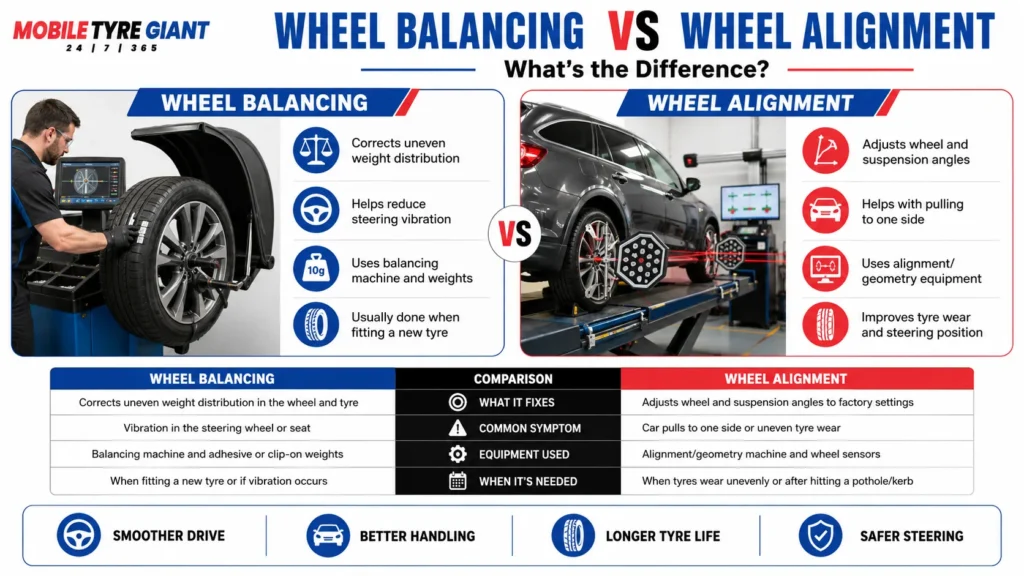
Wheel balancing and wheel alignment are often mentioned together, but they correct two different problems. Wheel balancing deals with uneven weight distribution in the rotating wheel-and-tyre assembly, while alignment concerns the angles at which the wheels sit relative to the vehicle and road. If a wheel is unbalanced, the driver may notice vibration that becomes more obvious at certain speeds. Alignment problems are more commonly associated with the vehicle pulling consistently to one side, the steering wheel sitting off-centre, or unusual directional tyre wear. Both problems can affect the way a car feels, which is why drivers sometimes book the wrong service when they rely on one symptom alone. Understanding the difference can save time and help the technician investigate the right area first.
A useful way to think about it is to compare balancing with adjusting the weight on a spinning fan, while alignment is more like making sure the fan itself is pointing in the correct direction. One process deals with smooth rotation, while the other deals with geometry and position. A vehicle can need balancing without needing alignment, and it can also need alignment even when all four wheels are perfectly balanced. In some cases, both issues may exist at the same time, particularly after a strong pothole or kerb impact. This is why a professional inspection is more useful than assuming that every steering problem needs tracking or every vibration needs balancing. The table below gives a simple comparison that drivers can use before deciding what kind of check may be appropriate.
| Question | Wheel Balancing | Wheel Alignment |
|---|---|---|
| What does it correct? | Uneven weight distribution in the wheel-and-tyre assembly | Incorrect wheel or suspension angles |
| Common clue | Vibration at certain road speeds | Pulling, off-centre steering or directional wear |
| Equipment used | Wheel-balancing machine and weights | Alignment or geometry equipment |
| Is it normally part of fitting a new tyre? | Yes, the newly fitted wheel should be balanced | Not automatically |
| Can both be needed? | Yes | Yes |
Will Wheel Balancing Fix Every Steering Wheel Vibration?
No, wheel balancing will only correct vibration that is actually being caused by an imbalance in the rotating wheel-and-tyre assembly. This distinction matters because steering vibration is a symptom rather than a diagnosis. A driver may feel shaking through the steering wheel and assume the balancing is wrong, but the cause could also be a damaged tyre, bent wheel, worn suspension component, wheel-bearing issue, or another mechanical problem. Vibration that appears only under braking may point toward a different area again. The speed, conditions, recent repairs, and location of the sensation all give useful clues. A good technician therefore listens to the symptoms before simply adding or moving weights.
This is similar to hearing a rattle in a room and assuming the window is responsible because that is where the sound seems loudest. The noise may actually be travelling from somewhere else. Vehicle vibration can behave in the same way because movement from one component can be transmitted through the steering column, seat, floor, or body of the car. If the vibration appears after a new tyre has been fitted, checking the balance is sensible, but it should not become the only possibility if the first correction changes nothing. Repeatedly balancing the same wheel without inspecting other possible causes can waste time and money. The aim should always be to identify why the vehicle is vibrating rather than simply carrying out the easiest service.
Why Is My Car Still Vibrating After Wheel Balancing?
If a car continues to vibrate after its wheels have been balanced, the first question is whether the balancing process itself was completed correctly. The wheel needs to be centred properly on the machine because an incorrect mounting position can create a misleading reading. A balancing weight may also have moved or fallen off after the work was completed, particularly if the mounting surface was dirty or the adhesive did not bond correctly. The wheel should therefore be rechecked before assuming that a larger mechanical problem exists. Tyre pressure, visible tyre condition, and any recent impact should also be considered. If the balance is confirmed as correct and the vibration remains, further inspection becomes more important.
A physically damaged wheel is another possibility because balancing weights cannot straighten a bent or buckled rim. The machine may be able to compensate for weight distribution to a certain extent, but it cannot repair a wheel that no longer rotates correctly. Tyres can also develop irregularities that create vibration even when the measured balance appears acceptable. Suspension components, wheel bearings, steering parts, and other rotating components may need checking if the symptoms persist. This is why drivers should tell the fitter whether the vibration began suddenly, followed a pothole impact, appeared after tyre work, or has gradually become worse. That background can help separate a straightforward balancing issue from a problem that needs a different type of diagnosis.
Could a Wheel Be Bent or Buckled Even If It Balances Correctly?
Yes, a wheel can sometimes show an acceptable balance reading while still having a physical shape problem that affects how it rotates on the road. Balancing measures weight distribution, while a bent or buckled rim involves the physical geometry of the wheel itself. Imagine spinning a slightly bent dinner plate: adding a small weight might change how evenly its mass is distributed, but it would not make the plate perfectly straight again. A damaged wheel may therefore create a repeating movement or vibration even after weights have been fitted. Potholes, kerb impacts, and other hard strikes are common situations where wheel damage should be considered. The severity may not always be obvious from a quick visual check.
This does not mean every vibration after a pothole is caused by a buckled wheel. The impact might have disturbed a balancing weight, damaged the tyre, changed the alignment, or affected another component instead. The useful point is that balancing should not be treated as a repair for physical damage. If the wheel continues to vibrate after a correct balance check, the technician may need to inspect how the rim and tyre rotate rather than simply adding more weights. Drivers should also avoid assuming that a wheel is safe simply because it looks normal from the outside. Minor deformation can sometimes be easier to detect when the wheel is rotating than when the vehicle is parked.
Can You Drive With Unbalanced Wheels?
A mild wheel imbalance may not immediately stop a car from being driven, but persistent vibration should not simply be ignored. The shaking can make motorway driving uncomfortable and may place unnecessary stress on the tyre and other vehicle components over time. It can also make it harder for the driver to notice whether the vibration is becoming worse or whether another fault has developed. If the shaking is strong, appears suddenly, or starts after a heavy impact, the safer approach is to have the vehicle checked rather than continuing normal driving and hoping it disappears. The key issue is that the driver does not yet know whether the vibration is only an imbalance or something more serious. A professional inspection can separate those possibilities.
If the vibration is light and only appears within a narrow speed range, the vehicle may still be movable, but that does not make the symptom normal. Drivers should note when the vibration begins, where they feel it, and whether it changes during braking or turning. Those details can be extremely useful when describing the problem to a mobile fitter. If the tyre looks damaged, the wheel appears visibly bent, or the vehicle feels unstable, normal driving should be avoided until the cause has been assessed. Wheel balancing is often a relatively straightforward correction when imbalance is the real problem. The important part is recognising when the symptoms suggest that a simple rebalance may not be enough.
Is Wheel Balancing Included With Mobile Tyre Fitting?
Wheel balancing is commonly carried out when a new tyre is fitted, but drivers should still check what their chosen mobile service includes before confirming an appointment. The reason is simple: mobile tyre businesses do not all carry exactly the same equipment or package their services in the same way. With Mobile Tyre Giant, the current service information states that digital wheel balancing is included with tyre fitting, which means the newly fitted tyre and wheel can be checked as part of the same visit. That saves the awkward situation of having a fresh tyre fitted only to discover a steering vibration once the car reaches higher speeds.
If you are booking elsewhere, asking one simple question can prevent confusion: “Will the new wheel-and-tyre assembly be balanced after fitting?” This is particularly useful when arranging an emergency replacement, because customers naturally focus on getting the damaged tyre changed and may forget about what happens afterwards. A professional fitting should leave the wheel ready for normal road use, not simply place a new tyre on the rim. If balancing cannot be carried out during the appointment, the driver should know that before the work begins so another check can be arranged if necessary.
Can Mobile Tyre Fitters Rebalance Existing Wheels?
Yes, a properly equipped mobile tyre fitter may be able to rebalance an existing wheel even when no new tyre is required. This can be useful when vibration has started after a balancing weight has fallen off, after recent tyre work, or when a driver notices a speed-related shake that was not present before. The wheel can be removed, mounted on the balancing machine, checked, corrected with the required weights, and verified again. This makes mobile wheel balancing useful for more than punctures and tyre replacements.
However, rebalancing should not become an automatic response every time the steering wheel moves or the car feels different. If the same wheel has already been balanced correctly and the vibration remains, continually adding or repositioning weights may simply delay finding the real cause. A careful fitter should consider tyre condition, wheel damage and the circumstances in which the vibration appears. Think of it like repeatedly adjusting a picture frame when the wall itself is uneven. Sometimes the obvious adjustment is not the thing that actually needs correcting.
Do All Four Wheels Need Balancing?
Not every vibration means all four wheels immediately need balancing. If only one tyre has been replaced, that newly fitted wheel-and-tyre assembly should be balanced, while the remaining wheels may not need any work unless symptoms or inspection suggest otherwise. If all four tyres are being replaced, then each newly assembled wheel should be balanced. For an existing vibration, the sensible approach is to investigate the affected vehicle rather than automatically selling four balancing procedures without evidence that they are required.
The location of the vibration can provide clues, although it should not be treated as a perfect diagnostic test. Movement felt strongly through the steering wheel may lead a technician to inspect the front wheels carefully, while vibration felt through the seat or body may prompt attention elsewhere. Vehicle design can transmit vibration in different ways, so there is no reliable rule saying that one sensation identifies one exact wheel. The fitter should combine the driver’s description with physical inspection and balancing measurements before deciding how many wheels need attention.
What Should You Tell a Mobile Tyre Fitter Before Booking?
Giving the fitter useful information before the appointment can make diagnosis quicker and help ensure the correct equipment is brought. Start with the vehicle registration or make and model, followed by the tyre or wheel size if you know it. Explain whether the tyres were recently replaced and describe where you feel the vibration, such as through the steering wheel, seat or floor. It also helps to mention approximately what speed the vibration begins, whether it changes during braking, and whether the vehicle recently hit a pothole or kerb.
Location details matter as well because mobile work requires enough safe space around the vehicle. Tell the fitter whether the car is on a driveway, workplace car park or another accessible location, rather than waiting until arrival to discover that the working area is unsuitable. If your wheels are expensive, refurbished or unusually designed, mention that too. A short, accurate description such as “the steering starts shaking around motorway speed after two front tyres were fitted yesterday” is far more useful than simply saying “the car feels strange.”
When Should You Book Mobile Wheel Balancing?
A wheel balance check makes sense when a new tyre has been fitted, when vibration appears at certain speeds, or when a previously smooth vehicle begins shaking after tyre work. It may also be worth investigating after a wheel has lost a balancing weight or following a significant pothole or kerb impact. These situations do not prove that imbalance is the cause, but they provide a reasonable reason to inspect the wheel-and-tyre assembly. The sooner the actual cause is identified, the less likely the driver is to spend money repeatedly treating the wrong problem.
There is no need to wait until the steering wheel is visibly shaking in your hands before paying attention. Subtle changes can be worth noting, particularly if they are consistent and appear at the same speeds each time. On the other hand, sudden severe vibration, visible tyre damage, a visibly damaged wheel or unstable handling deserves more than a routine balancing assumption. In those circumstances, the vehicle may need a broader inspection before normal driving continues. Mobile wheel balancing is useful when imbalance is the problem, but accurate diagnosis should always come before convenience.
Final Words: Can Mobile Tyre Fitters Balance Wheels On-Site?
The bigger lesson is that vibration should not automatically be labelled a balancing problem. Speed-related shaking can make wheel imbalance worth checking, but damaged tyres, bent wheels, alignment problems and other vehicle faults may create similar symptoms. If the car still vibrates after a correct balance, further investigation is more useful than repeatedly balancing the same wheel. A professional mobile fitter should help identify what the vehicle actually needs, giving the driver a smoother, more convenient route from recognising the problem to getting the correct work carried out.
Wheel Vibration? Get It Balanced On-Site
If your steering wheel shakes at speed or your wheels may be out of balance, Mobile Tyre Giant can provide professional mobile wheel balancing at a suitable location.
Frequently Asked Questions
Find quick answers to the most common questions our customers ask.
Yes. Properly equipped mobile tyre fitters can balance wheels on-site using a balancing machine carried in the van, then add corrective weights and verify the result before refitting on-site safely.
Yes. Wheel balancing can be performed at home when the fitter has suitable equipment and the vehicle is parked safely on a stable surface with enough working space for access.
Yes. Newly fitted tyres should normally be balanced with their wheels because the complete tyre-and-wheel assembly can still have uneven weight distribution even when both components are new before driving.
Common clues include vibration through the steering wheel, seat or floor, especially at certain speeds. However, similar symptoms can come from tyre, wheel, suspension or mechanical problems requiring inspection first.
It can be. Accuracy depends on suitable equipment, proper calibration, correct wheel centring, weight placement and technician technique rather than simply whether the machine is mobile or workshop-based in practice.
No. Balancing corrects uneven weight distribution in the rotating wheel-and-tyre assembly, while alignment adjusts wheel and suspension angles that affect steering direction and tyre wear patterns during normal vehicle operation.
Possible causes include incorrect balancing, a lost weight, bent wheel, tyre irregularity, suspension problems or another mechanical fault. Persistent vibration should be investigated rather than repeatedly rebalanced by a professional.
It depends on the provider. Some include balancing with tyre fitting, while others may charge separately or lack balancing equipment, so confirm what is included before booking with the fitter.
Yes. A pothole can dislodge a balancing weight or damage the tyre or rim. It may also affect alignment, so new vibration should be properly inspected before normal driving continues.
Not always. Every wheel receiving a newly fitted tyre should be balanced, but an existing vibration does not automatically mean all four wheels need balancing or are faulty at once.