

A flat tyre is inconvenient on any vehicle, but the situation can feel more complicated when your car has air suspension. You may look at the lowered corner, hear the faint hiss of escaping air from the tyre, and immediately wonder whether an ordinary tyre change is safe. Cars with self-levelling suspension are not necessarily difficult to work on, but they should not be treated as though every suspension system behaves in exactly the same way. Some vehicles require a specific Jack Mode or another method of managing self-levelling before they are raised, while others follow different manufacturer procedures. That distinction matters because the suspension can respond to changes in ride height while the vehicle is being lifted. The good news is that mobile tyre fitting for cars with air suspension can often still be carried out where the vehicle is parked when the location, equipment and vehicle procedure are suitable. A professional fitter needs to understand what they are lifting, where the approved lifting areas are and whether the suspension needs any preparation before the wheel leaves the ground. Think of it like lifting a modern adjustable office chair compared with a simple wooden stool: both can be raised, but the mechanisms underneath behave very differently. Understanding that difference is the first step towards a safer tyre replacement.
For drivers, the most important thing is not memorising complicated suspension terminology. What matters is knowing that air suspension adds another consideration to an otherwise familiar tyre-fitting job. A Range Rover, Tesla Model X, Mercedes-Benz with AIRMATIC or another vehicle equipped with self-levelling suspension may require a different approach from a conventional hatchback sitting on steel springs. Procedures can also vary between model years and specifications, so advice that works for one vehicle should not automatically be copied to another. This is why a competent fitter should identify the vehicle before deciding how it will be raised. If the tyre itself is the only problem, professional mobile tyre fitting can remove the need to drive a damaged tyre to a garage while still allowing the tyre to be replaced at a suitable location. Throughout this guide, we will separate genuine lifting considerations from the confusing advice that often appears online. We will also explain Jack Mode, self-levelling, lifting points, vehicle differences and what should happen during professional fitting. The aim is simple: help you understand what matters without turning a tyre problem into a lesson in suspension engineering.
Can Mobile Tyre Fitters Work on Cars With Air Suspension?
Yes, many vehicles with air suspension can have their tyres changed by a mobile tyre fitter. Having air suspension does not automatically mean the car has to be transported to a dealership or placed on a workshop lift for every tyre replacement. The important question is whether the technician can safely access the vehicle, identify its suspension requirements and use the correct lifting approach. Before raising the car, factors such as the exact model, suspension configuration, tyre specification, working surface and designated lifting areas may need to be considered. On some vehicles, the self-levelling system must be placed into a particular mode before lifting begins. On others, the required procedure may be different, which is why a one-size-fits-all instruction such as “always switch the suspension off” is misleading. Mobile tyre fitting for cars with air suspension is therefore less about using a completely different tyre-fitting process and more about preparing the vehicle correctly before the wheel is removed. Once the car has been safely raised, the tyre itself can generally be removed, replaced, balanced and refitted using the appropriate professional equipment. The key is knowing what needs to happen before that lifting process starts.
This is particularly important for drivers of premium SUVs, executive cars and certain electric vehicles where expensive suspension and underbody components sit close to areas that may look suitable for lifting. A technician should never assume that a lifting point used on one vehicle is suitable for another simply because both cars have air suspension. The manufacturer’s designated lifting areas and suspension procedure take priority over shortcuts picked up from another model. This is also why telling the fitter your registration, model and suspension type before the appointment can be genuinely useful rather than unnecessary detail. It gives them an opportunity to prepare for the actual vehicle instead of discovering important information after arriving. For owners who have read conflicting forum discussions, this can be reassuring because the professional approach should be based on the car in front of the fitter, not a random internet trick. A correctly planned mobile appointment can be especially useful when the damaged tyre makes driving to a garage undesirable or unsafe. In other words, the presence of air suspension does not automatically rule out mobile fitting. It simply means the lifting stage deserves more thought.
Why Is Changing a Tyre Different on a Car With Air Suspension?
A conventional suspension system largely relies on mechanical springs and dampers to support the vehicle, while air suspension uses pressurised air springs or air struts to help control ride height and comfort. Modern systems may also use ride-height sensors, compressors, valves and electronic control modules that constantly monitor how the vehicle is sitting. If passengers climb into the car or heavy luggage is loaded into the boot, the suspension may adjust itself to keep the body closer to its intended height. That automatic behaviour is useful on the road, but it becomes relevant when one corner of the vehicle is intentionally raised during tyre fitting. The system may detect an unusual height difference because the body and wheel are no longer sitting in their normal relationship. Depending on the vehicle, that is where Jack Mode, service mode or another manufacturer-specific lifting procedure may come into play. The objective is not to make the tyre change complicated for the sake of it. It is to make sure the suspension is behaving as expected while the car is lifted. Once you understand that, much of the mystery surrounding air suspension tyre changes disappears.
It helps to picture the suspension as a person constantly trying to keep a tray level while people add or remove weight from different corners. During normal driving that ability is useful because the vehicle can compensate for changes in load and road conditions. During lifting, however, one corner suddenly moves far beyond its normal position, so the system may need to be told that this change is intentional. That is why two air-suspension vehicles parked next to each other can require different preparation even though both appear mechanically similar from the outside. The actual process depends on how each manufacturer designed its self-levelling controls and lifting instructions. It also explains why forum advice can become confusing so quickly, especially when owners discuss different generations of the same model as though they are identical. A useful rule is therefore not “all air suspension must be switched off,” but “check what this specific vehicle requires before lifting.” Mobile Tyre Giant’s wider vehicle tyre guidance covers different manufacturers because tyre and vehicle requirements can vary significantly between brands and models. Treating those differences seriously is a much better sign of competence than simply claiming experience with luxury cars.
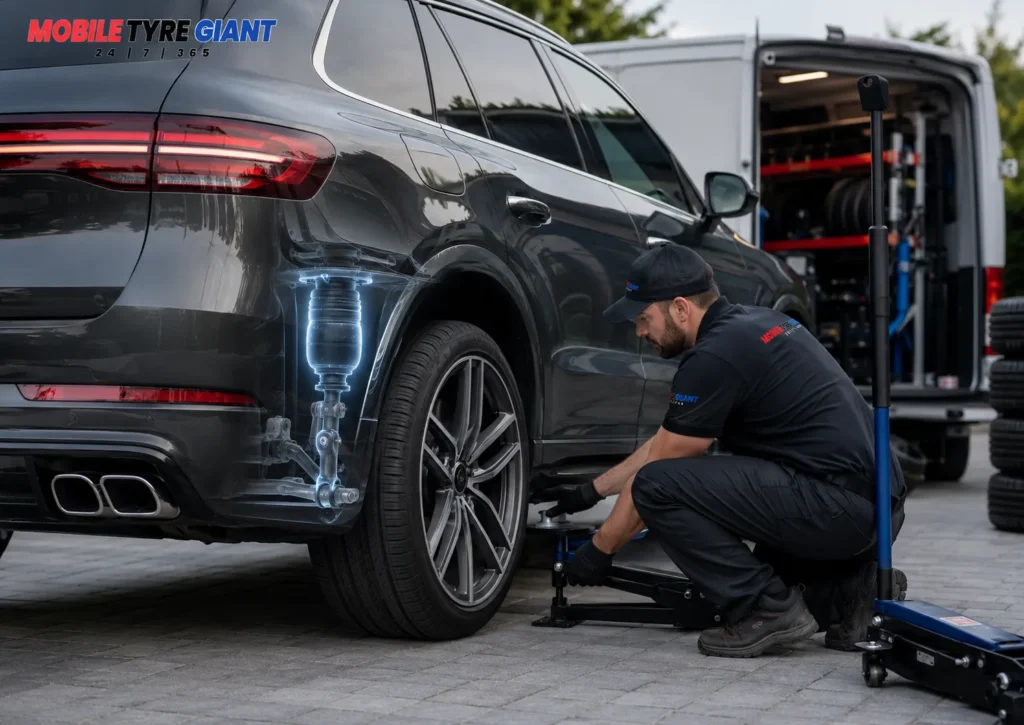
What Does Self-Levelling Suspension Actually Do?
Self-levelling suspension is designed to help maintain the vehicle at an intended ride height even when the load on the car changes. Sensors monitor the position of the body relative to the wheels, while the suspension control system can add or release air where the design allows it. You may notice this when passengers get into a large SUV and, after a moment, the body subtly adjusts rather than remaining noticeably lower at the rear. That small movement gives a useful clue about why lifting the car is different from simply parking it. When a jack begins pushing one corner of the body upward, the suspension sees a height change that is far greater than anything caused by luggage or passengers. A vehicle designed to keep itself level may therefore need to know that it is being deliberately lifted. On models where a Jack Mode or equivalent procedure is specified, that setting prevents normal self-levelling behaviour from interfering with the lifting process. It does not turn air suspension into conventional springs, nor does it mean every manufacturer handles the situation identically. It simply creates a controlled condition for servicing where the vehicle’s design requires one.
Drivers do not need to understand every valve, sensor and line underneath the car to appreciate the practical point. Imagine trying to hold one end of a spirit level while somebody at the other end keeps adjusting it because they think you want it perfectly horizontal. That constant correction is useful when maintaining balance, but inconvenient when the change in height is intentional. Air suspension can operate on a similar principle, although the actual engineering is far more sophisticated and varies between vehicles. This is why mobile tyre fitting for cars with air suspension should start with identifying how that particular system behaves during lifting. A technician should also recognise that electronic self-levelling and the physical suspension components are related but not interchangeable concepts. A dashboard setting may influence automatic levelling behaviour, while the air springs and suspension arms will still physically extend as the wheel moves downward. Understanding both parts prevents misleading assumptions about what the vehicle “should” look like while it is being raised. In the next section, that becomes especially useful because the large amount of suspension travel can make some owners think the jack is not working properly.
Why Can the Wheel Keep Dropping as the Car Is Lifted?
One of the strangest things for an owner watching an air-suspension vehicle being raised is seeing the body move upward while the wheel seems determined to stay close to the ground. At first glance, it can look as though the jack is simply lifting the body without ever getting the tyre clear of the surface. In many cases, what you are seeing is suspension travel. As the body rises, the suspension extends and allows the wheel to move farther downward before it finally leaves the ground. Vehicles designed for comfortable road travel, variable ride height or greater suspension articulation can have considerably more vertical wheel movement than a driver expects. Self-levelling behaviour may add another layer of confusion if the vehicle has not been prepared according to its required procedure. This does not automatically mean the suspension is faulty or that the fitter has placed the jack incorrectly. It does mean the technician needs to understand the expected behaviour of that particular vehicle. A longer lift can therefore be normal on some air-suspension cars, but safe lifting points and the correct vehicle procedure still remain essential.
This is also where experienced-looking shortcuts can become dangerous. An owner may see the wheel hanging low and assume the solution is simply to jack the car higher, change the suspension setting or copy a trick they saw in a video. The safer approach is to understand why the wheel is travelling downward and then follow the procedure intended for that vehicle rather than improvising. The suspension arms, air springs and wheel assembly are designed to move through a range of positions, so what looks unusual from outside may actually be normal mechanical extension. Problems arise when normal suspension travel is confused with a universal instruction about how far every vehicle should be raised. That distinction matters even more on heavy SUVs and premium vehicles with large wheels, where both the vehicle weight and wheel assembly demand suitable professional equipment. Mobile tyre fitting for cars with air suspension works best when the technician understands these behaviours before the vehicle leaves the ground. For the driver, the takeaway is simple: a wheel taking longer than expected to clear the surface does not by itself prove that something is wrong. What matters is whether the vehicle is being lifted in the correct place and according to the requirements of its specific suspension system.
Do You Need Jack Mode Before Changing a Tyre?
The short answer is that it depends on the vehicle. Some cars with air suspension specifically require Jack Mode, service mode or another manufacturer-defined procedure before the vehicle is lifted, while others manage self-levelling differently. This is why telling every driver to simply “switch off the air suspension” is not reliable advice. Jack Mode is particularly important on vehicles where the suspension can continue reacting to changes in body height while a wheel is being raised. In that situation, the car may interpret the movement as something it needs to correct rather than a deliberate tyre-changing procedure. A properly prepared vehicle allows the suspension to remain in the state intended by the manufacturer while the technician carries out the work. For the owner, this means you do not need to know every menu setting before booking a mobile fitter, but you should mention that the vehicle has air suspension. The fitter can then identify the correct procedure for the specific model rather than treating it like a conventional suspension system. With mobile tyre fitting for cars with air suspension, the safest principle is always vehicle-specific preparation rather than a universal rule.
This is also where online advice can become confusing. One owner may say they always raise their vehicle to its highest setting before lifting, while another may insist the suspension should be lowered first. Both could be describing completely different vehicles, generations or suspension systems. A procedure that is correct for one Tesla, Range Rover, Mercedes-Benz or Volvo should not automatically be copied to another car simply because both use air springs. The technician needs to consider the exact suspension design, current ride height and approved lifting instructions before the wheel is removed. Think of it like restarting two different smartphones: both perform the same general job, but the buttons and sequence can be completely different. The same principle applies to air suspension. What matters is not memorising the phrase “Jack Mode,” but understanding whether that particular vehicle uses it and what preparation is required. That model-specific approach removes much of the uncertainty surrounding air suspension tyre changes.
What Is Jack Mode on an Air-Suspension Car?
Jack Mode is a vehicle setting used on certain air-suspension systems to prevent normal self-levelling behaviour from interfering while the car is being lifted. Under everyday conditions, self-levelling is useful because the vehicle can adjust its ride height as passengers, luggage and road conditions change. During tyre fitting, however, the body is deliberately being moved far beyond its normal relationship with one or more wheels. Jack Mode tells the vehicle, in effect, that this unusual change in height is intentional. It does not remove the air from the suspension or mechanically lock every component in place. Instead, on vehicles designed with this function, it helps prevent the control system from attempting normal automatic height corrections during lifting. This is why Jack Mode is a servicing feature rather than a driving mode. It is also why the setting usually matters before the vehicle leaves the ground, not once the wheel is already hanging in the air. Understanding this basic purpose makes the system much less mysterious for drivers.
The exact activation method varies, which is one reason we should avoid turning this guide into a universal button-by-button tutorial. Some vehicles use a touchscreen menu, others use suspension controls, and some do not use a setting called Jack Mode at all. A Tesla Model X with air suspension, for example, has its own vehicle-specific lifting considerations that should not be assumed to apply to every other EV or premium SUV. Drivers looking specifically for Tesla tyre support can also read about Tesla mobile tyre fitting and the tyre requirements associated with those vehicles. The important point is that Jack Mode is one part of the preparation process, not the entire tyre change. Safe lifting still depends on the correct working surface, suitable equipment and designated lifting points. A technician who understands the vehicle should verify all of these before starting. That combination of suspension knowledge and proper tyre-fitting practice is what matters most.
What Happens If Jack Mode Is Not Activated?
If a vehicle specifically requires Jack Mode and it is not activated, the suspension may continue responding to changes in vehicle height while the car is being raised. That does not mean the suspension will automatically break the moment a jack touches the vehicle, but it can create unnecessary risk. The system may attempt to self-level because the sensors are seeing a large difference between the body and wheel positions. This can make the vehicle behave differently from what the technician expects while lifting is taking place. Depending on the design, that behaviour could affect stability, suspension position or the way the vehicle responds as the wheel leaves the ground. The correct response is therefore not to rely on the fact that “someone else forgot Jack Mode and nothing happened.” Manufacturer procedures exist because they define the safest intended conditions for servicing the vehicle. A professional fitter should follow those requirements rather than gambling on an internet anecdote. Risk management is especially important on heavy SUVs and luxury vehicles where the suspension and underbody components can be expensive to repair.
Drivers should also be careful not to assume that a warning message after tyre fitting proves the suspension has been damaged. Timing alone does not establish the cause of a mechanical or electronic fault. A warning could relate to the suspension returning to its normal operating state, an existing problem that became noticeable at the same time, or an unrelated fault that needs diagnosis. If the car remains uneven, refuses to return to its normal ride height or continues displaying a suspension warning, that deserves proper inspection. The sensible approach is to observe the vehicle’s behaviour rather than immediately jumping to the worst conclusion. This distinction is important because online discussions can quickly turn a routine tyre change into a horror story without enough evidence. Mobile tyre fitting for cars with air suspension should be based on correct preparation before lifting and sensible checks afterwards. When both are done properly, the process becomes far more controlled and predictable.
Does Every Air-Suspension Car Have Jack Mode?
No, every air-suspension vehicle does not have a feature literally called Jack Mode. Different manufacturers use different suspension designs, control systems and servicing procedures, and those differences may even exist between generations of the same model. One car may provide a dedicated menu option for disabling self-levelling, while another may use a different operating sequence or automatically manage certain suspension functions under specific conditions. This is why searching online for “air suspension Jack Mode” can produce contradictory instructions. Owners are often comparing vehicles that share the same broad suspension technology but not the same electronic controls. A Range Rover, Tesla, Mercedes-Benz, BMW, Audi, Volvo or Porsche may therefore require different preparation before tyre fitting. Even within one brand, specification and model year can matter. The correct question is not “Does air suspension need Jack Mode?” but “What does this exact vehicle require before lifting?” That small change in wording leads to much safer advice.
This is also why a good mobile fitter should never appear embarrassed to verify a procedure. Checking vehicle-specific information is a sign of professional care, not inexperience. The dangerous approach would be assuming that because one air-suspension SUV was lifted a certain way yesterday, every similar-looking vehicle should be handled identically today. Modern cars contain increasingly complex suspension, braking, TPMS and electronic systems, and proper preparation matters more than memorising shortcuts. For drivers, the easiest step is simply to provide accurate vehicle information when arranging the tyre appointment. Registration details, model year where known and any suspension warning on the dashboard can all help build a clearer picture before work starts. This reduces the chance of surprises at the roadside or on a driveway. It also keeps the conversation focused on the actual vehicle rather than generic advice. That is exactly the level of care premium and air-suspension vehicles deserve.
Can You Jack Up a Car With Air Suspension Safely?
Yes, an air-suspension vehicle can be lifted safely when the correct procedure, equipment and lifting locations are used. Air suspension does not make a vehicle impossible to jack up, nor does it automatically mean that only a dealership workshop can remove the wheels. The difference is that the suspension may have electronic self-levelling behaviour that needs to be considered before lifting begins. The technician also needs to know where the manufacturer intends the vehicle to be supported because modern underbodies can contain components that should never carry lifting loads. Once the appropriate suspension preparation has been completed, the lifting process should be controlled and stable. The car needs to be positioned securely, and the jack or lifting equipment must be suitable for the vehicle’s size and weight. Heavy SUVs with large alloy wheels can place significant loads on equipment, so professional capacity matters. The wheel should only be removed once the vehicle is stable and there is adequate clearance to carry out the tyre work. Safe lifting therefore comes from a combination of suspension knowledge and correct physical setup.
The environment is just as important as the suspension system itself. A flat, solid driveway or safe working area gives the fitter a much better foundation than soft ground, a steep slope or a dangerous roadside position. Even the perfect Jack Mode procedure cannot compensate for unstable ground underneath the lifting equipment. This is why mobile tyre fitting sometimes requires judgement about whether the location is genuinely suitable before the vehicle is raised. If the car is positioned somewhere unsafe, the correct decision may be to move it to a safer location or consider another recovery option rather than forcing the job. The same principle applies if the designated lifting area is visibly damaged or another mechanical problem is present. Mobile tyre fitting for cars with air suspension is most effective when both the vehicle and the working environment allow the technician to work safely. Convenience matters, but it should never come ahead of safe lifting conditions. That balance is what separates professional mobile fitting from simply trying to change a wheel wherever the car happens to stop.
Why Correct Jacking Points Matter
A jacking point is not simply any solid-looking piece of metal underneath a vehicle. Manufacturers design specific areas to carry the forces involved when thousands of kilograms of vehicle weight are concentrated onto a small lifting surface. Using the wrong location can damage bodywork, undertrays, suspension components or other equipment beneath the car. This becomes even more important on electric vehicles where high-voltage battery structures may occupy a large part of the floor area. Air-suspension components can also sit close to areas that an inexperienced person might mistakenly consider suitable for a jack. For that reason, a technician should identify the approved lifting points before applying load. The correct position may also require a particular pad or lifting adapter depending on the vehicle. Guessing based on another manufacturer’s design is not a sensible approach. Correct lifting points protect both the car and the person working around it.
This is another area where vehicle-specific knowledge matters more than broad claims about experience. A premium SUV may have strong chassis components underneath, but that does not mean every visible structural area is approved for lifting. The same applies to a low-slung luxury car or an EV with carefully designed underbody protection. Once the jack is carrying the vehicle, even a small positioning mistake can place pressure somewhere that was never intended to support it. That is why safe tyre fitting begins before the wheel nuts are removed. A careful technician identifies the lifting position, checks the ground beneath the equipment and makes sure the vehicle remains stable as it rises. For the customer, most of this happens quietly in the background, but it is one of the most important parts of the job. The tyre replacement itself may take only a short period compared with the cost of repairing damage caused by incorrect lifting. Proper preparation is therefore not unnecessary caution. It is part of doing the work correctly.
Do Air-Suspension Tyre Fitting Procedures Differ by Vehicle?
Yes, and this is one of the most important things for drivers to understand before an air-suspension vehicle is lifted. Two cars can both use self-levelling air suspension yet require completely different preparation before tyre fitting begins. The manufacturer, model, generation, suspension specification and electronic control system can all affect the correct approach. Some vehicles provide a dedicated Jack Mode, while others use a different service setting or a manufacturer-defined lifting procedure. Even the recommended ride height before lifting can vary, which is why copying instructions from another vehicle is risky. This is especially relevant with premium SUVs and executive cars because several generations of the same model may use different suspension hardware or software. A fitter should therefore identify the exact vehicle before deciding how it will be raised. The same principle applies to jacking points because a location that looks structurally strong is not automatically an approved lifting area. Good tyre fitting begins with understanding the car rather than reaching immediately for the jack. That vehicle-first approach is what makes mobile tyre fitting for cars with air suspension controlled rather than improvised.
The table below shows why there is no single instruction that can safely cover every air-suspension vehicle. It should be read as a comparison of considerations, not as a DIY lifting guide. Tesla Model X is a useful example because certain versions use a clearly defined Jack Mode, while Range Rover and Land Rover procedures can depend heavily on the exact model and generation. Mercedes-Benz AIRMATIC, BMW air suspension, Audi adaptive air suspension and systems used by Volvo or Porsche also have their own designs and servicing requirements. This does not mean one system is necessarily more difficult than another. It simply means technicians should avoid assuming that experience with one brand automatically provides the correct procedure for the next vehicle. An experienced fitter knows when to verify the information rather than rely on memory alone. For owners, providing the registration number and exact model before the appointment helps remove much of this uncertainty. It also allows tyre specification, wheel size and other vehicle-specific requirements to be considered in advance. That preparation becomes particularly valuable when the car is stranded and there is little room for trial and error.
Vehicle or Suspension Example | Main Consideration Before Lifting | What Should Be Verified |
Tesla Model X with air suspension | Self-levelling and Jack Mode | Correct vehicle setting and designated lifting areas |
Range Rover / Range Rover Sport | Procedure can vary by generation | Exact model-specific lifting guidance |
Mercedes-Benz AIRMATIC | Electronic ride-height control | Approved lifting points and vehicle procedure |
BMW models with air suspension | System varies by model and specification | Suspension configuration and lifting requirements |
Audi adaptive air suspension | Adjustable ride height and electronic control | Model-specific preparation before lifting |
Volvo models with air suspension | Jack/service procedure may apply | Current vehicle instructions |
Porsche air-suspension models | Ride-height system and vehicle weight | Approved lift locations and servicing procedure |
Tesla Model X, Range Rover and Other Premium Air-Suspension Vehicles
Tesla Model X provides a good example of why vehicle-specific preparation matters because air suspension and EV lifting considerations can exist at the same time. The fitter is not only thinking about self-levelling but also about where the vehicle can safely carry lifting loads. That makes correct identification of the designated lifting areas especially important before the car leaves the ground. A Range Rover presents a different situation because instructions can vary between models and generations, and broad online advice often mixes them together. One owner may describe a procedure for an older Range Rover Sport while another is discussing a newer vehicle with different controls. Mercedes-Benz vehicles equipped with AIRMATIC can introduce another variation, as can BMW, Audi, Volvo and Porsche systems. This is exactly why the phrase “air suspension” should not be treated as though it describes one identical mechanism across every manufacturer. The tyre itself may be changed using familiar professional equipment, but vehicle preparation comes first. A competent technician should be comfortable verifying what the car requires rather than guessing from its badge. That approach protects the vehicle while keeping the tyre fitting process straightforward.
Premium vehicles can also introduce tyre-related considerations beyond the suspension itself. Large wheels, low-profile tyres, higher load ratings, run-flat construction and manufacturer-specific tyre specifications may all affect what replacement should be supplied. An air-suspension SUV may feel exceptionally smooth on the road, but that does not mean it can safely use any tyre that happens to match the wheel diameter. The tyre’s complete size, load index, speed rating and specification still matter because the suspension cannot compensate for an unsuitable tyre. Electric and luxury vehicles can also be sensitive to wheel balance because additional vehicle weight or large alloy wheels may make vibration more noticeable at speed. For that reason, the air suspension should be viewed as one part of the fitting decision rather than the only technical consideration. The fitter needs to combine suspension knowledge with ordinary tyre fundamentals such as correct specification, wheel condition and pressure. When all of those factors are considered together, a complicated-looking vehicle becomes a much more manageable job. The driver’s role is mainly to provide accurate information and avoid assuming that every premium vehicle requires the same treatment. The technician’s role is to turn that information into a safe and appropriate fitting plan.
What Does a Mobile Tyre Fitter Check Before Lifting an Air-Suspension Car?
A professional appointment should begin with checks rather than immediately lifting the damaged corner. The fitter first needs to confirm that the vehicle in front of them matches the information supplied during booking. Registration, make, model and sometimes model year help establish the correct tyre and suspension requirements. The tyre itself should also be checked because the visible problem may not tell the whole story. A tyre that looks merely flat could have sidewall damage, a puncture, a damaged valve or another issue that changes whether repair or replacement is appropriate. The technician should then consider the suspension configuration and any dashboard messages related to ride height or self-levelling. If the vehicle requires a particular lifting mode or procedure, that needs to be addressed before the jack carries the vehicle’s weight. The designated lifting area should be identified and the ground beneath the vehicle assessed for stability. This preparation may look slower than simply throwing a jack underneath the sill, but those few minutes can prevent much larger problems. With mobile tyre fitting for cars with air suspension, careful preparation is part of the service rather than wasted time.
The surrounding location also matters more than many customers initially realise. A wide, solid driveway is very different from loose gravel, a steep incline or a narrow roadside where traffic passes within a few feet of the technician. Even perfect knowledge of the suspension cannot make an unstable work area safe. The fitter also needs enough room to position equipment, remove the wheel and operate the tyre-fitting machinery without creating another hazard. Locking wheel nuts should be considered at this stage because discovering a missing or damaged key after the vehicle has been prepared wastes valuable time. Where the original key cannot be used, specialist locking wheel nut removal may be required before the wheel can come off. The same practical mindset applies to tyre stock because an unusual premium or high-load tyre may need to be identified accurately before attendance. Good preparation therefore covers the vehicle, the suspension, the tyre and the location together. Drivers can make this process easier by giving clear information rather than simply saying, “I have a flat tyre.” That small amount of detail helps the fitter arrive better prepared for the actual job.
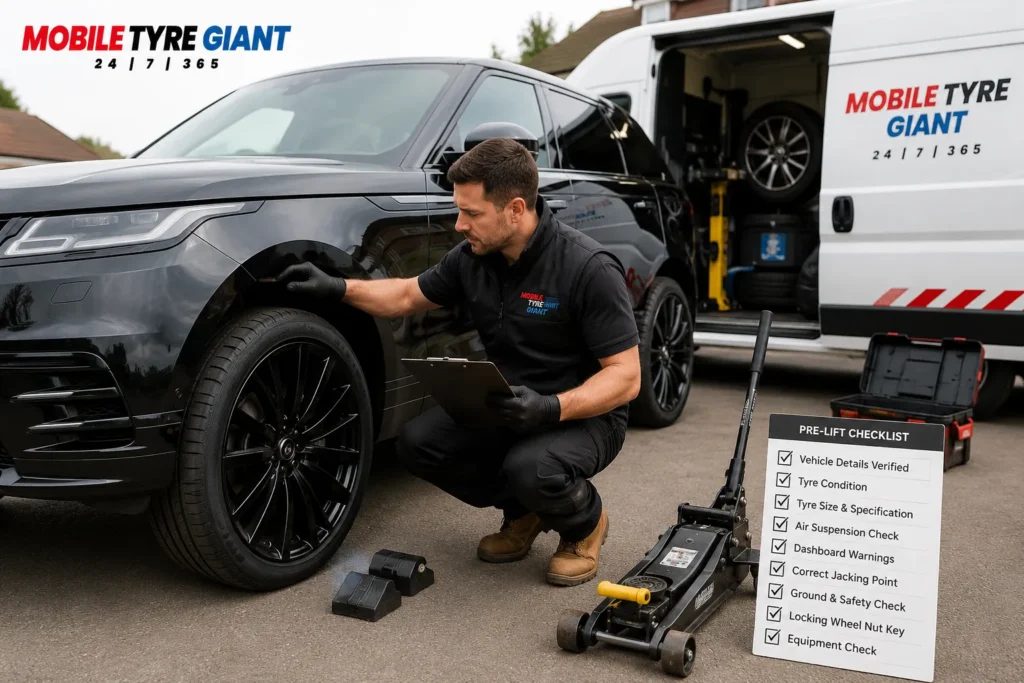
What Happens During Mobile Tyre Fitting on an Air-Suspension Car?
Once the vehicle has been identified and prepared correctly, the tyre-fitting process becomes much more familiar. The car is raised using the appropriate lifting point and suitable equipment, with the suspension handled according to the vehicle’s requirements. The wheel can then be removed and inspected for obvious damage before the tyre is taken off the rim. If replacement is needed, the new tyre should match the required size and appropriate specification for the vehicle. The tyre bead is mounted carefully so the wheel surface and valve area are handled correctly, particularly on expensive alloy wheels. Pressure is then set according to the vehicle requirement rather than guessed from another model. If a TPMS sensor is fitted, the technician should also remain aware of its position while working around the valve and tyre bead. A damaged or faulty valve can require additional attention, and Mobile Tyre Giant provides TPMS valve replacement where that service is appropriate. The wheel is then prepared for balancing before being refitted to the car. At this stage, the job has moved beyond simply “putting a new tyre on” and becomes a sequence of checks designed to return the vehicle to normal use.
The final stages are just as important as the initial lift. A newly fitted tyre can still produce an unpleasant steering-wheel tremor or seat vibration if the wheel assembly is significantly out of balance. Professional mobile wheel balancing helps correct uneven mass around the wheel and tyre assembly before the vehicle returns to normal driving. The wheel is then refitted and the fixings tightened appropriately, rather than relying on excessive force as proof that the wheel is secure. Once the vehicle is back on the ground, the suspension should be allowed to return to its normal operating state according to the vehicle’s procedure. Tyre pressure and any relevant dashboard information should also be checked before the job is considered complete. If a warning remains, the fitter should not pretend that replacing the tyre has automatically solved a separate suspension or electronic problem. This is particularly important on modern premium cars where tyre pressure monitoring and air suspension are different systems even though both can display warnings to the driver. A professional fitting therefore ends with observation and confirmation rather than simply packing the equipment away. That final check gives the driver greater confidence that both the tyre and vehicle are behaving as expected.
Why Wheel Balancing, TPMS and Final Checks Matter
Air suspension can make a vehicle feel exceptionally smooth, which means an unbalanced wheel may become even more noticeable once you return to motorway speeds. You may feel a fine vibration through the steering wheel, floor or seat that was not obvious at lower speeds. That sensation is not normally caused by the air suspension itself, yet drivers can easily connect the two because the tyre work has just been completed. Correct wheel balancing helps separate a normal tyre-related issue from concerns about the suspension system. TPMS deserves similar attention because a pressure warning after tyre fitting does not automatically indicate a suspension problem. The sensor, valve and tyre pressure all belong to a separate monitoring system, even though their warnings may appear on the same dashboard. A good fitter therefore checks the tyre-related systems before suggesting that a suspension component is at fault. This prevents unnecessary worry and reduces the risk of chasing the wrong problem. It also demonstrates why modern tyre fitting involves more than physically changing rubber on a rim. The smoother and more technically advanced the vehicle, the more valuable these final details become.
Drivers should pay attention to how the car feels once normal driving resumes, but there is no benefit in becoming hyper-alert to every tiny movement. A correctly fitted tyre should hold pressure, the wheel should run smoothly and the vehicle should return to its expected ride height. If a persistent tyre-pressure warning, strong vibration, visibly uneven ride height or suspension message appears, it deserves investigation rather than guesswork. Sometimes the issue may be tyre-related, while in other cases it could involve a sensor, suspension fault or an unrelated condition that existed before fitting. The important point is not to diagnose the cause purely because the symptom appeared after the tyre change. A professional fitter can confirm the work they performed, while genuine suspension problems may require separate mechanical diagnosis. This balanced approach avoids both extremes: ignoring a real warning or blaming every warning on the recent tyre fitting. For owners of air-suspension cars, that distinction is particularly valuable because online discussions can make routine servicing sound much more dangerous than it normally is. Good mobile tyre fitting for cars with air suspension combines correct lifting with proper tyre installation and sensible final checks. When those stages are treated as one complete process, the service is far easier for the driver to understand and trust.
Can Incorrect Tyre Fitting Damage Air Suspension?
Incorrect lifting can create problems on an air-suspension vehicle, but it is important not to turn that possibility into unnecessary fear. The tyre-fitting process itself should not damage a correctly handled air-suspension system. Risk increases when the vehicle is lifted from the wrong area, a required suspension procedure is ignored, or unsuitable equipment is used. On some vehicles, self-levelling can continue reacting to changes in body height unless the correct servicing mode is selected. That movement can make the vehicle behave differently from what a technician expects during lifting. Heavy premium SUVs also place significant loads on jacking equipment, so the weight and stability of the vehicle cannot be treated casually. The safest approach is to identify the exact vehicle, understand its lifting requirements and use the designated lifting points before removing the wheel. This is why professional mobile tyre fitting for cars with air suspension should begin with preparation rather than speed. A quick tyre change is useful, but only when the vehicle is being handled correctly from the start.
Drivers should also be careful with dramatic stories found online about suspension failure immediately after a tyre change. If a compressor fault, ride-height warning or uneven stance appears afterwards, the timing alone does not prove that the fitter caused the problem. Air suspension contains electronic and mechanical components that can develop faults independently of tyre work. A vehicle may already have a weak compressor, ageing air spring, height-sensor issue or intermittent warning that becomes noticeable around the same time. That does not mean post-fitting symptoms should be ignored, but diagnosis should come before blame. Look at how the vehicle sits, whether the warning remains and whether its normal ride height returns correctly. If the suspension continues behaving abnormally, a proper mechanical inspection is more useful than guessing from a forum comment. The key distinction is simple: incorrect lifting can create risk, but every suspension issue after tyre fitting is not automatically evidence of damage. Keeping those two ideas separate gives drivers a much more accurate understanding of the situation.
What If a Suspension Warning Appears After Tyre Fitting?
A suspension warning after tyre fitting can be unsettling, especially if the dashboard was clear before the work began. The first thing to avoid is assuming that the new tyre itself has caused an air-suspension failure. Tyre pressure monitoring and suspension control are separate systems, even though both can display messages on the same dashboard. The vehicle may simply need to return to its normal operating state after being raised, depending on how the suspension system is designed. Check whether the car is sitting evenly and whether the warning disappears after the vehicle has settled. If one corner remains noticeably lower, the ride height looks abnormal or the warning persists, the issue should be investigated. Continued driving with an obvious suspension fault is not a sensible way to test whether the problem will disappear. A professional diagnosis is particularly important if the vehicle feels unstable, unusually harsh or significantly different from normal. The goal is to establish what has actually happened rather than connecting two events simply because they occurred close together.
It is also worth separating a tyre-pressure warning from an air-suspension warning before becoming concerned. A newly fitted tyre may require pressure adjustment or a TPMS-related check, while an air-suspension message points towards a different system. The wording on the dashboard can therefore provide an important clue about where the problem lies. Drivers should take a photograph of the message if it disappears before the vehicle can be inspected because intermittent warnings can be difficult to describe accurately later. Listen for unusual compressor activity and notice whether the car raises or lowers as expected, but avoid attempting complicated suspension resets based on random online instructions. If a genuine fault exists, repeatedly changing vehicle settings may make diagnosis harder rather than easier. A tyre fitter can confirm what happened during the tyre service, but significant suspension problems may require a workshop with appropriate diagnostic equipment. That distinction does not reduce the value of mobile fitting. It simply recognises where tyre work ends and suspension diagnosis begins.
Mobile Tyre Fitter or Garage: Which Is Better for an Air-Suspension Car?
Neither option is automatically better simply because the car has air suspension. If the problem is limited to a punctured, damaged or worn tyre and the vehicle is parked somewhere suitable for safe lifting, mobile fitting can be a practical solution. It allows the tyre to be replaced without asking the driver to travel on a damaged tyre simply to reach a workshop. This can be particularly useful at home, work or another safe location where there is enough solid ground and space around the vehicle. The important requirement is that the fitter understands the vehicle’s suspension and lifting requirements before work begins. A workshop can perform the same tyre replacement, but the existence of a fixed lift does not automatically make the service more knowledgeable. The quality of the procedure matters more than whether the technician is standing beside a van or inside a building. For a tyre-only problem, professional mobile fitting can therefore offer convenience without automatically compromising the handling requirements of an air-suspension vehicle. The decision should be based on the actual fault and the working environment.
A workshop becomes more appropriate when the problem extends beyond the tyre. If the vehicle has a persistent suspension warning, damaged suspension component, abnormal ride height or suspected mechanical fault, replacing the tyre may solve only part of the problem. Workshop diagnostic equipment and access to suspension repair facilities can then become more important than the convenience of a mobile appointment. The same applies if the vehicle cannot be safely lifted where it is currently parked. Soft ground, steep slopes, restricted access or a dangerous roadside location can make mobile fitting unsuitable regardless of the technician’s experience. Drivers should not view this as a failure of the mobile service model. Knowing when a job should not be attempted on location is part of professional judgement. A competent fitter should be willing to say that the conditions are unsuitable rather than force the vehicle into an unsafe position. In practical terms, mobile fitting is strongest when the issue is clearly tyre-related and the working conditions allow the car to be handled correctly.
When Mobile Tyre Fitting May Not Be the Right Option
Mobile tyre fitting works well in many situations, but it is not the right solution for every vehicle problem. The first reason to reconsider it is an unsafe working location. A car sitting on loose gravel, a steep incline, unstable ground or a narrow road with fast-moving traffic may not provide the conditions needed for controlled lifting. The second concern is visible damage around the vehicle’s designated lifting areas, because the technician needs a safe structure to support the weight. A third issue is an obvious suspension fault, such as one corner sitting dramatically lower than the others before tyre work begins. In that case, the tyre may not be the only problem affecting the vehicle. Mechanical damage from an accident or impact can also make a normal tyre replacement inappropriate until the surrounding components have been inspected. A mobile fitter should therefore assess the situation rather than assuming every roadside call ends with a tyre being removed. Safety and vehicle condition must come before completing the job at any cost.
There are also situations where the tyre itself tells you that more investigation may be needed. Severe uneven wear, repeated damage on the same corner or unusual contact between the tyre and bodywork may indicate another mechanical issue that simply fitting fresh rubber will not correct. Air suspension can mask or compensate for changes in ride height while driving, but it cannot fix damaged suspension geometry or worn components. If a new tyre is installed without addressing the underlying cause of abnormal wear, the replacement may begin deteriorating in the same pattern. The driver should therefore describe any unusual handling, rubbing noise, recent impact or suspension warning when arranging the appointment. This information allows the fitter to understand whether the call is likely to be a straightforward tyre job or something more complicated. Mobile tyre fitting for cars with air suspension is most valuable when it solves the right problem. Knowing its limits is part of giving the customer an accurate service rather than simply promising that everything can be fixed at the roadside.
What Should You Tell the Mobile Tyre Fitter Before They Arrive?
Giving accurate information before the appointment can make the difference between a smooth fitting and an avoidable delay. Start with the vehicle registration, make and exact model because this helps identify both the tyre and relevant vehicle information. If you know the model year, that can also be useful because suspension systems sometimes change between generations. Tell the fitter clearly that the vehicle has air suspension rather than assuming it will become obvious once they arrive. Provide the tyre size from the sidewall if it can be read safely, especially if the vehicle uses large or unusual tyres. Mention any suspension, tyre-pressure or dashboard warnings currently showing. You should also say whether the tyre is completely flat, slowly losing pressure, visibly damaged or affected by an impact. Confirm whether the locking wheel nut key is available because the wheel cannot always be removed normally without it. Finally, describe where the vehicle is parked and whether the surface is flat, solid and accessible to a mobile fitting van.
Those details help the fitter prepare for the actual situation instead of discovering important information one item at a time. Imagine ordering a replacement part for a laptop by saying only that you own “a computer.” The technician may eventually identify what you need, but the process becomes much faster when the exact model and problem are known from the beginning. The same logic applies to modern vehicles with complex suspension and tyre specifications. Accurate information improves the chance that the correct tyre, equipment and vehicle preparation can be planned before attendance. It also allows potential problems, such as restricted access or a missing locking key, to be discussed early. Drivers do not need to become tyre experts before making the call. A few clear details are normally far more useful than a long technical explanation. Good communication helps make mobile tyre fitting predictable, and that matters even more when the vehicle uses self-levelling air suspension.
Final Words: Is Mobile Tyre Fitting Safe for Cars With Air Suspension?
Yes, mobile tyre fitting can be suitable for many cars with air suspension when the vehicle is handled according to its specific requirements. Air suspension does not automatically turn a tyre replacement into a workshop-only job. The important difference is that the technician may need to consider self-levelling behaviour, Jack Mode or another manufacturer-specific procedure before lifting begins. Correct lifting points, suitable equipment and a safe working surface matter just as much as the suspension setting itself. Once the vehicle has been prepared and raised correctly, the tyre can be replaced using the same professional principles that apply to other modern vehicles. Wheel balancing, tyre pressure, TPMS considerations and correct refitting remain essential parts of the finished job. Drivers should also remember that different manufacturers and generations can use very different air-suspension systems. Advice that is correct for one car should never automatically be copied to another. The safest approach is always to identify the exact vehicle and follow the procedure intended for it.
For the customer, the most useful step is simply to give the fitter accurate information before the appointment. Tell them the make, model, registration, tyre details and that the car has air suspension, along with any warning lights or unusual vehicle behaviour. If the problem is clearly limited to the tyre and the vehicle is parked in a safe location, a mobile service can save the inconvenience of trying to drive a damaged tyre to a garage. If there is also a genuine suspension fault, damaged lifting point or unsafe working environment, workshop diagnosis may be the better next step. That balanced approach is more useful than pretending mobile fitting is the answer in every situation. Air suspension should encourage better preparation, not unnecessary panic. With the right vehicle knowledge and lifting procedure, a tyre change on an air-suspension car can remain a controlled and straightforward job.
Need a Tyre Changed on a Car With Air Suspension?
Share your vehicle details, tyre size and location. We’ll help arrange mobile tyre fitting with the right approach for your car’s suspension system.
Frequently Asked Questions
Find quick answers to the most common questions our customers ask.
Yes. Many air-suspension cars can be handled by a professional mobile fitter when the correct vehicle-specific suspension procedure, lifting points and equipment are used.
Not always. Some vehicles require Jack Mode or another method of controlling self-levelling, while others use different procedures depending on the model and suspension design.
Jack Mode is a setting on certain vehicles that prevents normal self-levelling behaviour from interfering while the vehicle is being lifted for servicing or wheel removal.
No. Different manufacturers and models use different terminology, controls and lifting procedures, so drivers should not assume every air-suspension car has the same setting.
Incorrect lifting can create risk if the wrong lifting area is used or required suspension procedures are ignored, but proper tyre fitting should account for these vehicle-specific requirements.
Potentially, yes. If the vehicle is safely positioned and the correct procedure for that exact Range Rover model is followed, mobile tyre fitting can be suitable.
Yes, when the vehicle's specific lifting procedure, designated lifting areas and applicable Jack Mode requirements are correctly followed.
Yes. Mentioning the suspension system, make, model, registration and any warning messages before arrival helps the fitter prepare for the correct vehicle.
For a tyre-only problem, mobile fitting can be suitable. If the vehicle also has a suspension fault or mechanical damage, workshop diagnosis may be more appropriate.
Check whether the warning remains and whether the vehicle sits and drives normally. Persistent warnings, abnormal ride height or unusual behaviour should be properly diagnosed rather than guessed at.
Not automatically. The decision depends on remaining tread, tyre specification, axle compatibility and drivetrain requirements. All-wheel-drive vehicles may require closer matching between tyres than ordinary two-wheel-drive vehicles.
Repair cost varies with damage, tyre type, location and whether mobile attendance is required. Ask for a clear quote covering inspection, repair, balancing and any call-out charge.