

Seeing 205/55 R16 printed on the side of a tyre can feel like reading a code that was designed for a technician rather than an everyday driver. In reality, each part tells you something straightforward about the tyre’s size and construction. The problem is that many drivers only notice these markings when a tyre is worn, damaged or suddenly needs replacing. At that point, choosing the wrong specification can turn a simple tyre purchase into an expensive mistake. Understanding the markings first makes the buying process much easier. It also helps you recognise why two tyres that look almost identical online may not actually have the same specification.
This guide starts with the basics before moving into load ratings, speed ratings, tyre types and replacement choices in later sections. Think of the tyre code a little like a shoe size combined with construction information. The numbers describe how wide and tall the tyre is, while the letters tell you more about how it is built. Once you know how to read the code, checking the correct tyre size for your vehicle becomes far less confusing. The important point is that 205/55 R16 describes the main tyre dimensions, but it is not the complete specification you may need when ordering a replacement.
What Does 205/55 R16 Mean?
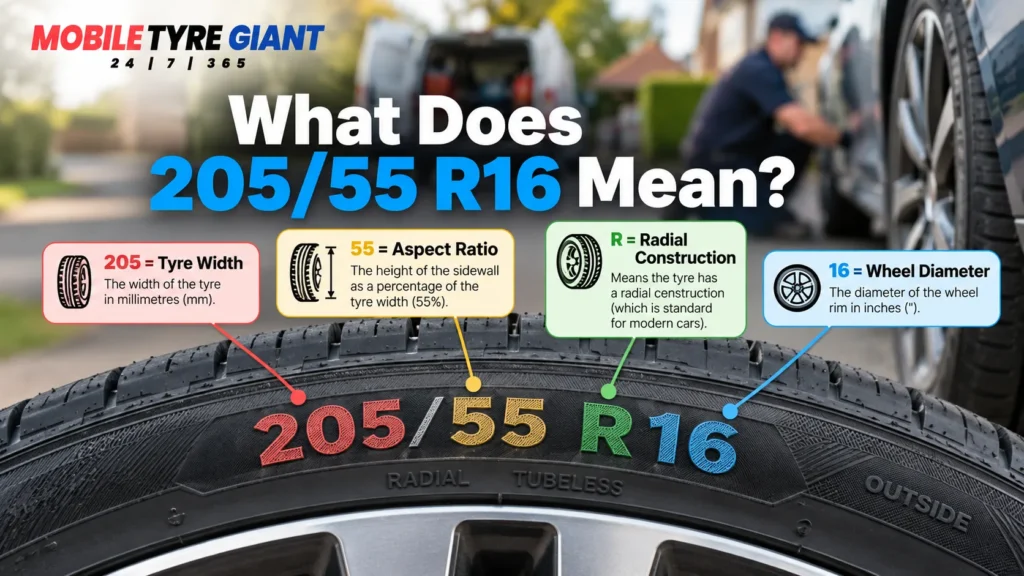
The 205/55 R16 marking gives you four important pieces of information about a tyre. The first number, 205, represents the tyre’s nominal section width in millimetres. The second number, 55, is the aspect ratio and describes the sidewall height as a percentage of that width. The letter R tells you that the tyre uses radial construction, which is the standard construction used on modern passenger-car tyres. The number 16 tells you the diameter of the wheel rim the tyre is designed to fit, measured in inches. Put together, the code gives a quick description of the tyre’s basic dimensions and construction.
What it does not tell you is equally important. A tyre may also carry a load index, speed rating, Extra Load marking, run-flat marking or other information that affects whether it is suitable for a particular vehicle. This is why simply seeing the same four basic size markings on two tyres does not guarantee that they are interchangeable. One tyre might be designed to carry a heavier load, while another may have a different speed capability or construction. Later in the guide, we will look closely at markings such as 91V and 94V XL. For now, the easiest way to read the basic code is to separate it into width, profile, construction and wheel size.
What Does 205 Mean on a Tyre?
The number 205 refers to the tyre’s nominal section width, measured in millimetres. In simple terms, it tells you roughly how wide the tyre is from one sidewall to the other when it is mounted correctly on an appropriate wheel. A 205 tyre is therefore nominally 205 mm wide. This measurement is useful because tyre width affects how the tyre fits the wheel and sits within the vehicle’s available space. It can also influence characteristics such as steering feel, road contact and rolling resistance. However, width should never be considered on its own when choosing a replacement tyre.
Actual manufactured width can vary slightly between tyre models even when the sidewall carries the same 205 marking. Differences in tread design, construction and the width of the wheel rim can all affect the final measured dimensions. That is similar to buying two pairs of shoes marked with the same size but finding that one feels slightly wider than the other. The important point is that 205 is the nominal specification, not a promise that every tyre will measure exactly 205 mm in every installation. For replacement purposes, you should use the complete tyre specification approved for the vehicle rather than trying to judge suitability from width alone.
What Does 55 Mean on a Tyre?
The 55 is the tyre’s aspect ratio, sometimes casually called the tyre profile. It means the nominal sidewall height is 55% of the tyre’s 205 mm section width. Using the basic calculation, 55% of 205 mm is approximately 112.75 mm. That gives a nominal sidewall height of roughly 113 mm from the wheel rim area to the outer tread area. The number does not mean the sidewall itself is 55 mm tall. This is one of the most common misunderstandings when drivers first learn to read tyre markings.
The aspect ratio matters because changing it changes more than the way the tyre looks. A taller or shorter sidewall changes the tyre’s overall diameter and can influence ride comfort, steering response and vehicle clearance. Imagine replacing a trainer with another shoe that has the same width but a noticeably thicker sole. The fit around your foot may remain similar, but the overall height and feel change. The same principle applies when comparing tyre profiles. This is why switching from a 55 profile to a 60 profile should never be treated as a small cosmetic change without checking vehicle compatibility.
What Does R Mean on a Tyre?
The letter R stands for radial construction. It describes the way the internal reinforcing cords are arranged within the tyre rather than indicating the radius of the tyre. Radial tyres use cords that run roughly at right angles to the direction of travel, with additional reinforcing layers helping support the tread area. This construction became the normal choice for modern passenger vehicles because it provides a practical combination of durability, flexibility and road performance. When you see R in a size such as 205/55 R16, it therefore describes construction rather than a performance rating.
Drivers sometimes assume the R means rim, radius or even speed rating because it appears directly before the wheel-size number. That interpretation is incorrect. Speed ratings appear separately and use letters such as H, V or W later in the full tyre specification. Understanding that distinction becomes important when you see something like 205/55 R16 91V on a replacement tyre. In that example, R still means radial construction, while V is the speed rating. Keeping those two letters separate makes the complete sidewall code much easier to understand.
What Does the 16 Mean in 205/55 R16?
The 16 means the tyre is designed for a wheel rim with a diameter of 16 inches. This measurement refers to the diameter of the wheel where the tyre seats, not the overall height of the tyre once it is fitted. A tyre marked R16 therefore needs a compatible 16-inch wheel. It cannot simply be mounted onto a 15-inch or 17-inch rim because the wheel diameter is physically different. This sounds obvious once explained, but it becomes particularly important when drivers compare alternative tyre sizes online.
For example, 195/65 R15 and 205/55 R16 may appear relatively similar when comparing their overall tyre dimensions, yet they require different wheel diameters. Changing between them would therefore involve more than replacing the rubber tyre itself. You would need to know whether the vehicle is approved for the alternative wheel and tyre combination. The wheel diameter is one of the simplest parts of the code to understand, but it is also one of the least flexible. If your current wheel is 16 inches, the replacement tyre normally needs the same R16 fitment unless the entire wheel setup is being changed correctly.
How Big Is a 205/55 R16 Tyre?
A 205/55 R16 tyre has a nominal width of 205 mm and a sidewall height of approximately 113 mm. When the two sidewalls and the 16-inch wheel diameter are considered together, the tyre has a nominal overall diameter of roughly 632 mm. These measurements are useful when comparing tyre sizes because they show how width, profile and wheel diameter work together. Looking only at one number can give a misleading impression of how large the finished tyre actually is. A wider tyre is not necessarily taller, and a higher profile changes the overall diameter even when the wheel size stays the same. Understanding the full dimensions is particularly useful when drivers start considering alternative tyre sizes.
The figures below should be treated as nominal dimensions rather than exact measurements for every individual tyre model. Manufacturing tolerances, tread design, tyre construction, inflation and wheel width can cause small differences in the real-world measurements. That is why tyre compatibility should always be based on the approved vehicle specification rather than a calculator alone. Still, these figures give a clear picture of what the size code means physically. They turn the lettering on the sidewall into dimensions you can actually visualise. Once you understand this basic size, the next step is learning why two tyres carrying these same dimensions can still have different load ratings, speed ratings and construction requirements.
Tyre Specification | 205/55 R16 |
Nominal tyre width | 205 mm |
Aspect ratio | 55% |
Nominal sidewall height | Approx. 113 mm |
Construction | Radial |
Wheel rim diameter | 16 inches |
Nominal overall diameter | Approx. 632 mm |
What Cars Use 205/55 R16 Tyres?
The 205/55 R16 tyre size is used on many everyday hatchbacks, saloons and family cars, which is one reason drivers frequently come across it when searching for replacement tyres. Certain versions of vehicles such as the Ford Focus, Skoda Octavia, Volkswagen Golf, Toyota Corolla, Kia Ceed and Renault Megane may use this size. However, seeing a particular model on a compatibility list does not mean every version of that car uses 205/55 R16 tyres. Manufacturers often offer several wheel and tyre combinations across the same model range. A higher trim level might leave the factory with larger wheels and lower-profile tyres, while another version of the same car may use 16-inch wheels. Engine choice, production year and optional wheel packages can also change the approved tyre specification.
For that reason, vehicle compatibility should never be confirmed from the model name alone. Imagine two identical-looking cars parked next to each other, one fitted with standard 16-inch wheels and the other with an optional 17-inch package. From a distance they may look almost the same, yet the required tyre sizes can be completely different. The safest approach is to check the tyre currently fitted and compare it with the manufacturer’s approved specification for the exact vehicle. The vehicle handbook, tyre-information label and manufacturer data are useful places to confirm this. If there is any uncertainty, the full specification should be checked before a tyre is ordered or fitted rather than assuming that another version of the same model uses the same size.
How Do You Know if 205/55 R16 Is Correct for Your Car?
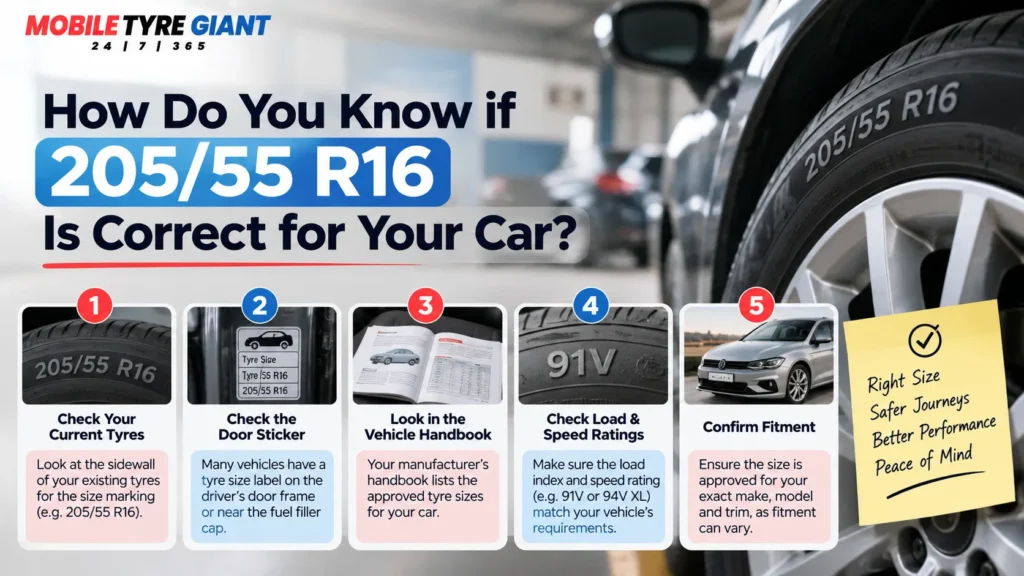
The first place most drivers look is the sidewall of the tyres already fitted to the vehicle. If the current tyre is marked 205/55 R16, that gives you an immediate indication of the size being used, but it should still be considered alongside the vehicle manufacturer’s specification. Tyre information may also appear in the handbook, on a label inside the driver’s door opening or, on some vehicles, around the fuel-flap area. These locations can show approved tyre sizes and recommended pressures for different loads. This matters because a used vehicle may previously have had different wheels or tyres fitted, so the existing tyre should not always be treated as unquestionable proof. Checking more than one reliable vehicle-specific source gives you much stronger confirmation.
The complete specification matters as much as the basic size. A driver may correctly identify 205/55 R16 but still overlook a required load index, speed rating, Extra Load specification or run-flat construction. That is why tyre replacement should be approached like matching all the details on a key rather than simply matching its overall shape. A tyre that physically fits a 16-inch wheel is not automatically the correct tyre for the vehicle. You should check the dimensions, load capability and speed capability together before making the final choice. This becomes particularly important when several versions of 205/55 R16 appear beside each other online and look almost identical at first glance.
Are All 205/55 R16 Tyres the Same?
No, tyres carrying the same 205/55 R16 size marking are not necessarily the same. The four main markings tell you the nominal width, aspect ratio, construction and wheel diameter, but they do not describe every performance or load characteristic. One tyre may carry a 91V specification, another may be 94V XL, and another may have a different speed rating altogether. Some versions are designed as summer tyres, while others are all-season or winter tyres. Run-flat versions may also exist alongside conventional tyres in the same nominal size. This is why searching only for the four basic dimensions can produce a long list of apparently similar options that are actually designed for different applications.
Tyres can also behave very differently on the road even when their printed dimensions match. Tread design, rubber compound, casing construction and manufacturer engineering can influence wet braking, steering response, comfort, road noise, wear and rolling resistance. One driver may prefer a tyre that feels calm and quiet during long motorway journeys, while another may place greater value on sharper steering response or strong wet-weather confidence. The correct choice therefore involves more than finding the same numbers on the sidewall. You first need to match the vehicle’s required specification, then compare suitable tyres according to the way the car is used. This distinction is important because the tyre size tells you whether the dimensions are suitable, while the rest of the specification helps determine whether the individual tyre is suitable.
What Does 205/55 R16 91V Mean?
When you see 205/55 R16 91V, the first four parts still describe the dimensions and construction explained earlier, but 91V adds two important pieces of information. The number 91 is the tyre’s load index, which corresponds to a maximum rated load of 615 kg per tyre under the specified conditions. The letter V is the speed rating, indicating a maximum rated speed capability of 240 km/h, approximately 149 mph. These figures do not mean that the vehicle should be driven at that speed or loaded to the tyre’s limit. Instead, they provide standardized information that helps manufacturers and tyre professionals match tyres to the demands of a particular vehicle. The vehicle’s approved specification determines the minimum suitable load and speed capability.
This is where tyre markings begin to make more sense as a complete system rather than a string of unrelated numbers. The dimensions tell you whether the tyre is shaped for the correct wheel and fitment, while 91V gives additional information about the load and speed capabilities. Think of two boxes that are exactly the same physical size but are designed to carry different maximum weights. Their outside dimensions may match, yet their structural capability is not identical. Tyres work in a similar way, which is why matching only 205/55 R16 can leave important information unchecked. Before replacing a 91V tyre with another specification, the vehicle requirements should be confirmed rather than assuming that any tyre in the same nominal size will do.
What Does Load Index 91 Mean?
The load index is a numerical code that represents the maximum load a tyre is designed to carry under its rated conditions. For a tyre with load index 91, the corresponding rated load is 615 kg per tyre. This figure applies to the individual tyre rather than the total vehicle, so the load capacity across all four tyres should not be interpreted without considering axle loads and manufacturer requirements. A heavier vehicle may require tyres with a higher load index even when the tyre dimensions remain unchanged. That is why 205/55 R16 can appear with several different load indices in the market. The correct value depends on what the vehicle manufacturer specifies for that particular model and configuration.
Using a tyre with insufficient load capacity can place the tyre outside the conditions it was designed to handle. The tyre may experience additional heat, stress and deformation when carrying loads beyond its rating, which is why the load index should never be treated as an optional detail. At the same time, simply choosing the highest number available is not a sensible replacement strategy either. The tyre still needs to match the vehicle’s approved dimensions, construction and other specifications. Checking the required load index before ordering is a small step that can prevent a much larger fitment mistake. It also explains why two 205/55 R16 tyres sitting next to each other can have different specifications despite looking almost identical.
What Does the V Speed Rating Mean?
The V speed rating indicates that the tyre has been rated for speeds up to 240 km/h, or about 149 mph, under the conditions defined for the rating. Speed ratings are part of a standardised system used to describe the performance capability of tyres. Other tyres in the same 205/55 R16 size may carry letters such as H or W, depending on the specification. The rating should not be interpreted as a recommendation to drive anywhere near the stated maximum speed. It is a technical capability that forms part of the vehicle’s approved tyre specification. Even in the UK, where legal road speeds are far below a V rating’s maximum capability, the required speed rating still matters when selecting replacement tyres.
A common mistake is to focus on the tyre’s dimensions and assume that the speed letter is unimportant because the car will never travel at the rated maximum. In reality, the manufacturer selected the tyre specification based on more than normal road-speed limits. Vehicle weight, performance characteristics and operating conditions all form part of the tyre requirement. The correct approach is therefore to use a speed rating that meets the vehicle manufacturer’s specification rather than deliberately choosing a lower rating just because the car is driven slowly. When comparing tyres, it helps to read the full marking from left to right rather than stopping once you reach R16. Doing so turns 205/55 R16 91V from an intimidating code into a clear description of size, construction, load capability and speed capability.
205/55 R16 91V vs 94V XL: What’s the Difference?
The main difference between 205/55 R16 91V and 205/55 R16 94V XL is their load specification and construction. A load index of 91 corresponds to a rated load of 615 kg per tyre, while an index of 94 corresponds to 670 kg per tyre under the relevant rated conditions. Both examples use V as the speed rating, so their stated speed capability is the same. The XL marking stands for Extra Load and identifies a tyre designed to operate at a higher load capacity than a comparable standard-load tyre when used correctly. This does not make the 94V XL tyre automatically better for every car. It means it has a different load specification that may be required on some vehicles and unnecessary on others.
The easiest way to think about the difference is to imagine two similarly sized travel bags made for different carrying loads. They may occupy almost exactly the same amount of space, but one has been constructed to handle more weight. A 91V and 94V XL tyre can share the same basic 205/55 R16 dimensions while having different load capabilities. That is why the vehicle manufacturer’s specification should settle the question rather than price, appearance or the assumption that a higher number must always be preferable. When choosing between these specifications, check what the vehicle requires first and then select a tyre that meets those requirements. The table below makes the main differences easier to see at a glance.
Specification | 205/55 R16 91V | 205/55 R16 94V XL |
Nominal width | 205 mm | 205 mm |
Aspect ratio | 55% | 55% |
Rim diameter | 16 inches | 16 inches |
Load index | 91 | 94 |
Rated load per tyre | 615 kg | 670 kg |
V speed rating | Up to 149 mph | Up to 149 mph |
Extra Load marking | Not necessarily | XL when marked |
What Does XL Mean on a Tyre?
XL stands for Extra Load. It indicates that the tyre has been designed to support a higher load capacity than a comparable standard-load tyre of the same basic size when operated at the appropriate conditions. The marking relates to the tyre’s construction and load capability rather than simply being another name for a larger tyre. An XL tyre can still have exactly the same 205/55 R16 dimensions printed on its sidewall. What changes is the load specification and the way the tyre is engineered to handle it. This is why the XL marking should be read together with the load index rather than treated as part of the tyre-size code itself.
It is also important not to assume that every tyre with load index 94 is automatically XL unless the tyre is actually marked accordingly. The load index and Extra Load marking provide related but distinct pieces of information. If the vehicle manufacturer specifies an Extra Load tyre, that requirement should be respected when choosing a replacement. Likewise, fitting XL simply because it sounds stronger is not a substitute for checking the approved specification. A correctly matched tyre is more important than chasing the highest number or strongest-sounding label. Understanding XL removes another layer of confusion from the many 205/55 R16 options drivers see when shopping for replacements.
Can You Use 94V XL Instead of 91V?
A 94V XL tyre may be suitable instead of a 91V tyre in some applications, but it should not be treated as an automatic substitution for every vehicle. The dimensions may be identical, and the higher load index provides greater rated load capacity, but vehicle compatibility still depends on the manufacturer’s requirements. Tyre construction, approved load index, speed rating and inflation requirements all need to be considered together. The fact that a tyre has a higher numerical rating does not remove the need to check the full specification. If the vehicle is approved for that tyre, the higher load rating may be acceptable, but that conclusion should come from vehicle-specific information rather than guesswork.
The same principle works in the opposite direction and is even more important. You should not replace a tyre requiring a higher load specification with a lower-rated version simply because the dimensions are the same. A 205/55 R16 tyre can physically look right while still being unsuitable for the loads the vehicle is designed to carry. This is why buying tyres solely by searching the four main size characters can create problems. The safest process is to confirm the manufacturer’s approved tyre specification first and then compare products that meet or exceed the relevant requirements where appropriate. Once those technical requirements are settled, you can move on to the factors drivers usually care about most, including wet grip, comfort, noise, seasonal performance and price.
Which Type of 205/55 R16 Tyre Should You Choose?
Choosing the right 205/55 R16 tyre depends on much more than finding the correct dimensions on the sidewall. Two tyres can share exactly the same size yet behave very differently once they are on the road. Your annual mileage, driving environment, typical journey length and priorities should all influence the decision. A driver covering long motorway distances may care about road noise, comfort and wear, while someone regularly using wet country roads may place more emphasis on grip and braking confidence. Drivers who mainly make short urban journeys may have another set of priorities altogether. This is why there is no single 205/55 R16 tyre that can honestly be described as the best choice for every vehicle and every driver.
The sensible approach is to first confirm the vehicle’s required load index, speed rating and any XL or run-flat specification before comparing performance characteristics. Once those requirements are satisfied, you can look at seasonal design, wet grip, noise, efficiency and price. This is similar to choosing a pair of shoes for a specific purpose rather than buying purely because the size fits. Running shoes, walking boots and formal shoes may all fit the same foot, but they are designed for completely different conditions. Tyres work in much the same way. Our guide to choosing the right tyres for your car explains these wider factors in more detail. Matching the tyre to the way the vehicle is actually used usually leads to a better decision than choosing on brand name or price alone.
Summer vs All-Season 205/55 R16 Tyres
Summer tyres and all-season tyres are both widely available in the 205/55 R16 size, but they are designed around different priorities. Summer tyres are generally developed to perform well in warmer conditions and can offer strong dry and wet-road performance when temperatures are suitable. All-season tyres are designed to cope with a broader range of weather conditions without requiring a seasonal tyre change. For many UK drivers, that flexibility can be attractive because journeys may involve rain, cold mornings and mild conditions within the same period. However, an all-season tyre should not be assumed to outperform a dedicated summer tyre in every situation. The correct choice depends on where, when and how the vehicle is driven.
A driver who spends most of the year on urban and motorway roads may value predictable year-round convenience more than maximum performance in one particular season. Another driver may prefer a summer-focused tyre because the vehicle rarely encounters severe winter conditions and sharper warm-weather performance is more important. Think of the difference like choosing between a specialised coat and a versatile jacket. One may excel in a narrow range of conditions, while the other is designed to remain useful across more varied weather. Neither approach is automatically right for everybody. When comparing options, look at the complete specification and independent performance information rather than assuming the seasonal label tells you everything. The tyre must still meet the vehicle’s required size, load and speed specification.
Are 205/55 R16 Run-Flat Tyres Available?
Yes, 205/55 R16 run-flat tyres are available, but that does not mean a run-flat version is automatically suitable for every vehicle using this size. Run-flat tyres are designed so that, following certain types of pressure loss, the tyre can support the vehicle for a limited distance and at a restricted speed. This can allow the driver to reach a safer location rather than stopping immediately beside a busy road. Their construction is different from that of a conventional tyre, particularly around the sidewall. That difference can affect ride feel, weight and how the tyre behaves after losing pressure. A run-flat tyre therefore needs to be treated as a specific construction type, not simply another version of the same basic dimensions.
If the vehicle was originally designed around run-flat tyres, changing to conventional tyres should not be done casually. The vehicle’s suspension setup, tyre-pressure monitoring system and manufacturer guidance may all be relevant. The same is true in reverse if a driver wants to replace conventional tyres with run-flats. A tyre may physically carry the correct 205/55 R16 dimensions but still be the wrong construction for the intended setup. Imagine replacing one structural component with another that fits in the same space but behaves differently under stress. The dimensions alone would not tell the whole story. Before changing between run-flat and standard tyres, confirm that the alternative is appropriate for the specific vehicle rather than making the decision from size and price alone.
Premium, Mid-Range or Budget 205/55 R16 Tyres?
Price is one of the first differences drivers notice when comparing 205/55 R16 tyres. Budget, mid-range and premium options can all appear in the same search results with the same basic dimensions, which makes it tempting to assume the cheapest one offers the best value. In reality, tyre value should be judged across more than the purchase price. Wet braking, road noise, steering response, comfort, rolling resistance and expected wear can all vary between tyre models. A cheaper tyre that wears quickly or does not suit the driver’s priorities may prove less appealing over time. At the same time, buying the most expensive tyre available does not guarantee that it is the ideal choice for every car or journey.
The better approach is to decide which performance qualities matter most to you before comparing price categories. A high-mileage motorway driver may place comfort, noise and wear near the top of the list. Someone using rural roads in frequent rain may care more about wet grip and braking behaviour. Another driver covering relatively few miles each year may prioritise sensible cost while still meeting the required safety and specification standards. This is similar to buying a phone where paying for the most expensive model makes little sense if you will never use its advanced features. Tyres should be selected around real driving needs rather than status or price alone. Once the required load and speed ratings have been confirmed, comparing relevant performance characteristics becomes far more useful than simply choosing the cheapest or most expensive option.
What Makes One 205/55 R16 Tyre Better for Wet Roads?
Wet-road performance is one of the biggest concerns drivers raise when discussing replacement tyres, particularly in the UK where standing water and frequent rain are common parts of everyday driving. Different 205/55 R16 tyres can behave differently in wet braking, cornering and resistance to aquaplaning even when their dimensions are identical. Tread design plays an important role because grooves need to move water away from the contact area efficiently. Rubber compound also matters because the tyre must maintain useful grip across changing temperatures and wet surfaces. European tyre-label information can provide useful comparative data for wet grip, but it should be considered alongside broader independent testing where available. One label grade or marketing claim should not be treated as a complete picture of real-world performance.
The difference becomes easier to understand when you imagine walking across a wet tiled floor in two pairs of shoes with different soles. Both pairs may be the same size, but one may feel planted while the other feels noticeably less secure. Tyres have similar differences in tread pattern, compound and construction. Drivers who regularly travel on motorways, rural roads or poorly drained surfaces should therefore pay particular attention to wet-weather performance. Correct tyre pressure and adequate tread depth also remain essential because even a capable tyre cannot perform properly if it is badly underinflated or heavily worn. The goal is not to find a tyre that makes wet roads risk-free because no tyre can do that. It is to choose a suitable specification and maintain it correctly so the tyre can perform as intended when conditions become slippery.
Are 205/55 R16 Tyres Comfortable?
A 205/55 R16 tyre can offer a practical balance between ride comfort and steering response on many everyday vehicles, partly because the 55 aspect ratio provides a reasonable amount of sidewall compared with much lower-profile alternatives. That sidewall acts as one part of the cushioning system between the wheel and the road. When the tyre rolls over rough tarmac, small joints or broken surfaces, the sidewall can flex and absorb some of the impact before it reaches the suspension and cabin. However, the tyre size itself does not guarantee a comfortable ride. Tyre construction, compound, inflation pressure, wheel design and the vehicle’s suspension all contribute to how the car feels. Two tyres in the same 205/55 R16 size can therefore produce noticeably different levels of comfort and road noise.
Drivers who value comfort should look beyond the profile number and consider how the individual tyre is designed. A firmer construction may provide a more immediate steering feel but can also transmit more texture from the road into the cabin. A tyre designed around touring comfort may feel softer and quieter, though another driver might prefer a firmer response. It is a little like choosing between a firm mattress and a softer one because neither is universally more comfortable for everyone. The correct choice depends on personal preference and the way the vehicle is used. Tyre pressure also has a major influence because incorrect inflation can change both comfort and handling. This is another reason not to judge a tyre entirely from its size marking.
What Tyre Pressure Should 205/55 R16 Tyres Have?
There is no single correct tyre pressure for every vehicle using 205/55 R16 tyres. The required pressure is specified by the vehicle manufacturer and can differ between cars even when they use exactly the same tyre size. Recommended pressure may also differ between the front and rear axles or change when the vehicle is carrying more passengers and luggage. This means generic advice such as saying every 205/55 R16 tyre should be inflated to one particular PSI figure can be misleading. The correct figures are usually found in the vehicle handbook or on a tyre-pressure label fitted to the vehicle. Depending on the car, that label may be inside the driver’s door area or around the fuel filler.
Tyre pressure should normally be checked when the tyres are cold because driving heats the air inside them and temporarily increases the measured pressure. A cold reading gives a more reliable comparison with the manufacturer’s recommended figures. Incorrect pressure can affect tread wear, steering feel, braking behaviour, fuel efficiency and how the vehicle responds on the road. Underinflation can make a tyre feel soft and generate excess heat, while excessive pressure can change the shape of the contact patch and ride quality. Think of pressure as part of the tyre specification rather than a maintenance detail that can be guessed. The 205/55 R16 marking tells you the tyre’s size, but it does not tell you how much pressure your particular vehicle requires. Always use the pressure specified for the exact vehicle and operating load.
Can You Change From 205/55 R16 to Another Tyre Size?
Changing from 205/55 R16 to another tyre size should never be based only on whether the alternative looks similar or fits the wheel. A change in width, aspect ratio or rim diameter can alter the tyre’s overall rolling diameter and may affect clearance around the suspension, wheel arch and steering components. It can also influence speedometer readings, gearing, handling and ride characteristics. Some vehicles have several manufacturer-approved wheel and tyre combinations, so an alternative size may be perfectly acceptable when it forms part of an approved setup. The important point is that compatibility must be checked for the exact vehicle rather than estimated from tyre dimensions alone.
Online tyre calculators can help explain how two sizes compare mathematically, but they cannot confirm every aspect of vehicle compatibility. Wheel width, offset, suspension movement, axle loads and manufacturer requirements all need to be considered. Imagine replacing a cog in a machine with one that is only slightly larger. The difference may look insignificant when the two are held side by side, but it can change how the entire mechanism operates. Tyre sizing works in a similar way because relatively small dimensional changes can affect several parts of the vehicle at once. If you want to move away from the original 205/55 R16 specification, the alternative should be properly verified before tyres are ordered.
Can You Use 205/60 R16 Instead of 205/55 R16?
A 205/60 R16 tyre is not automatically interchangeable with a 205/55 R16 even though both are 205 mm wide and designed for 16-inch rims. The important difference is the aspect ratio. On the 205/60 R16 tyre, the nominal sidewall height is 60% of the tyre width rather than 55%, making the tyre taller overall. That additional sidewall height increases the rolling diameter and circumference. As a result, the wheel and tyre assembly travels slightly farther with each complete rotation. This difference can influence the relationship between actual road speed and the speed displayed by the vehicle.
The taller tyre may also reduce clearance around the wheel arch or suspension on vehicles that were not designed for it. Whether 205/60 R16 is suitable therefore depends on the exact vehicle and its approved alternative sizes. It would be misleading to give every driver a universal yes simply because both options use a 16-inch wheel. Some vehicles may permit the alternative, while others may not. The correct choice should take account of wheel fitment, load capability and the vehicle manufacturer’s specification. If the current requirement is 205/55 R16, treat that as the starting point rather than assuming that a slightly taller profile is harmless.
Can You Use 195/65 R15 Instead of 205/55 R16?
A 195/65 R15 tyre cannot simply be fitted to the same wheel as a 205/55 R16 tyre because the two tyres are designed for different rim diameters. The R15 tyre requires a 15-inch wheel, while the R16 tyre requires a 16-inch wheel. Although the overall rolling dimensions of some alternative wheel and tyre packages can be relatively close, changing between them requires the complete wheel and tyre combination to be suitable for the vehicle. This is different from replacing one tyre with another on the existing rim. Wheel width, offset, brake clearance and manufacturer approval also become relevant.
Some cars leave the factory with different wheel sizes depending on trim level, so a particular model might legitimately use either a 15-inch or 16-inch setup on different versions. That does not mean the two combinations can be copied between vehicles without checking. Think of the wheel and tyre as one matched assembly rather than two unrelated components. A tyre can only fit a wheel with the correct rim diameter, and the completed assembly must then fit the vehicle correctly. Drivers considering a change from 205/55 R16 to a smaller wheel should therefore confirm the approved alternative wheel specification as well as the tyre size. This avoids turning what appears to be a simple tyre change into a fitment problem.
When Should 205/55 R16 Tyres Be Replaced?
There is no fixed mileage at which every 205/55 R16 tyre must be replaced. Tyre life varies according to driving style, road conditions, vehicle weight, alignment, inflation pressure, tyre construction and maintenance. A car covering long motorway journeys may wear tyres differently from one regularly driven through congested streets and rough urban roads. Hard acceleration, heavy braking and incorrect wheel alignment can also increase wear. This is why predicting tyre life from size alone is unreliable. Regular condition checks give a much more useful picture than waiting for a particular mileage figure to appear on the odometer.
Replacement may become necessary because of tread wear, cuts, bulges, cracking, exposed structural material or other damage that affects safe use. Uneven tread wear can also indicate an underlying pressure, alignment or suspension problem that should be investigated rather than simply ignored when the tyre is changed. Repeated loss of pressure deserves attention because it can indicate a puncture, valve issue, wheel problem or tyre damage. A tyre that looks reasonably healthy from one side should still be checked across the full tread and both sidewalls where visible. Running your hand visually around the tyre and checking it from different angles can reveal damage that is easy to miss from standing height. When the tyre’s condition is uncertain, professional inspection is more reliable than trying to judge serious damage from appearance alone.
What Is the Legal Tyre Tread Depth in the UK?
For cars in the UK, the legal minimum tread depth is 1.6 mm across the central three-quarters of the breadth of the tread and around the entire circumference of the tyre. The same requirement applies regardless of whether the tyre is 205/55 R16 or another passenger-car size. Tyres must also be in a safe condition and should not have dangerous cuts, bulges or other serious defects. Reaching the tread limit is therefore not the only reason a tyre might need replacing. Physical damage can make a tyre unsafe even when plenty of tread remains.
Drivers should check tread at several positions because wear is not always completely even across the tyre. If one shoulder is wearing noticeably faster than the rest, the cause may involve alignment, pressure or another mechanical issue. Waiting until the smoothest part of a badly worn tyre reaches an obvious extreme is not a sensible maintenance strategy. Wet-weather performance can also become more of a concern as tread wears because the grooves have less depth available to clear water. Regular inspections make it easier to identify developing problems before they become urgent. The legal minimum is a threshold that must be met, not a substitute for checking the overall condition of the tyre.
What Should You Check Before Buying 205/55 R16 Tyres?
Before ordering 205/55 R16 tyres, check the complete specification rather than stopping after the four basic size markings. Confirm the load index, speed rating and whether the vehicle requires an Extra Load or run-flat tyre. Check whether you want a summer or all-season design and consider how the vehicle is normally driven. A motorway commuter may prioritise low road noise and wear, while another driver may place wet grip and comfort higher on the list. If only one tyre is being replaced, the tyres already fitted to the vehicle should also be considered. The aim is to avoid finding the correct dimensions but the wrong overall specification.
A simple final check can prevent many ordering mistakes. Read the complete sidewall marking, compare it with the manufacturer’s approved specification and make sure the product being ordered matches those requirements. If something does not make sense, confirm it before purchasing rather than assuming that a higher load index or different speed letter will automatically be suitable. The exact 205/55 R16 tyre options can then be considered once the required specification is known. Think of this as checking a boarding pass before reaching the airport gate. Spending another minute verifying the details is easier than discovering later that one important part does not match. Correct specification should come first, followed by performance preferences and price.
Can 205/55 R16 Tyres Be Fitted at Your Location?
Yes, 205/55 R16 tyres can be fitted through a mobile tyre fitting service, allowing replacement to take place at a suitable location rather than requiring the vehicle to be taken to a traditional tyre centre. This can be particularly useful when a tyre has been damaged at home, at work or while the vehicle is parked somewhere it cannot conveniently be driven from. The correct tyre specification still needs to be confirmed before fitting. Size, load index, speed rating and any XL or run-flat requirements should be checked so that the fitter arrives with an appropriate replacement. Mobile fitting does not change the technical requirements of the tyre. It changes where the work can be carried out.
Convenience is especially valuable when the existing tyre is unsafe to drive on. Trying to reach a garage on a badly damaged or severely deflated tyre can turn a straightforward tyre problem into additional wheel or tyre damage. A professional mobile tyre fitting service allows the replacement process to come to the vehicle instead. The tyre can then be removed, replaced and balanced using appropriate equipment at the location. Before booking, providing the full tyre marking rather than simply saying “I need a 16-inch tyre” helps identify the correct option. A clear photograph of the sidewall information can also make the specification easier to confirm when the markings are difficult to describe.
Why Does Professional Fitting Still Matter With the Correct Tyre Size?
Buying the correct 205/55 R16 tyre is only part of a successful replacement. The tyre still needs to be fitted correctly to the wheel, inflated appropriately and balanced so that the wheel and tyre assembly rotates smoothly. Directional tyres must be installed according to their intended direction of rotation, while asymmetric tyres have inside and outside markings that need to be positioned correctly. The wheel itself should also be checked for obvious issues that could affect the new tyre. Correct wheel-nut tightening is another important part of completing the job properly. A tyre with the perfect sidewall specification can still perform poorly if the fitting process is careless.
Wheel balancing is particularly noticeable when it is wrong because the driver may feel vibration through the steering wheel or vehicle as road speed increases. Correct inflation is equally important because pressure influences the tyre’s contact with the road, wear pattern and temperature. The fitting process therefore acts as the final link between selecting the right tyre and getting the expected performance from it. It is similar to buying a correctly sized door but installing it at an angle. The product itself may be right, yet poor installation prevents it from working as intended. Professional fitting helps make sure that the research carried out before buying the tyre is not undermined during the final stage.
Final Words: What Matters Most When Choosing 205/55 R16 Tyres?
The most important thing to remember is that 205/55 R16 describes the tyre’s basic dimensions and radial construction, not its complete specification. The 205 indicates nominal width, 55 describes the aspect ratio, R identifies radial construction and 16 identifies the wheel diameter. Drivers then need to check additional markings such as load index and speed rating, along with any XL or run-flat requirement. This is why 205/55 R16 91V and 205/55 R16 94V XL should not automatically be treated as identical tyres. Vehicle manufacturer information should remain the starting point whenever there is uncertainty about what should be fitted.
Once the required specification is confirmed, the decision becomes much more practical. Drivers can compare summer and all-season designs, wet-road performance, comfort, road noise, expected wear and price according to the way the vehicle is actually used. Pressure should follow the vehicle manufacturer’s recommendation rather than a generic figure based on tyre size. Alternative sizes should also be properly verified before being fitted. The goal is not simply to find a tyre with 205/55 R16 printed on the sidewall. It is to choose a tyre that matches the vehicle’s requirements and the driver’s real-world needs, then make sure it is fitted and maintained correctly.
Need 205/55 R16 Tyres Fitted?
Confirm the correct size, load and speed rating for your vehicle, then arrange professional mobile tyre fitting at a convenient location.
Frequently Asked Questions
Find quick answers to the most common questions our customers ask.
205/55 R16 means the tyre has a nominal section width of 205 mm, an aspect ratio of 55%, radial construction and is designed for a 16-inch wheel rim. The 55 means the nominal sidewall height is 55% of the tyre's width, not that the sidewall is 55 mm tall.
Yes, 205/55 R16 is widely used on many passenger cars, particularly hatchbacks, saloons and family vehicles. However, the correct size still depends on the exact model, year, trim, engine and wheel package, so vehicle-specific compatibility should always be checked.
Certain versions of vehicles such as the Ford Focus, Volkswagen Golf, Skoda Octavia, Toyota Corolla, Kia Ceed and Renault Megane may use 205/55 R16 tyres. These are examples rather than universal fitments because different versions of the same model can leave the factory with different wheel and tyre sizes.
The first four markings describe the tyre's size and construction, while 91 is the load index and V is the speed rating. Load index 91 corresponds to a rated load of 615 kg per tyre under the relevant conditions, while V represents a rated speed capability of up to 240 km/h, approximately 149 mph.
Both tyres have the same nominal dimensions, but their load specifications differ. A 91 load index corresponds to 615 kg per tyre, while 94 corresponds to 670 kg, and the XL marking means Extra Load; the correct version should be selected according to the vehicle manufacturer's requirements rather than assuming the higher rating is automatically better.
A 94V XL tyre may be suitable in place of a 91V tyre for some vehicles, but this should not be treated as a universal substitution. The tyre dimensions, load rating, speed rating, construction and vehicle manufacturer's specification should all be checked before changing from one specification to another.
There is no universal pressure for every vehicle fitted with 205/55 R16 tyres because the recommended pressure is determined by the vehicle manufacturer and may vary according to axle position and load. Check the vehicle handbook or pressure label and measure pressures when the tyres are cold for the most reliable comparison with the recommended figures.
No, tyres with the same 205/55 R16 dimensions can have different load indices, speed ratings, Extra Load construction, run-flat capability, tread designs and seasonal purposes. They can also differ significantly in wet grip, comfort, noise, wear and rolling resistance, so the complete specification should be compared before buying.
Not automatically. A 205/60 R16 tyre has a taller sidewall and larger overall diameter than a 205/55 R16, which can affect clearance, speedometer readings and vehicle behaviour, so it should only be used when the alternative size has been properly verified for the specific vehicle.
For cars in the UK, tyres must have at least 1.6 mm of tread across the central three-quarters of the breadth of the tread and around the entire circumference. The tyre must also be in a safe overall condition and free from serious defects such as dangerous cuts or bulges.